
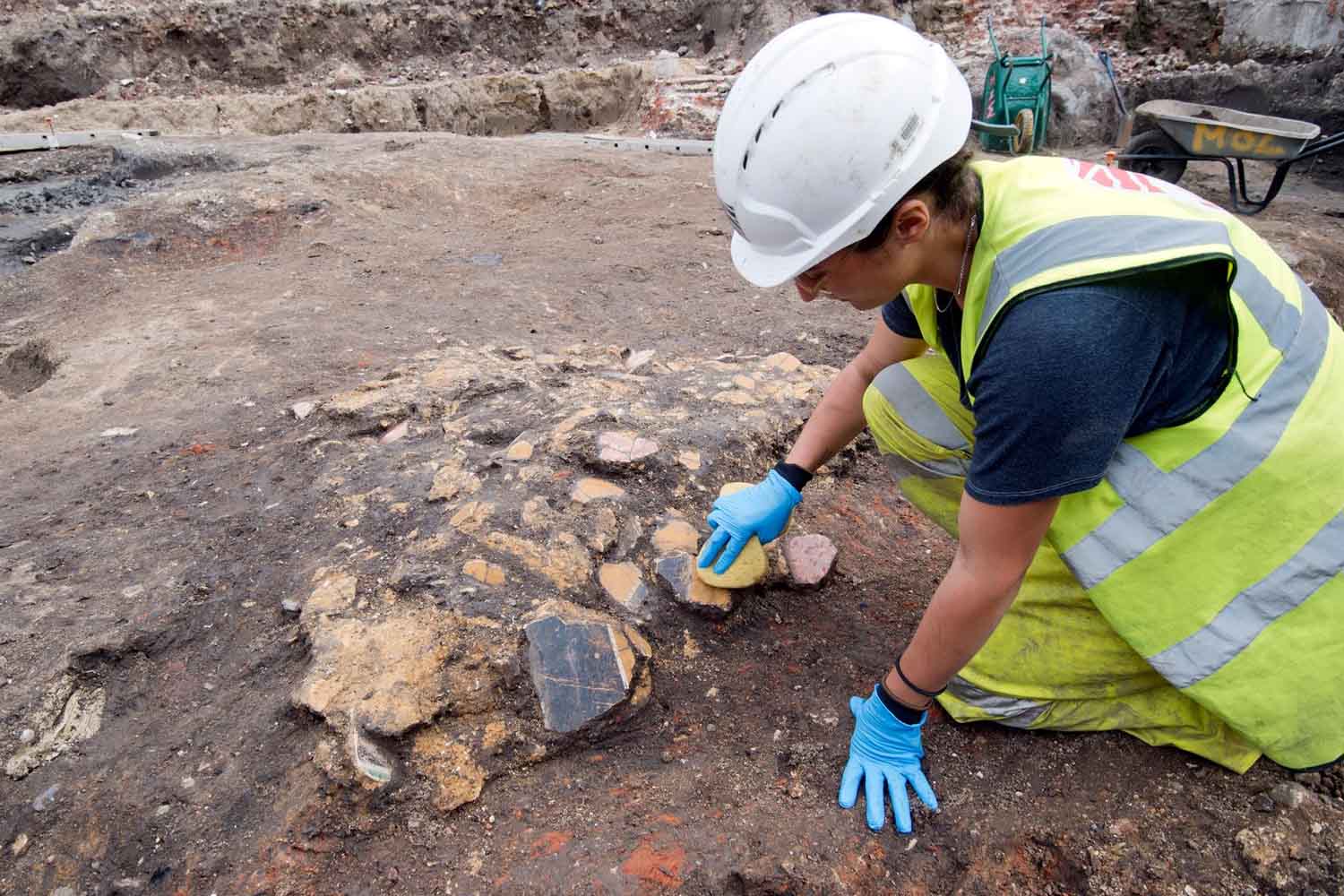
There is something deeply moving in the gesture of bringing to light What time has tried to erase. Han li, archaeologist and specialist in ancient materials at the Museum of London Archaeology (Mola), who just completed one of the most delicate and extraordinary artistic reconstruction works of recent years.
With patience, dedication and competence, he spent three months to tidy up Thousands of painted plaster fragmentsthrown into a large pit and forgotten for almost two thousand years. The result? The wider set of Roman frescoes Never discovered in London. A real archaeological puzzle, fragment after fragmentup to reveal a world of shapes and colors that no one saw anymore From the second century AD.
An explosion of colors and symbols
The discovery took place in Southwark, a neighborhood in Central London, where a high -ranking building of Roman London once stood. The property had already been demolished before the 200 dcand much of the internal decoration had ended shattered in a pit.
It is there that the archaeologists of the Mola found this extraordinary set of frescoed plasters, datable between 43 and 150 AD, a period in which Rome dominated Britain. According to scholars, The frescoes held at least twenty internal wallsprobably in private and representative environments, designed to exhibit the owner’s wealth and refined taste.
The decorations develop in lively yellow panels, separated from black elementsand populated by natural reasons: Fruits, flowers, birds and even musical instruments such as lira. A surprising and rare chromatic combination, since the yellow panels were not common even in Roman art. To date, a similar type of decoration has been identified in a few other British sites.
The signs left over time
Among the fragments recomposed by Han Li, archaeologists have also identified what remains of one Roman artistic signatureengraved on one anexed tabulathe classic decorative license plate in which the artists of the time left their name.
The only legible word is “Fecit”or “did”, but The painter’s name has been lostdeleted from a break to the exact point where it should have appeared. A detail that makes this job even more poetic: The work resists, but its author remains invisible.
Among the fragments, they also emerged Graffiti left by unknown hands. Among these, the design of A woman in tearswith a hairstyle attributable to Flavia at the time. But that’s not all: another fragment reports The entire Greek alphabetengraved by hand.
A curiosity that surprised the scholars: according to similar examples found in Italy, the alphabet could have a practical use, as a reminder or tool to count. To date, these are the only known example of this type coming from Roman Britain.
Han commented on the discovery:
When I started to arrange the fragments, I was fought between the enthusiasm and the fear of not succeeding. Many pieces were very thin, and they came from different walls, all mixed together. It was really like recomposing the most difficult puzzle in the world.
The work requested an extreme sensitivity: each fragment has been studied, clean and with care carefully, in a long and delicate process that has made it possible to restore form and life to a work that Nobody, not even the Romans of the following centuries, had ever seen again.
The discovery, explain from the mola, represents A unique testimony of the Roman presence in Englandwhich lasted from 43 to 410 AD, and today still visible through fragments that speak, whisper, resist.
How It’s Started -> How It’s Goingwe’Ra Incredibly Excited to Share That During Our ExCavations at the Liberty Site in …
Posted by Museum of London Archaeology On Thursday, June 19, 2025
