
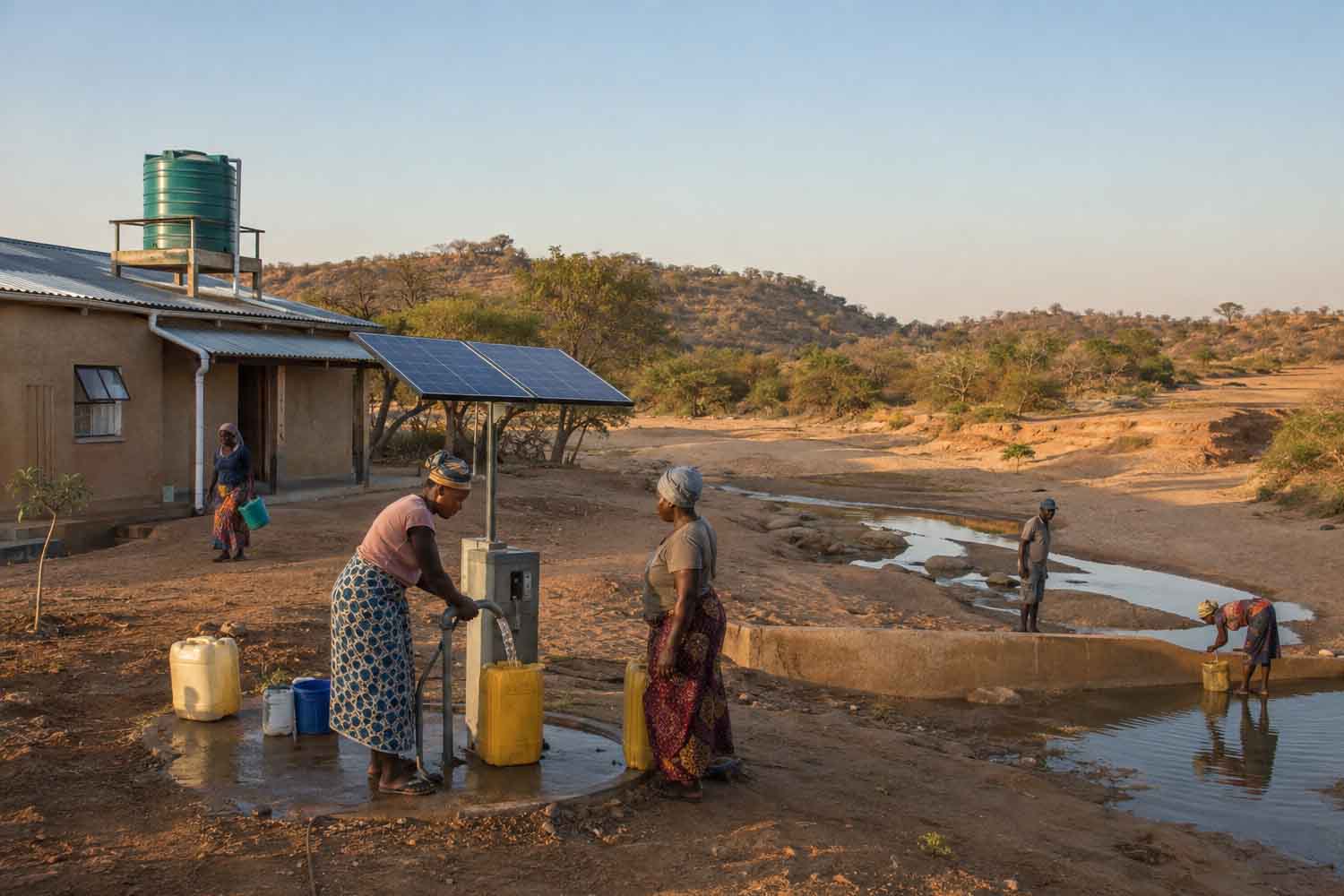
The water runs down the roof and into a tank. In other villages it rises from underground with a pump powered by the sun. Elsewhere it remains hidden in the sand, held back by small dams built in seasonal river beds. In southern Africa, drought is also addressed in this way: with very concrete solutions, often unspectacular, and for this very reason precious.
He tells her about a review published on PLOS Climatewhich analyzed 141 studies on drought adaptation in the 16 countries of the Southern African Development Community, SADC. The articles examined cover the period between January 2020 and June 2025 and focus mainly on South Africa, Tanzania and Zimbabwe, with a smaller presence of Malawi. It is a clarification that matters: the review maps what research has studied and published, not everything that is happening in the area.
The picture that emerges is much less heroic than some rhetoric on climate innovation and much more useful. There are cisterns, pumps, fields cultivated differently, animals moved, seeds preserved better, communities that organize themselves to decide who uses water and when. Less from brochures, more from everyday life that must arrive alive until the following season.
Where water collects, is pumped and stored under the sand
Among the strategies most present in the studies are the collection of rainwater and its storage. In some houses the water is intercepted on the roof, conveyed through simple ducts and accumulated in tanks or containers. When rain becomes rare, even a small reserve changes the day a lot.
The review then highlights wells powered by solar energy among the most interesting infrastructure interventions. Instead of depending on fuels or an uncertain electricity grid, a photovoltaic pump allows underground water to be brought to the surface by exploiting a resource that, unfortunately or fortunately, is almost never lacking in those parts.
There are also the sand damsthe sand dams. They are built along seasonal waterways and hold sand and water behind a barrier. The water remains stored in the spaces between the grains and can be recovered in the dry months. In the studies collected by the review, these works are associated with an increase in the months during which a community can still collect water after their construction.
Alongside the more visible structures, less conspicuous measures appear: repairing leaks, installing meters, placing tanks near houses, reusing gray water, reducing pressure in taps, introducing small drip or bucket irrigation systems. No wonder from a tech fair. Only infrastructures that, when they work, do something very serious: they lengthen the time before the next void.
In the fields the seeds, the times and even the herds change
Drought also passes through the fields, and there are many answers. The studies analyzed often cite drought or disease resistant varieties, faster maturing crops, rotations, intercropping, crop diversification and changes in sowing dates.
In drier periods, resistant varieties are often associated with better yields than traditional ones. Growing cereals other than corn also allows you not to lose everything when the main crop fails. We also intervene on the soil, with mulching, minimal tillage, planting pits, organic fertilizers and moisture conservation practices.
When livestock are at stake, other strategies come into play: conservation of fodder, more adaptable breeds, better access to water, division of herds, movement to other grazing areas, land reserved for grazing in the worst periods. Some studies report positive effects, such as reduced animal mortality or fewer illnesses during periods of water stress.
However, the review also highlights a very concrete limitation: recovery takes time. After a severe drought, a family may have saved part of their crop or herd and still find themselves more fragile than before. If the next blow comes too soon, even the best strategy begins to deflate.
The most important part is rarely seen: who decides how to use the water
In the works considered more “transformative” by the authors of the review the same idea often returns: a system alone is not enough. We also need who manages it, with what rules and on whose behalf.
For this reason, forms of community water management, coordination between different actors and more decentralized decision-making models appear among the most interesting cases. One of the studies cited in the review, published in 2024 on Current Research in Environmental Sustainabilityshows how community management of water rights can strengthen resilience and equity, especially when accompanied by infrastructure such as solar wells.
The meaning is simple: a well may exist, but without maintenance, shared rules and real possibility of participating in decisions, it lasts a short time or ends up helping some more than others. The review places great emphasis on this aspect. Governance and social capital, the authors write, consistently shape adaptation outcomes.
It is also one of the few points where the scientific article moves away from the somewhat comfortable idea that simply deploying a technology is enough to solve a problem. The sun turns the pump. Someone, however, still has to decide who turns on the tap, who pays for the repairs and who stays out of the loop.
Solutions help, sometimes they present the bill later
The review also dedicates a lot of space to the risks of maladaptationthat is, an adaptation that works immediately and leaves problems later. It’s the least photogenic part, but also the one that saves you from automatic enthusiasm. Pumping more groundwater, for example, can become a risk to aquifers if monitoring and recharge measures are lacking. The authors cite several studies that call for controlling groundwater levels and the sustainability of withdrawals.
Efficient irrigation has another paradox: if the saved water is used to expand cultivated areas, total withdrawals can rise instead of fall. Some drought-tolerant seeds must be purchased every season, resulting in higher costs for farmers. Early maturing varieties can help in bad years and produce less when the year is good.
Then there are the strategies that look more like an orderly retreat than a long-term adaptation: selling animals, using savings, getting into debt, reducing meals, looking for work elsewhere. They are useful, sometimes indeed. Repeated enough times, however, they consume resources that should help withstand the next drought.
Even campaigns to save water risk running out of steam. During the 2015-2017 drought in Windhoek, Namibia, the #DontWashMeNAM campaign urged people not to wash their cars and, according to a study published in Frontiers in Climatehelped reduce water used in car washes by between 15% and 40% during the initiative. The authors also reported long times to see results and a lower-than-expected overall impact. Even good will alone has its limits.
The measure of success is how much time remains before the next drought
A very concrete variable often recurs in the text of the review: the recovery time between one shock and another. If families and communities can rebuild crops, savings, animals and access to water before the next dry spell, adaptation holds. If the drought returns too soon, the margin shrinks until it almost disappears.
The authors also urge caution when reading the results. Many included studies incompletely described samples and methods, some relied on very long recall periods, others had no comparison groups. Furthermore, the review only considers peer-reviewed scientific literature in English. What he tells is therefore partial by definition, although very useful for understanding where more evidence is accumulating.
It remains a pretty clear picture. In southern Africa, adaptation to drought does not just involve grand plans and generic promises. It goes from a cistern connected to a gutter, from a solar pump that pulls water out of the ground, from a sand dam built where the river runs only for part of the year, from different seeds placed in the same field and from people forced to agree on a dwindling resource.
They are small, medium, sometimes fragile solutions. In the meantime, they are keeping open a very real possibility: arriving with a little more water, a little more harvest and a little less debt for the dry season that comes after. It’s not a little.
