
There night of San LorenzoToday August 10this traditionally linked to peak of the most beautiful shooting stars of the yearthe Perseids. Which, precisely because of this historical “bond” are sometimes called ‘Tears of San Lorenzo‘. In reality, however, for a long time now, the peak of the swarm is not today, but moved further ahead. This year the peak will be in night between 12 and 13 August. Let’s prepare many wishes!
The night of San Lorenzo and its traditions
In our country the Perseids, which take their name from the constellation of Perseus from which they seem to originate, are known above all as the ‘Tears of San Lorenzo‘, a popular tradition that has its roots in the Middle Ages: the anniversary of San Lorenzo in fact, it falls on August 10th and, for many centuries, the peak of the swarm occurred precisely near that date.
Today, admiring the shooting stars of San Lorenzo is a collective ritual: looking at the sky on these August nights means participating in a thousand-year-old tradition made up of stories, legends and hopes, which have their roots perhaps even in pagan rites preceding Christianity.
Among other things, in addition to the observation of the Perseids, in recent years a particular symbolic ritual linked to water and rice has also returned to circulation: the so-called San Lorenzo watera propitiatory practice that uses few elements – a glass or bowl, water and grains of rice – and which is associated with the fulfillment of desires, prosperity and abundance.
It is probably no coincidence that in Roman times meteors were considered one auspicious rain of sperm of god Inuo-Priapus who, with this gesture, fertilized the fields. During some celebrations, the so-called ‘fescennina iocatio’i.e. the ‘silly joke‘ and the enormous phallus of the god Priapus was carried in procession, also celebrating his “tears” and fertility.
With the advent of Christianity, the fruitful “tears” of Priapus were “transformed” into those of San Lorenzo, the Christian archdeacon killed on August 10 due to an edict according to which bishops and presbyters had to be killed.
Hence his “tears”: the fire with which he was killed in fact involved burning coals and therefore the shooting stars would be none other than embers on which the saint was burned.
The Perseids are already here
If we want to be precise, however, the Perseids can already be seen for several days: in fact, even if the peak is expected between 12 and 13 August, in reality the swarm is active since last July 17th (and it will be until August 24th).
Considering the traditional frequency and brightness of meteors, we can really hope for nice surprises even well before the peak, which we are very close to (in the map the sky of August 10, 2026 at approximately 11.45 pm).
©Stellarium
When and how to admire the peak of the Perseids 2026 (and why this year will be even more beautiful)
For a long time the peak of the most beautiful swarm of the year has not been August 10th: this is because of the slow evolution of Earth’s orbits and of precession of the equinoxeswhich moved the maximum two or three days forward in time.
As the UAI explains, the Perseids represent one of the great annual meteor showers together with Quadrantids of January and at Geminids of December. At the maximum, which this year is expected on the night between 12 and 13 August, their frequency will reach approximately 100 meteors per hour under ideal observing conditions.
Conditions that have every probability of occurring this year: the Moon will in fact be in the New phase on August 12thin the same hours in which the swarm will be close to maximum activity (on the map the sky of August 12, 2026 at approximately 11.00 pm).
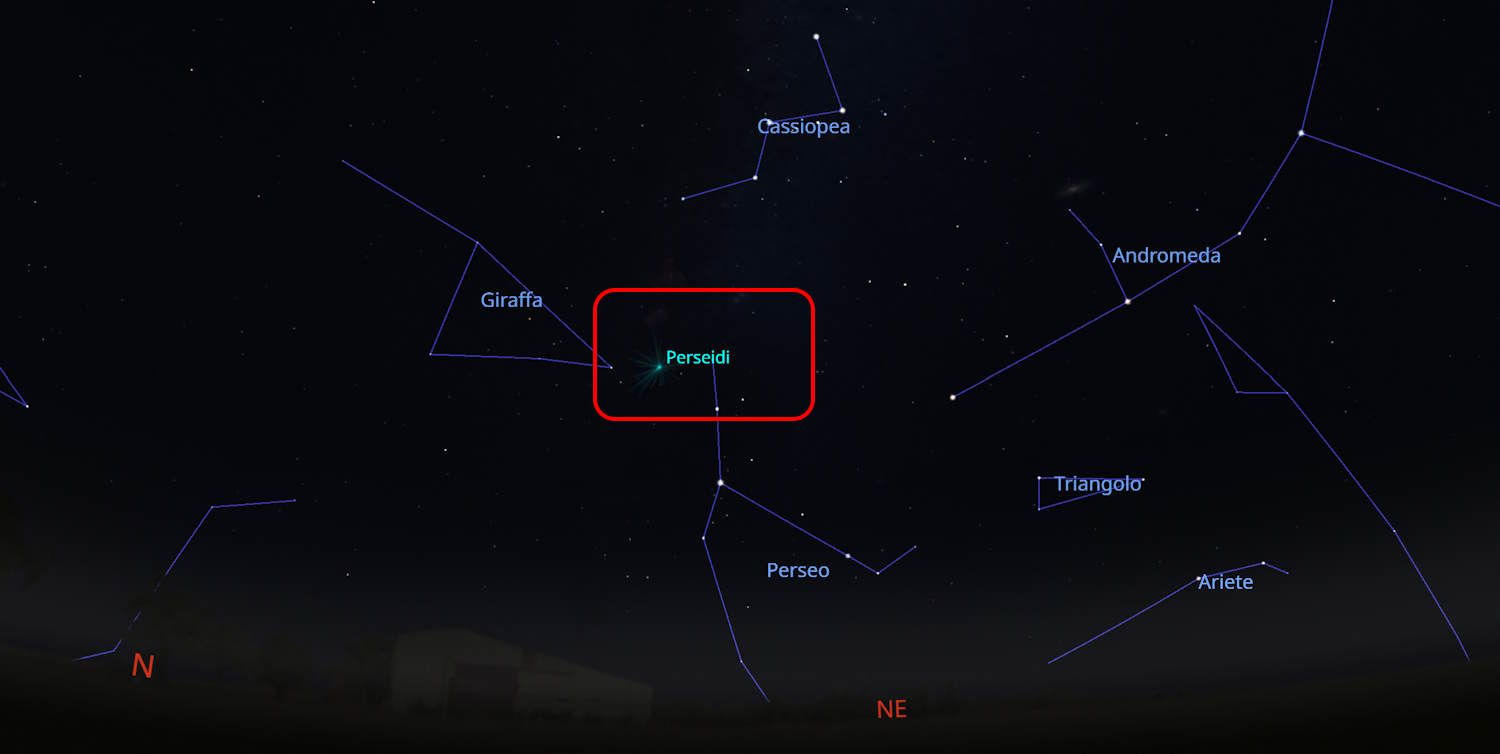
©Stellarium
This means that throughout the night the sky will be completely free from the disturbance of moonlight – write the UAI experts – allowing even the faintest meteors to be observed. This is an extremely favorable configuration, which does not occur every year and which makes 2026 one of the best opportunities of the decade to witness the spectacle of shooting stars
Let’s prepare the most beautiful wishes and let’s not fail to admire the most incredible sky of the whole year!
Source: UAI
