
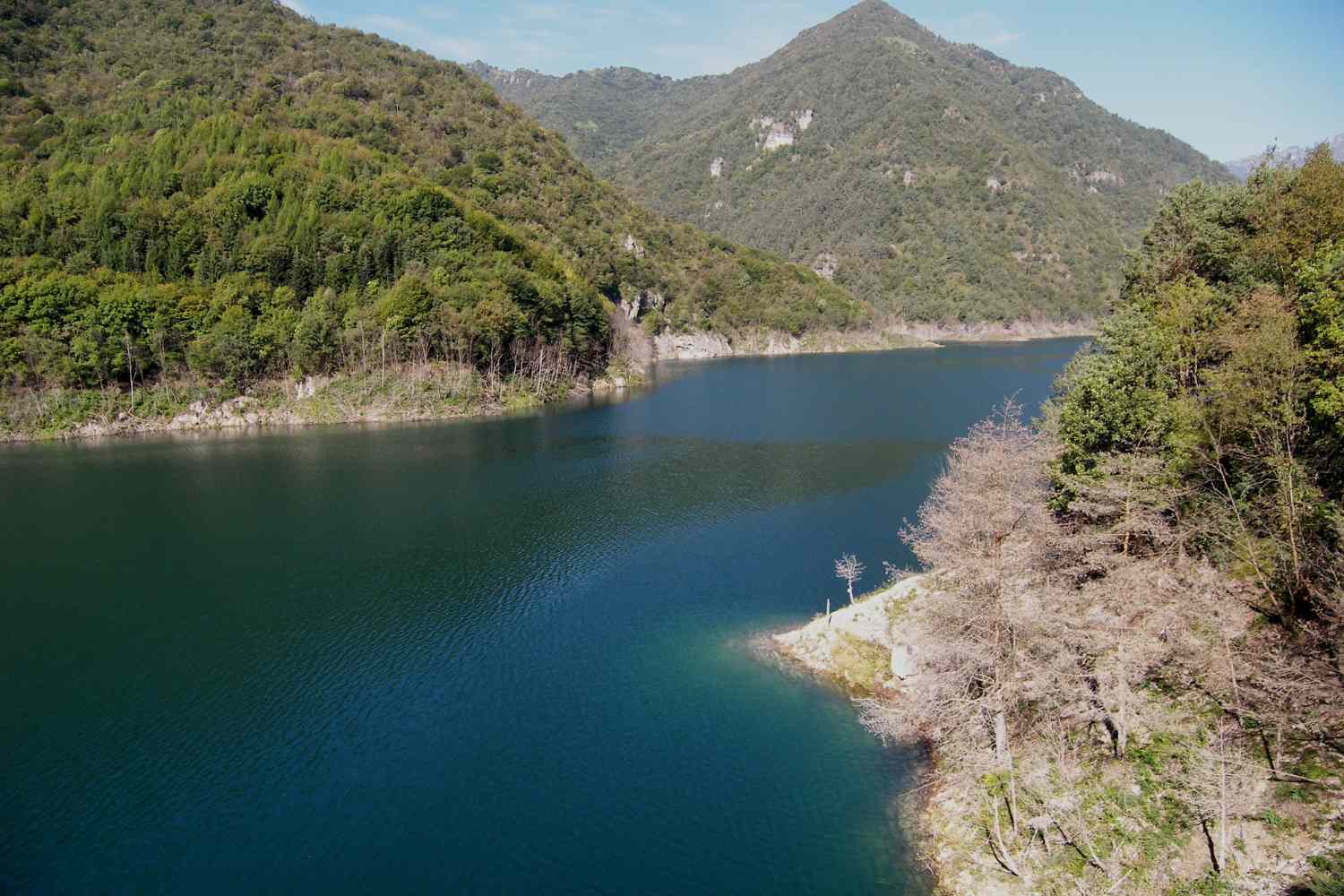
There are places that seem to come from far away, from Northern European countries where mountains and water meet in spectacular scenery. And instead they are found much closer, hidden in the Lombard Alps. This is the case of Lake Valvestino, a wild corner of the province of Brescia that resembles a miniature Norwegian fjord: deep inlets, rocky walls that descend towards the water and dense vegetation that is reflected in its emerald waters.
A still little-known place, far from the more crowded tourism of nearby Lake Garda, where the landscape invites you to slow down and rediscover a more authentic relationship with nature.
A fjord in the Lombardy mountains
Lake Valvestino was born artificially in 1962 with the construction of the Ponte Cola dam, built on the Toscolano stream. 124 meters high, the imposing hydraulic work has transformed an Alpine valley into a basin with sinuous shapes, creating one of the most evocative scenarios of the Alto Garda Brescia area.
Its waters insinuate themselves between the mountains like a green and blue ribbon, surrounded by the reliefs of Monte Palotto, Monte Fassane, Monte Pracalvis and Monte Alberelli. Here the border between water and forest seems to almost disappear: the forests reach up to the shores, while the rocks are reflected on the surface of the lake creating a landscape in continuous movement with the changing light.
It is precisely this particular conformation that gives the lake that Nordic fjord atmosphere: a cozy, vertical, silent environment.
The double soul of the lake
Behind the wild beauty of the landscape there is also a story linked to energy, the Ponte Cola dam powers the Gargnano hydroelectric plant, the pumping station has a power of 137 MW and an average annual production of around 80 GWh, enough energy to cover the average consumption of around 30 thousand homes.
A wild valley between woods and animals
Lake Valvestino is located in an area of great naturalistic value: part of the area falls within the Western Gardesana Nature Reserve and the Alto Garda Bresciano Regional Park.
Here the rhythm is that of nature, the woods preserve a rich biodiversity: deer, roe deer and mouflon populate these mountains, while in the more remote areas the landscape still retains almost intact characteristics.
One of the most fascinating places is the Val di Vesta, one of the wildest pre-Alpine valleys in Lombardy, reachable mainly via walking or boat routes. The Vesta stream passes through ravines and gorges, creating spectacular environments until it reaches the “fjord” of the lake.
An ideal area for those looking for slow tourism, made up of trekking, silence and encounters with still authentic nature.
Trekking in the Val di Vesta: a 6 and a half hour ring
To discover the most hidden face of Lake Valvestino you can tackle the trek to the Valvestino Dam and the Wilderness area. It is a circular route lasting approximately 6 and a half hours, starting from Molino di Bollone (510 metres) and passing through the Vesta Pass (1,359 metres), up to the towns of Vesta di Cima, Vesta di Mezzo and Cuel Sant, before returning.
A challenging itinerary (classified EE, for expert hikers), but very rich in suggestions: along the way you come across ancient boundary stones from the eighteenth century, military evidence from the First World War, trenches and artillery emplacements that tell the story of a valley that was once a border land.
The submerged customs house that re-emerges from the lake
Lake Valvestino also holds a secret hidden under its waters. When the level of the basin lowers, the remains of the Lignago Customs resurface, an ancient building that marked the border between the Kingdom of Italy and the Austro-Hungarian Empire.
Before the First World War, Val Vestino had a strategic position: it was a passageway between two worlds, crossed by men, goods and trade. The old customs house controlled the transit of goods and represented a sensitive point along the border.
Today, when the waters restore walls and foundations, the lake seems to open a window on the past, bringing to light fragments of a history made up of borders, wars and political changes. In Lignago a plaque still commemorates the ancient border between Italy and Austria-Hungary.
Top Rest
A trip to Valvestino is not complete without a visit to the plateaus and small villages that preserve ancient traditions. Among these, Cima Rest stands out, famous for its characteristic thatched barns, now also recovered as accommodation for stays immersed in nature. Here there is also an astronomical observatory, perfect for observing the sky away from the light pollution of the cities.
At the table the protagonist is Tombea, a historic cheese from the valley, a Slow Food Presidium and a traditional Italian agri-food product. A mountain cheese that tells of pastures, the work of herdsmen and peasant culture.
How to get to Lake Valvestino
Reaching Lake Valvestino means crossing one of the most scenic and wild areas of Alto Garda Bresciano. The simplest way is to arrive by car: from Gargnano, on the Lombard shore of Lake Garda, follow provincial road 9 which goes up towards Valvestino through hairpin bends, tunnels dug into the rock and thick woods, with numerous panoramic points of the lake and the surrounding mountains. The route takes about 40 minutes and already gives you the atmosphere of the place during the journey.
Another access is from the Lake Idro area, passing through the territory of Capovalle and Val Vestino, along a more internal and equally evocative road. Those arriving from Brescia can first reach Lake Idro or Lake Garda and then continue towards the valley.
The area is poorly served by public transport, so the car remains the most practical way to explore the lake and the small villages in the surrounding area. Once you arrive, it is best to move slowly: many of the most interesting locations, such as the Val di Vesta and some panoramic paths, can be discovered mainly on foot, following the rhythms of an area where nature and silence are still the protagonists.
A lake far from the crowds
Reaching Lake Valvestino means choosing a different Lombardy: less known, quieter, made up of panoramic roads, curves through the woods and small villages where time seems to pass more slowly.
The road that connects Lake Idro to Lake Garda offers continuous panoramic points, also much loved by motorcyclists, but outside the high season it can happen that you travel for kilometers without meeting anyone.
This is precisely the magic of the place: a spectacular landscape without the need for crowds, a small Italian fjord where water and forest become one large ecosystem.
