
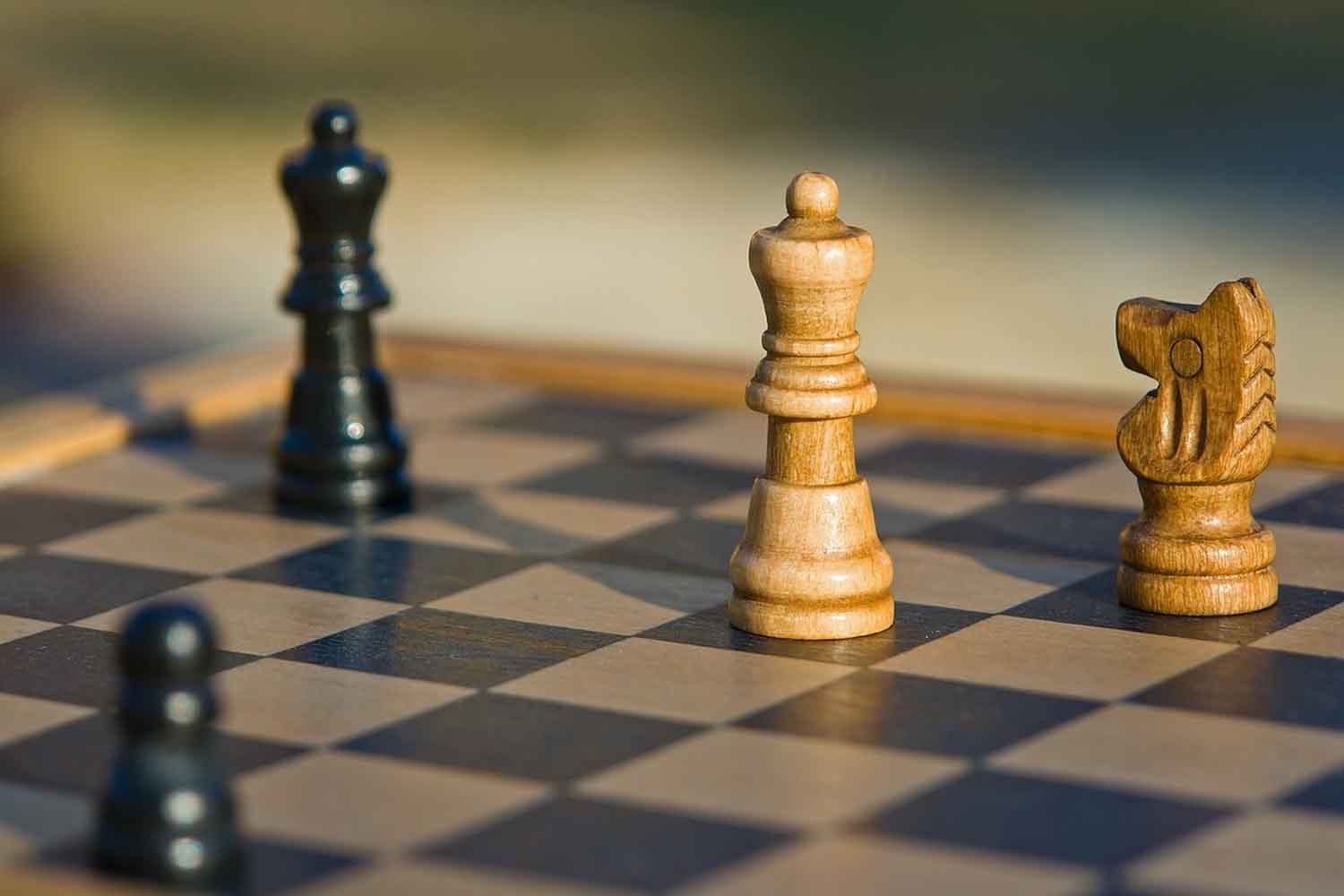
For centuries we have considered them the symbol of pure strategy, of mental balance, of the intellectual challenge par excellence. Yet, chess may not be as fair as we are led to believe. A new statistical analysis calls into question the traditional arrangement of pieces on the board, suggesting that the game is unbalanced from the first move.
A theme that intrigues not only professionals, but also those who play for passion, perhaps in the evening, in front of a wooden chessboard or on an app.
White’s advantage
In the world of chess it is almost an open secret: whoever plays with White has an advantage. The reason is simple and concrete. Moving first means setting the pace, immediately occupying the central space and forcing the opponent to respond. In matches between expert players this advantage, apparently minimal, can become decisive.
For years it was thought to be an acceptable, almost inevitable flaw. But today, thanks to data analysis and chess engines, that suspicion takes the form of a mathematical certainty.
When Bobby Fischer tried to change the rules without touching the game
In the nineties, the legendary Bobby Fischer had an intuition that was as simple as it was revolutionary. To reduce the weight of the openings studied by heart and make the games more creative, he devised a variant in which the pieces on the first rank do not follow the classic pattern.
Thus, Chess960, also known as Fischer Random Chess, was born. The rules remain the same, the pawns do not move, but the initial arrangement of the pieces changes each time, generating 960 possible configurations. The idea was clear: less automatism, more reasoning. And, at least on paper, also a greater balance between Black and White.
The statistics tell another story
A study conducted by Marc Barthelemy, a researcher at Paris-Saclay University, calls everything into question. By analyzing all 960 Chess960 positions with the help of the open source chess engine Stockfish, Barthelemy measured the initial advantage and decision complexity of each configuration.
The result is surprising and, in some ways, unsettling. In 99.6% of cases White still maintains an advantage. The pieces change, the order changes, but the problem remains. According to the researcher, the first move advantage is not a defect of the traditional chessboard, but a structural feature of the game.
In other words, it doesn’t matter how much we shuffle the pieces: starting first always matters.
The classic chessboard isn’t special, it’s just familiar
Another interesting aspect that emerged from the study concerns our relationship with the traditional chessboard. The arrangement we have always known was not chosen because it was fairer, but because it was visually symmetrical and easy to memorize. A balance that is more aesthetic than real.
According to Barthelemy, classical chess presents an average complexity and a decision asymmetry superior to many other possible configurations. This doesn’t make them worse, but it invites us to look at them with different eyes, less romantic and more aware.
Is there really a “fairest” position of all?
Among the 960 configurations of the Chess960, one in particular stands out for its almost perfect balance. It is the so-called position 198, the one in which White’s advantage and the decision-making difficulty between the two players are practically eliminated. A sort of ideal meeting point, at least according to the numbers.
At the other extreme there is a configuration that generates the maximum possible complexity, making each game a small strategic labyrinth from the first moves. Two sides of the same coin, showing how much the game can change simply by moving the pieces.
This research takes nothing away from the charm of chess, nor its history. If anything it adds a level of awareness. Knowing that perfect parity does not exist can help you design fairer tournaments, experiment with new solutions and, why not, make the game even more stimulating.
Maybe chess will continue to not be entirely fair. But it is precisely in this small imperfection that, for centuries, they have found their strength.
You might also be interested in:
