
It’s curious how nature, so generous with colours, seems to suddenly become stingy when it comes to violet. We find green at every corner, yellows and reds galore, even some bold blues that defy physics. Violet, however, remains a sporadic guest, almost a whim of biology. To understand why we need to observe what happens when light meets an organism and when evolution decides which colors deserve energy, time and complex structures to manifest themselves.
There are two very different ways to create a colour: pigments, which absorb some wavelengths and reflect others, and microscopic structures, which do not dye at all but play with the light, deflect it, disperse it, transform it. If a pigment holds back more energetic frequencies, such as blue, and sends back weaker ones, it will appear red. And this is precisely where nature begins to get complicated: plants, for example, depend on blue light for photosynthesis and cannot afford the luxury of reflecting it. Thus blue becomes rare in the plant kingdom and consequently also becomes rare in many animals that obtain pigments through their diet.
Violet is born where pigments and structures fail together
When structural colors come into play, the situation is reversed: the most energetic wavelengths are precisely those that micro-architectures disperse best. This gives rise to iridescent butterfly wings, iridescent bird feathers, blue reflections that almost become a trademark of the structural colouring. Red, on the other hand, being low in energy, does not allow itself to be “thrown” easily and remains an almost non-existent structural colour.
It should turn out that violet, being even more energetic than blue, would be a feast for these structures. And instead the opposite happens: violet is too extreme, too close to the limit of the visible spectrum. The molecules struggle to produce pigments that reflect such short lengths and the structures, to do so, must be very refined, almost surgical. Very few organisms have that architecture.
Coloring studies confirm this. Some research, such as that conducted on mesoporous metamaterials, shows that it is theoretically possible to obtain the entire visible spectrum only by modifying the structure and not the material. Even more recent work on the chitinous ridges of butterfly wings shows that varying the height of these micro-scales is enough to generate almost all the colors of the spectrum. These results, paradoxically, also explain why violet is rare in nature: all it takes is a ripple out of place and that wavelength escapes.
Information collected by the Natural History Museum in London tells a further detail: when it appears, violet often takes on intense, sometimes threatening roles. It can become a decoy for pollinators, a warning to predators or a protection against sunlight. Yet it remains a secretive, almost secret performance, because most organisms do not have the tools to produce it.
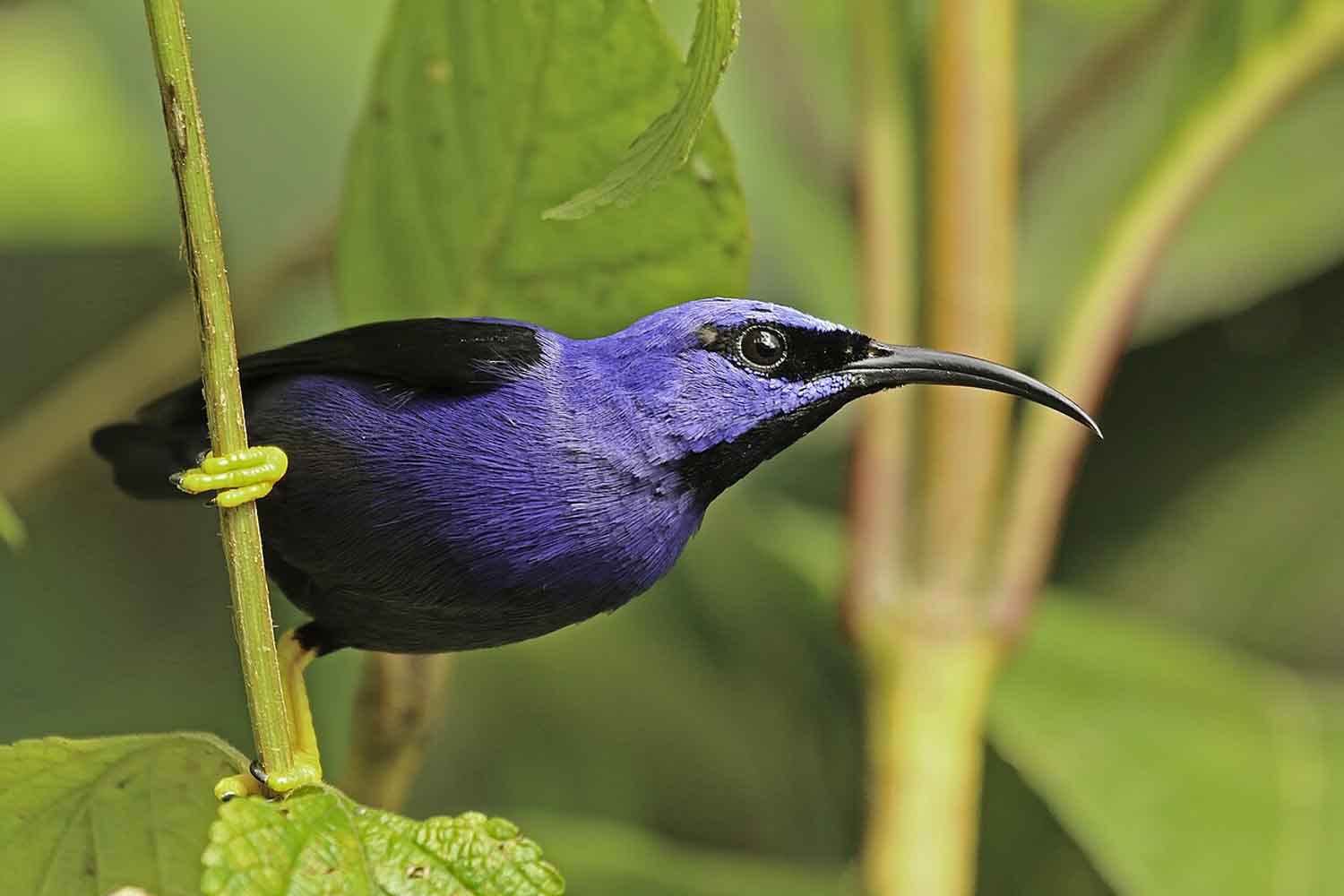
The animal world is even more drastic: mammals simply do not possess the necessary pigments. If we want to see a truly purple color we have to turn to other kingdoms, from purple honeybirds to purple-backed partridges, from emperor butterflies to marine creatures such as stars and sea snails. Small appearances in a universe that seems to prefer more easily manageable, more useful, safer shades.
However, when violet appears, it is an aesthetic event that does not go unnoticed. Perhaps also for this reason, throughout human history, it has become the color of kings and divinities: the famous Tyrian purple, extracted from very rare molluscs and in minimal quantities, cost as much as gold. It was, in its own way, a piece of nature that was difficult to reproduce.
Thus violet remains a color that nature grants drop by drop, a subtle balance between physics and life, a shade that requires more ingenuity than it seems. And this complexity makes it so fascinating: it doesn’t appear often, but when it does, no other color really resembles it.
You might also be interested in:
