
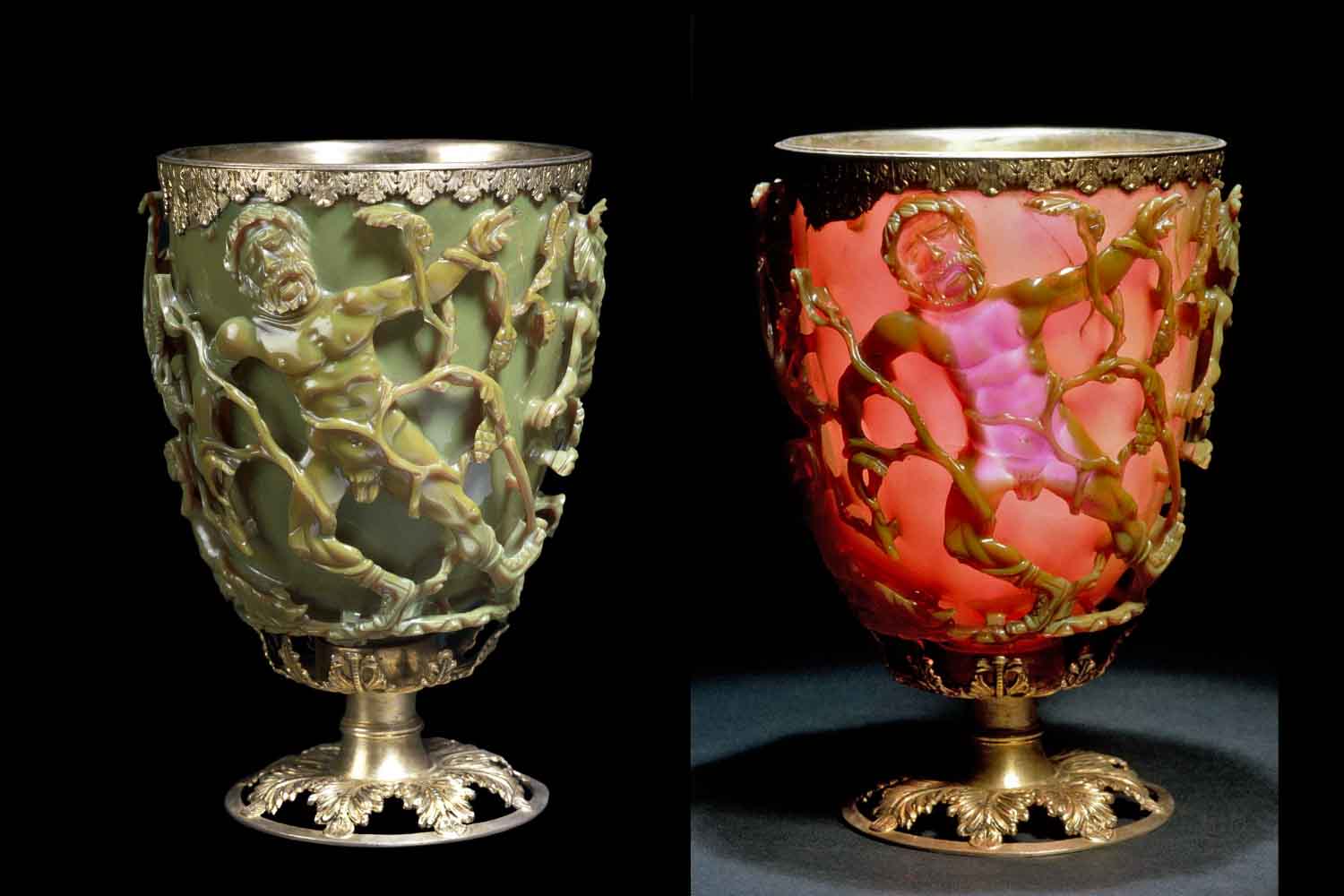
Jade green when illuminated from the outside, ruby red when the light passes through it. The Lycurgus cup, made by Roman craftsmen about 1,600 years ago and now preserved in the British Museum in London, has a peculiarity that for decades has given even modern researchers a hard time. Now scientists at the University of Sheffield have managed to reproduce color changing glassreconstructing the conditions necessary to obtain the same optical effect as the original.
The result comes from a series of experiments conducted on materials and production techniques compatible with those of the Roman era. No time machine, therefore. All it took was a furnace, tiny quantities of gold and silver, and several attempts. The outcome of the first phase of the research had already been described in a scientific contribution from 2025. Now the project has also led to the creation of a contemporary sculpture which will be exhibited in Sheffield from 6 November 2026.
The Roman cup that turns red when the light passes through
The Lycurgus cup, preserved in the British Museum, dates back to the 4th century AD. It is just under 16 centimeters high and has a decoration carved in glass which tells of the punishment of Lycurgus, king of Thrace, for having challenged Dionysus, the god of wine.
The sovereign is represented as trying to free himself from the vine shoots that envelop him. The figures are worked in relief, with some parts almost completely detached from the surface of the vessel. A work of extraordinary precision, especially considering how fragile the material is.
But the most striking feature is seen by changing the position of the light. If the cup is illuminated from the front, the glass appears green and almost opaque. However, when the light source is behind it, it becomes translucent and takes on an intense red color.
This phenomenon is called dichroism and depends on the presence of extremely small metal particles, dispersed within the glass. The scientific explanation came many centuries after the production of the artifact. Research published in Gold Bulletinsigned by Ian Freestone and other scholars, reconstructed the characteristics of the material and the role of gold and silver nanoparticles in producing the particular chromatic effect.
Essentially, these particles interact with light by modifying the different components that form it. When light passes through glass, some wavelengths are absorbed or scattered, leaving red to dominate. When reflected, the interaction between metal particles and the glass structure contributes to the greenish color. This all happens with tiny quantities of metal. And getting exactly those shades is much more complicated than it might seem.
How they recreated Roman glass after 1,600 years
At the University of Sheffield, researcher Lisa Hollands initially worked with Roman glass expert Caroline Jackson to reconstruct the manufacturing process. In the scientific contribution Reproducing the colors of the Lycurgus Cuppublished in 2025 in the journal Physics and Chemistry of GlassesHollands, Jackson and John Parker describe the work carried out starting from previous analyzes of the find and knowledge of Roman glassmaking techniques. The researchers modified the composition of the raw materials and the melting conditions to obtain a material with optical properties similar to those of the original.
The glass was brought to temperatures above 1,000°C. During cooling, gold and silver particles can aggregate into tiny crystals, capable of interacting with light. The difficulty lies in controlling its formation, size and distribution. Simply vary the furnace conditions to get a different result.
The first experimental phase lasted approximately four months. The glass with the desired effect has arrived the day before the opening of the exhibition for which it had been requested. A rather small safety margin, even for scientists. The research then continued with further casting and analysis tests to compare the modern materials with the ancient one.
Did the Romans already know nanotechnology?
Defining the Lycurgus cup as an example of ancient nanotechnology is correct if we refer to the physical properties of the material. However, it would be risky to imagine Roman craftsmen aware of manipulating particles on a nanometric scale, as happens today in laboratories. They knew how to produce glass and obtain particular colours. The ability to precisely control the phenomenon, however, remains uncertain. Moreover, that of Sheffield is an important result also because faithfully reproducing the two colors has proven difficult even with modern knowledge.
And there had already been some previous attempts. A study published in 2021 on the Journal of Cultural Heritage had documented the production of glass with composition and optical characteristics similar to those of the Roman cup, through controlled thermal treatments. The new experiment adds useful information to understand the production conditions of ancient glass. However, it remains difficult to establish how much the result of the Roman artisans was intentional and how much it depended on the specific conditions of the workmanship.
Then there is a particularly curious historical detail. According to one of the interpretations of the artefact, the transition from green to red may have been symbolically linked to the ripening of the grapes and their transformation into wine. An appropriate reference for a cup decorated with the myth of Dionysus, although the actual function of the vessel remains debated.
Roman glass is back on display, this time in Sheffield
The project also involved British sculptor Elliot Walker, who was tasked with creating a contemporary work using the material developed by the researchers. The sculpture combines references to the Lycurgus cup and the Farnese Atlas, the famous ancient statue that depicts the titan holding up the vault of heaven. In the contemporary interpretation, the globe is replaced by a cup.
The work will be presented by 6 to 15 November 2026 at the Millennium Gallery, Sheffield, as part of the University of Sheffield’s Festival of the Mind. It is subsequently scheduled to be permanently exhibited at the Turner Museum of Glass. The project thus allows us to directly observe an optical effect known for over sixteen centuries and to better understand the technical skills of Roman artisans.
The original cup will remain in the British Museum. In Sheffield you can admire a new work made with glass that reproduces its behaviour. To see it change color, just move the light. To be able to manufacture it, however, it took four months of experiments and a few more centuries of scientific knowledge.
