
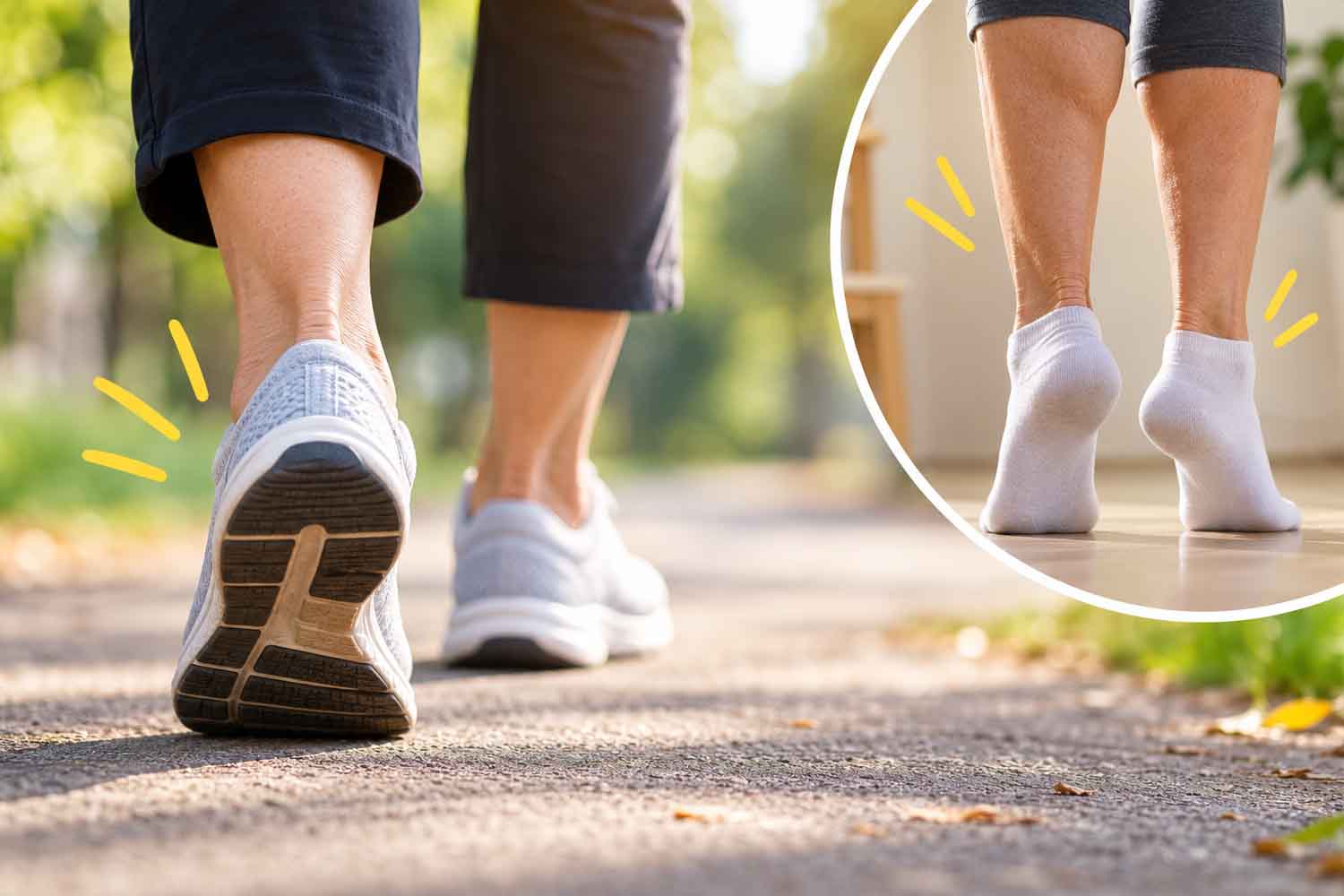
Fifty heel raises per session, twice a day, five days a week. For ten weeks. It is the training followed by a group of elderly Japanese who, at the end of the experiment, had improved their walking speed more than those who had continued their routine. The difference between the two groups’ improvements was 0.17 meters per second. An interesting result, considering that the exercise essentially consisted of standing on tiptoe. With one more detail: a device built specifically for the studio.
The research, published on Scientific Reportswas conducted by Osaka Metropolitan University, in collaboration with the Japanese company Mizuno. The goal was to understand whether simultaneously training calf strength and ankle movement speed could help older people walk faster.
Ten weeks on tiptoes: how the training works
The researchers involved 40 people aged at least 65, dividing them into two groups of 20. The first would follow an assisted training program, while the second would continue their daily activities. There were two exercises. The first involved 20 heel raises performed at high speed, the second 30 repetitions with particular attention to the descent phase.
The latter is called the eccentric phase, a technical term to describe what happens when the muscle works as it lengthens. In the case of the calves, this means controlling the movement as the heels return towards the ground, rather than letting them fall back to the feet. The experimental device allowed both modes of exercise to be combined, working on the strength necessary to support and push the body and on the speed with which the ankle can move.
A rather demanding program, at least on paper. Yet, of the 19 participants who actually started training, 18 made it to the end of the ten weeks. Everyone who completed the program performed the prescribed amount of exercise.
The results showed improvements on three fronts. Compared to the control group, those who trained had achieved a greater increase in calf muscle strength, equal to 7.5 kilograms-force, and in the speed of ankle movement, increased by 104.9 degrees per second.
Walking speed also improved the most, with a difference of 0.17 meters per second between the changes recorded in the two groups. Of course, this value represents the result of the overall comparison, so it does not mean that each participant walked exactly 0.17 meters per second faster.
@AI generated
To walk well, calf strength alone is not enough
When we walk, our calves work with virtually every step. They are among the muscles that allow us to lift the heel and push the foot against the ground to move forward. A mechanism so habitual that we hardly pay attention to it, at least until it starts to become more tiring.
In fact, with aging, the ability to produce force tends to decrease. But Japanese researchers also focused their attention on another characteristic: the speed with which we can move the ankle. Already in a previous study published in 2023, the same research group had examined 550 adults between 18 and 91 years old, observing that the speed of plantar flexion, i.e. the movement with which we push the toe downwards, was approximately 26% lower in elderly people than in young people.
The research also highlighted that muscle strength and speed are two distinct capabilities. Having sufficiently strong muscles, therefore, does not necessarily guarantee that you will be able to move them with the same speed. From this observation came the idea of combining two types of training, rather than focusing solely on strength. The result obtained after ten weeks suggests that this combination may be useful for improving calf function and, consequently, walking speed.
A promising exercise, with some verification still to be done
The study involved a limited number of participants and the assignment to groups did not occur randomly. Furthermore, as also indicated in the trial protocol, the volunteers were people already capable of walking without assistance. The results, therefore, concern this specific population and cannot be automatically extended to those with significant motor difficulties.
There is also a difference to consider between the experimental device and common toe exercises. The control group, in fact, did not follow an alternative training program and for this reason we do not know if the same benefits could be obtained without the equipment used by the researchers. The device is covered by a patent shared between the university and Mizuno, a company that funded the study and employs four of the authors. A collaboration declared in the scientific publication.
Despite these limitations, the results offer an interesting indication: training calf strength and speed together could contribute to improving the ability to walk during aging. Ten weeks of training were enough to observe measurable improvement. Now we will need to understand how long it lasts and whether the same program can work even without the experimental device. For the moment, the calves have done their part.
