
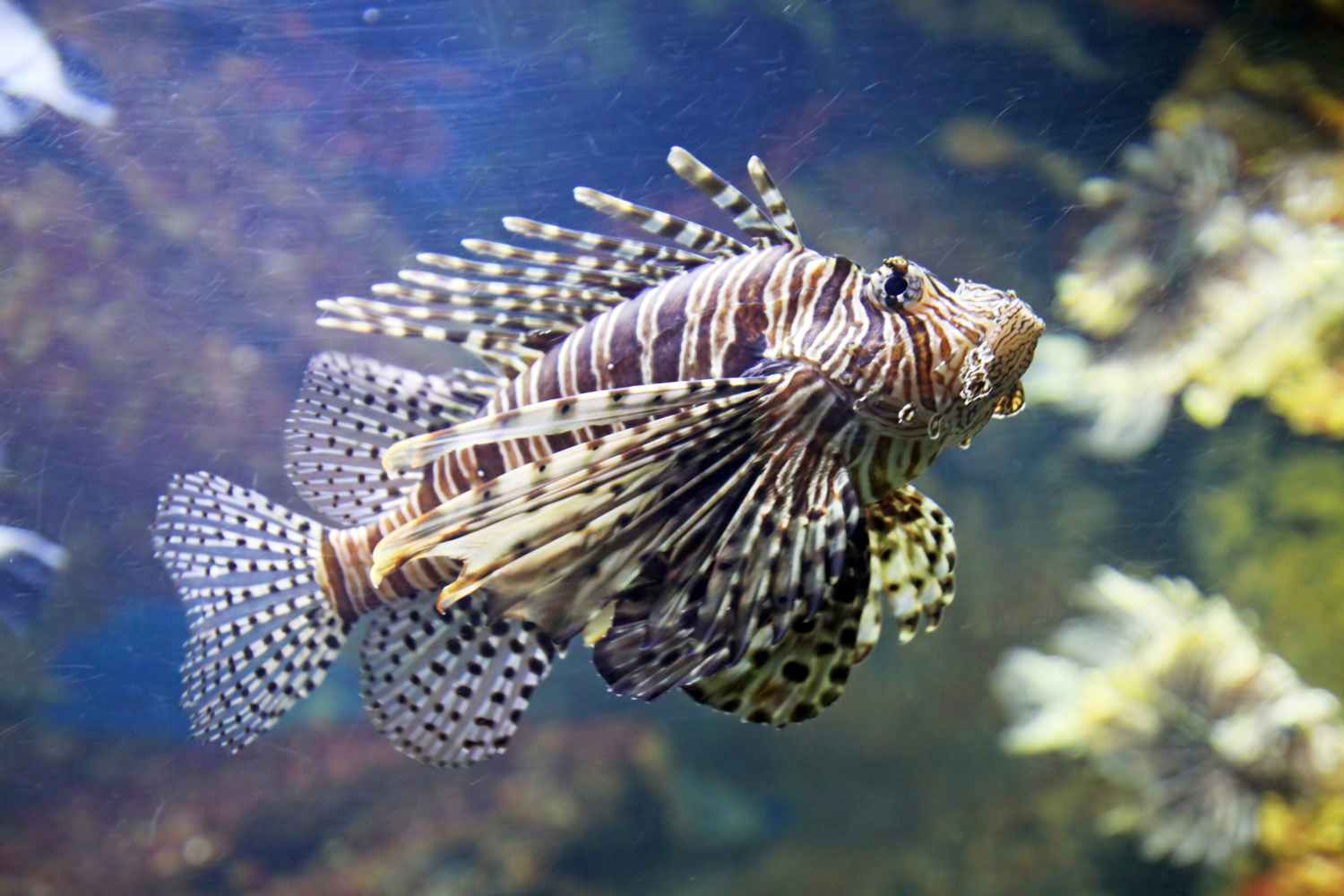
The crystal clear waters of Punta Secca, a seaside village known for Inspector Montalbano’s investigations, are home to a new unexpected (and unwelcome) inhabitant. This is the western scorpion fish (Pterois miles), a tropical species with a flashy appearance but dangerous for biodiversity, as well as for swimmers.
The discovery, the first officially documented in the province of Ragusa, was confirmed by the team of international researchers from the Civic Museum of Natural History of Comiso. The specimen was observed at about twenty meters deep by Federico Brugaletta, an expert diver and collaborator of the museum, as part of a Citizen Science project that involves citizens and enthusiasts in the monitoring of marine biodiversity. The worrying report takes on particular importance because it confirms the advance of a species native to the Indian Ocean and the Red Sea which, in recent years, is increasingly expanding its range in the Mediterranean.
The animal will now be subjected to in-depth genetic and morphological analyzes to reconstruct its origin and better understand the dynamics of its diffusion along the Italian coasts.
A dangerous alien species
Behind the almost elegant appearance, characterized by long spines and showy streaks, hides an extremely efficient predator. The lionfish, also known as the lionfish, feeds on small fish and invertebrates and can rapidly alter the balance of the ecosystems it colonizes.
Its presence worries scientists because, in the absence of natural predators, it manages to proliferate easily, reducing local biodiversity and putting native species under pressure. For this reason, the alien species is included among the most carefully monitored invasive organisms in the Mediterranean, together with the spotted pufferfish (Lagocephalus sceleratus) and the rabbitfish (Siganus luridus and Siganus rivulatus).
Beware of poisonous thorns
In addition to the ecological implications, lionfish also requires caution for health reasons. Its thorns are connected to glands that release a venom capable of causing very intense pain, swelling and, in the most serious cases, symptoms such as nausea, fever and breathing difficulties. The animal is not aggressive and tends to avoid contact with humans, but accidental handling can have unpleasant consequences. In the event of a sting, specialists recommend immersing the affected part in very hot water, compatible with the skin’s tolerance, and quickly contacting a doctor.
For researchers, each new sighting represents valuable information. This is why the invitation addressed to fishermen, divers and swimmers is simple: observe, document and report, without ever touching the animal.
View this post on Instagram
The climate crisis paves the way for invasive species
The arrival of the lionfish is not an isolated episode, but the symptom of a broader transformation that is affecting the Mediterranean. In recent decades, warming waters have made our sea increasingly similar to a tropical environment, favoring the settlement of species from the Red Sea and the Indian Ocean.
This process, known as tropicalization of the Mediterranean, is closely linked to the climate crisis. Indeed, higher temperatures allow many alien species to survive the winter, reproduce and establish permanent populations. In addition to the lionfish, the best-known examples include the spotted pufferfish (Lagocephalus sceleratus), one of the most problematic invasive species for Mediterranean fisheries, and the blue crab (Callinectes sapidus), which is causing extensive damage to coastal ecosystems and shellfish farms.
There are also increasingly frequent sightings of the Portuguese caravel (Physalia physalis), a tropical organism with stinging tentacles that finds conditions favorable to its presence in the Mediterranean in warmer waters.
