
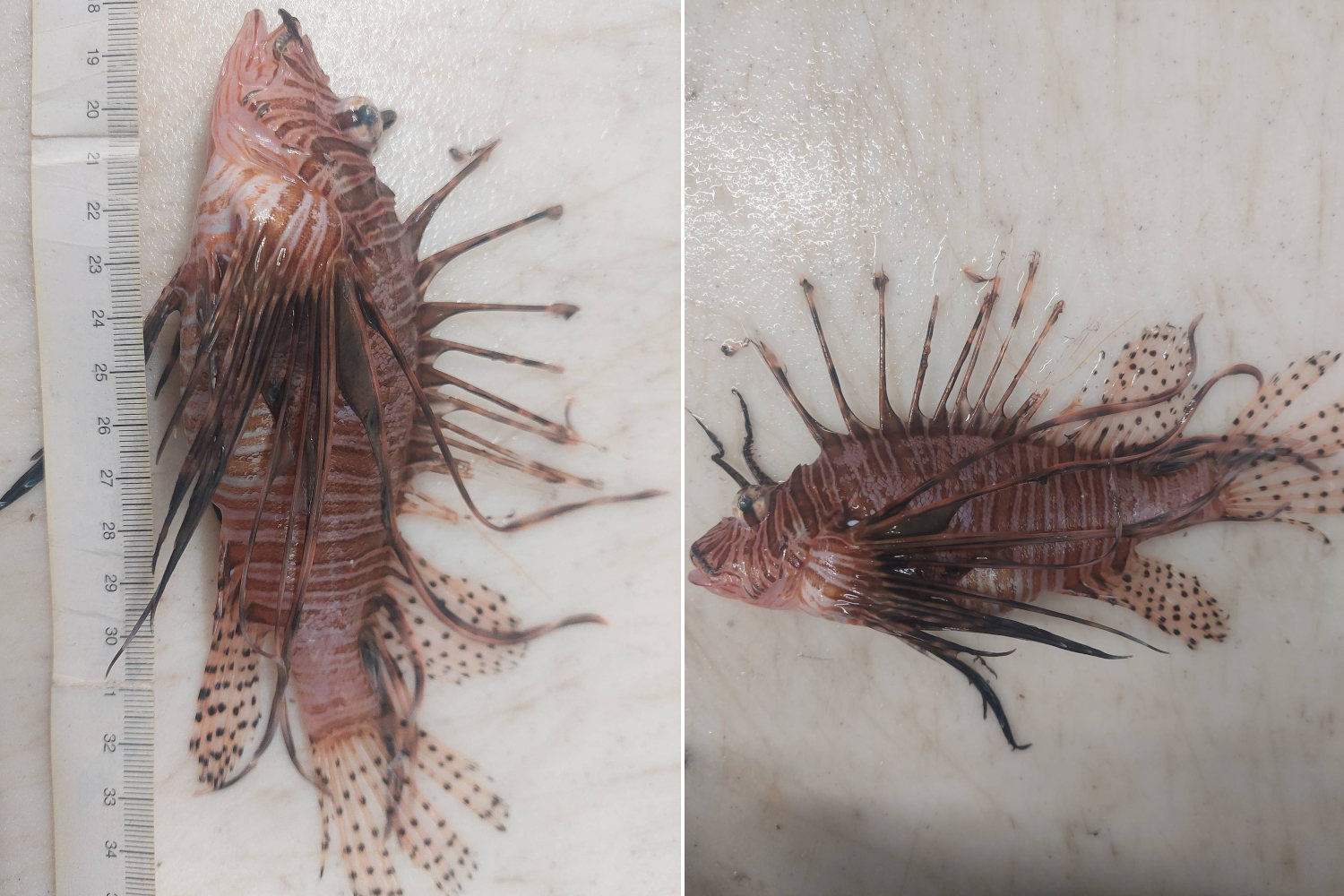
In the seas of Salento, the alert for so-called alien species is growing: for the first time a scorpion fish was caught off the coast of Ugento (Pterois volitans), also known as lionfish. The sighting was made by Antonio Sansò, a local fisherman, and confirmed by the naturalist Roberto Gennaio, who documented the specimen with the help of Matteo Santorsola and Fabio Pellegrino of the Pescheria del Porto di Torre San Giovanni.
The characteristics of the scorpion fish
The lionfish is a non-native species native to the Red Sea and the Pacific Ocean, from Southeast Asia to Australia, and from Japan to Polynesia. It was found about 50 meters deep among the fisherman’s gill nets, confirming its progressive colonization of the southern Mediterranean waters.
It prefers coral reefs, lagoons and rocky bottoms up to 150 meters deep. Juveniles move offshore in search of new habitats, explaining its ability to colonize new territories. The body of the eastern lionfish is characterized by a small head, wide mouth and protruding eyes topped with growths.
The back is curved, the belly flat, and the body narrows towards the rounded tail. The livery is vertically streaked with brown and white, with equally decorated fins. The first rays of the dorsal and anal fins are venomous spines, while the rays of the pectoral fins are not venomous. It reaches a maximum length of approximately 38 cm.
View this post on Instagram
A threat to marine ecosystems
In the 1990s the species was accidentally introduced into the Atlantic Ocean, spreading along the coasts of the United States and progressively into the Caribbean Sea, until reaching the Mediterranean. Like other invasive organisms, including the blue crab and the Louisiana killer shrimp, it can compete with local species and, being stronger, they tend to destroy local ones, modifying marine ecosystems.
The presence of lionfish and other alien organisms can alter local biodiversity and change the physiognomy of marine habitats. The naturalist underlines how essential it is to report sightings to bodies such as ISPRA, to monitor the expansion of these species and understand their impact over time.
The phenomenon of alien species is favored by the increase in sea temperatures, which facilitates the survival of tropical and subtropical organisms in the Mediterranean. In some cases, the lack of natural predators can allow these species to spread rapidly, while others may not find suitable habitats and regress spontaneously.
The risks for humans
Be careful because it is not only a risk for fauna: it is also dangerous for humans. Poisoning caused by lionfish is classified into three degrees: degree I causes erythema and bruising, degree II causes blisters, and degree III can cause local necrosis and alterations in sensitivity. Rarely, systemic effects such as nausea, vomiting, abdominal pain, respiratory difficulty or pulmonary edema occur. In extreme cases, deaths have been documented. The main treatment consists of immersing the affected part in hot water at around 45°C, which reduces pain and inactivates the toxin.
You might also be interested in:
