
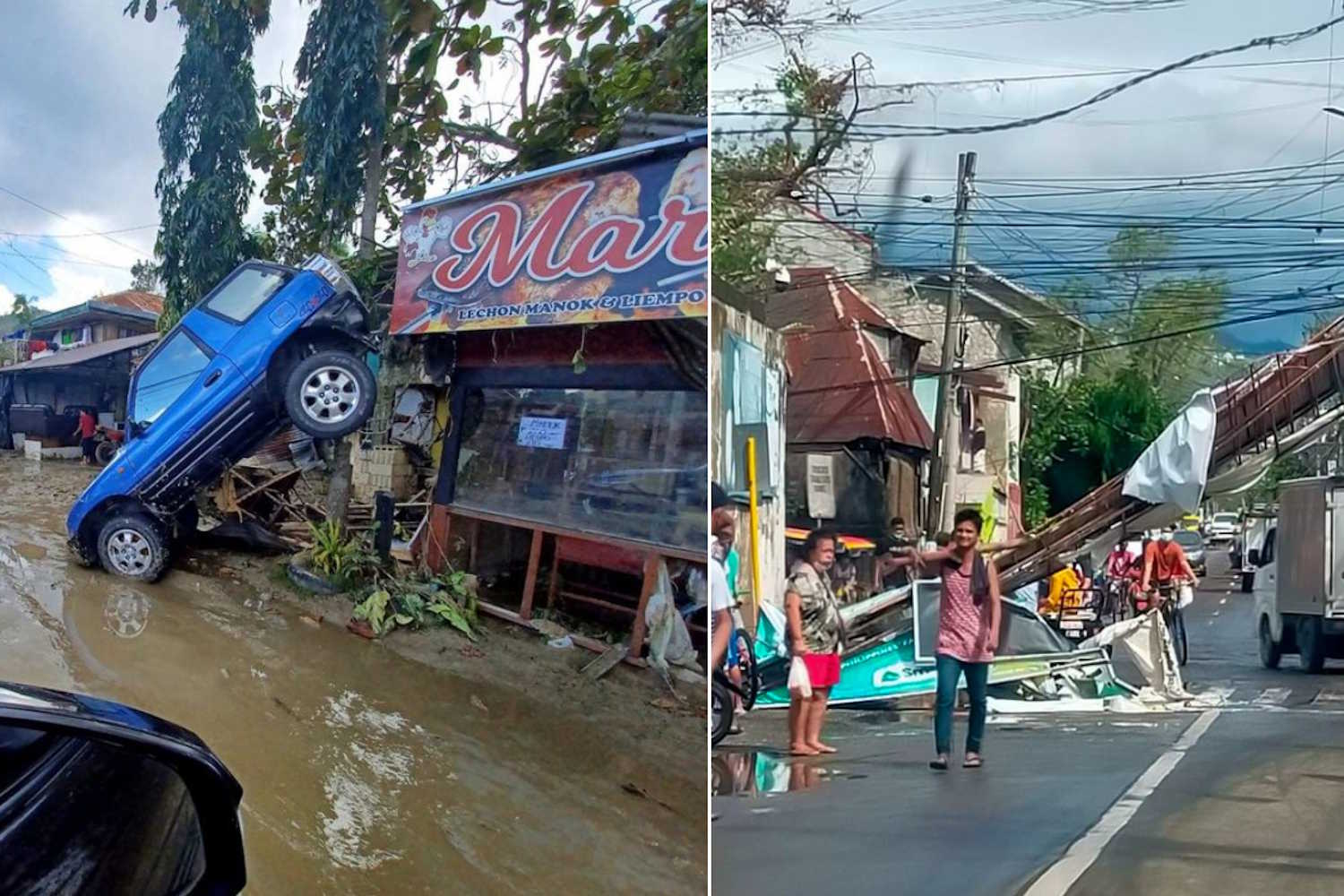
It was 2021 when, a few days before Christmas, a disastrous typhoon hit the Philippines. It was the frightening typhoon Rai, which hit the entire archipelago and was undoubtedly the most powerful recorded that year, with winds of up to over 200 km per hour.
Entire regions were literally razed to the ground: landslides and floods destroyed buildings, fields and boats. Around 400 people lost their lives.
Now a group of survivors is for the first time taking legal action against Shell, the UK’s largest oil company, claiming it played a role in making the typhoon far more devastating.
The devastation
Typhoon Rai, known locally as Odette, was the most powerful storm to hit the Philippines in 2021. With winds gusting up to 270 km/h, it destroyed around 2,000 buildings and displaced hundreds of thousands of people.
Now, a group of 103 people have filed a complaint profiling the first case of its kind in the Philippines. In an open letter, they argue that Shell is responsible for 2% of global greenhouse gases (as calculated by the Carbon Majors database on oil and gas production) and that the multinational has “materially contributed” to climate change by making the typhoon more damaging.
The survivors’ group also claims that Shell has a “history of climate misinformation” and has known since 1965 that fossil fuels are the main cause of climate change.
This is an unfounded claim and will not help tackle climate change or reduce emissions, a Shell spokesperson said in a statement to BBC News.
The Italian precedent: ReCommon against Eni
A similar judicial front has also opened in Italy. In recent years, Eni has ended up in court as a result of a legal action brought by the NGOs ReCommon and Greenpeace, together with twelve activists. Understanding the basis of this lawsuit helps outline the framework for new lawsuits against fossil fuel giants.
According to ReCommon, Eni’s responsibility in the climate crisis is no longer in question. The company, the activists explain, is globally responsible for a volume of greenhouse gas emissions greater than that produced by the whole of Italy, thus placing itself among the main culprits of ongoing climate change.
NGOs claim that Eni’s activities violate fundamental human rights, protected by the Italian Constitution and by international agreements and standards that are also binding for companies. A violation which, according to their reconstruction, constitutes illicit behavior prosecutable under the civil code, making both a compensatory and an injunction necessary. Without a change of course, they warn, the increase in global temperatures is destined to worsen, further moving away from the objectives set by the Paris Agreement.
However, there is a significant difference compared to the Shell case. The activists are in fact asking the court to ascertain and declare the responsibility not only of Eni, but also of the Ministry of Economy and Finance and Cassa Depositi e Prestiti, held jointly responsible for the damage to the health, safety and property of Italian citizens.
Greenpeace Italia and ReCommon are not asking for an economic quantification of the damages suffered, but for formal recognition of responsibilities. At the same time they urge Eni to review its industrial strategy, committing to reduce greenhouse gas emissions by 45% by 2030 compared to 2020 levels, in line with the objectives of the Paris Agreement.
