
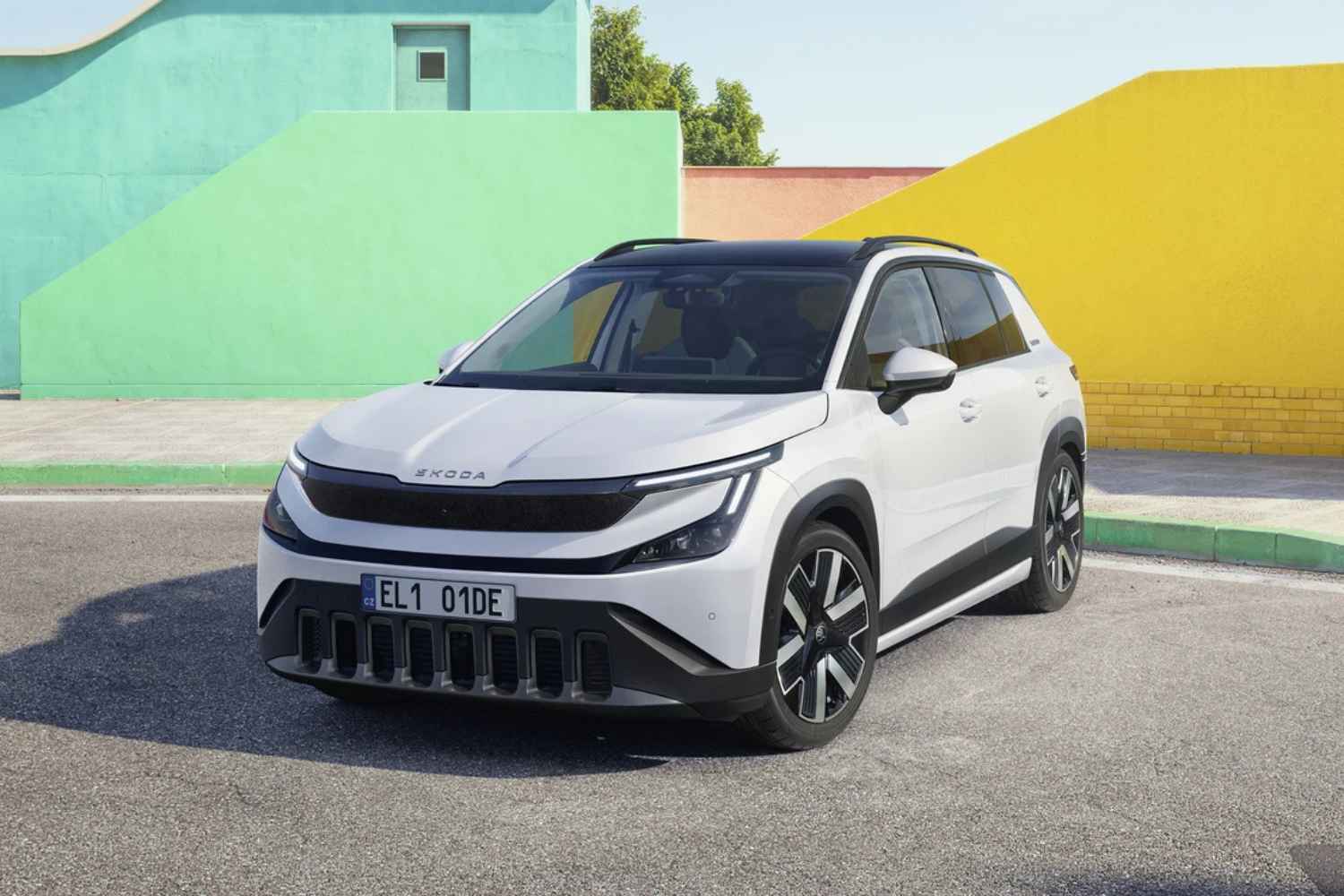
The electric car market is preparing to welcome a new model designed above all for those looking for a practical car, not too large and usable every day without necessarily spending a lot of money.
It’s called Škoda Epiq and it’s an electric crossover just 4.17 meters long, therefore also suitable for urban travel, but with an internal space which on paper seems to be one of its main strengths.
The range will start from 26,400 euros, a figure that could make it interesting even for those who have until now considered electric cars too expensive.
View this post on Instagram
Small on the outside, but with a larger car boot
One of the most interesting aspects of the new Epiq concerns space management. Although it is 417 centimeters long, seven less than the Škoda Kamiq with a petrol engine, it offers a 475 liter boot. By folding down the rear seats, the capacity rises to 1,345 litres.
Numbers that can make the difference especially for a family, for those who often travel with a lot of luggage or simply for those who want to use a single car both in the city and at the weekend.
The passenger compartment was also designed trying to make good use of the available space. The rear floor is practically flat and up to three people can fit on the sofa, while in front the space does not seem to represent a problem even for taller passengers.
Three versions, with prices starting from 26,400 euros
The range should include different engines, designed for different needs and budgets.
The entry version will be the Epiq 35, with 115 HP and a starting price of 26,400 euros. Just above will be the Epiq 40, with 135 HP, priced at 27,700 euros.
Both will use a smaller battery, around 37 kWh. The official ranges have not yet been communicated, but they should approximately be in the 300-350 km range, a value that could be sufficient especially for those who use the car mainly in the city and for daily journeys.
The Epiq 55 will be more powerful and also suitable for longer distances, with 211 HP, a usable 52 kWh battery and a declared autonomy of up to 441 km in the WLTP cycle.
It is worth remembering that this is data obtained through the approval cycle: in real use the autonomy can also change significantly depending on temperature, speed, driving style, use of the air conditioning and type of route.
During an initial test on mountain roads and motorways, a real range of around 350 km was estimated, but more in-depth tests will be needed to understand the actual efficiency of the car in different conditions of use.
How long does it take to recharge it?
For many motorists interested in switching to electric, range and charging times remain the two most important aspects.
The Epiq 55’s battery can accept up to 105 kW DC. According to Škoda, by connecting to a rapid charging station it is possible to go from 10 to 80% in about 25 minutes.
With a wallbox or an 11 kW alternating current column, however, a complete charge takes around five and a half hours.
These are not record values, but they can be more than sufficient for daily use, especially for those who have the possibility of charging the car overnight at home or while at work.
What it looks like inside
The interior follows a rather modern layout but without completely giving up physical buttons. In the center of the dashboard we find a 13-inch screen from which navigation, infotainment and various car functions are managed. For the climate control, however, some traditional controls remain under the display: a solution that can be more practical while driving than an entirely touch system.
The 5.3-inch digital instrument panel is smaller, providing the main driving information without relying on particularly elaborate effects.
The materials used in the upper part of the dashboard and the doors are soft to the touch and the general impression, at least from the first examples tested, is that of a carefully constructed cabin.
One-pedal driving also arrives in the city
Among the novelties of the Epiq there is the possibility of using the so-called “one pedal” driving. By selecting mode B, regenerative braking becomes more intense: when you lift your foot from the accelerator the car quickly slows down to a stop, recovering some of the energy at the same time.
In urban use it means being able to drive using the brake pedal much less, a feature already present on numerous electric cars but not yet available on other Škoda electric models.
The Epiq 55 also promises rather lively performance: 0-100 km/h is declared in 7.1 seconds. More relevant in daily use, however, could be the immediate response of the electric motor when starting and restarting.
How much does the Škoda Epiq cost?
The real element on which Škoda seems to want to play an important part of the game is the price.
The Epiq 35 will start from 26,400 euros, while the Epiq 40 will cost from 27,700 euros. Going up with battery, power and equipment you will reach over 30,000 euros, while the most complete setups can approach 40,000 euros.
The richer First Edition version, for example, is listed at 38,600 euros and adds mainly aesthetic and equipment elements, such as 20-inch wheels, a sports steering wheel and contrasting bodywork details.
Some more advanced driver assistance systems and LED matrix headlights, however, require additional packages.
A new electric car to keep an eye on
The test in daily use will establish how convenient the new Škoda Epiq is, especially in terms of consumption, motorway range and charging speed.
On paper, however, the combination of compact dimensions, 475 liters of boot and entry price of 26,400 euros is interesting.
And this could be precisely the point of the Epiq: not to try to amaze with extreme performance or gigantic batteries, but to propose a relatively simple, spacious electric that can be used as a normal family car.
The cheaper versions are expected during autumn 2026, with the start of marketing of the range on the Italian market.
