
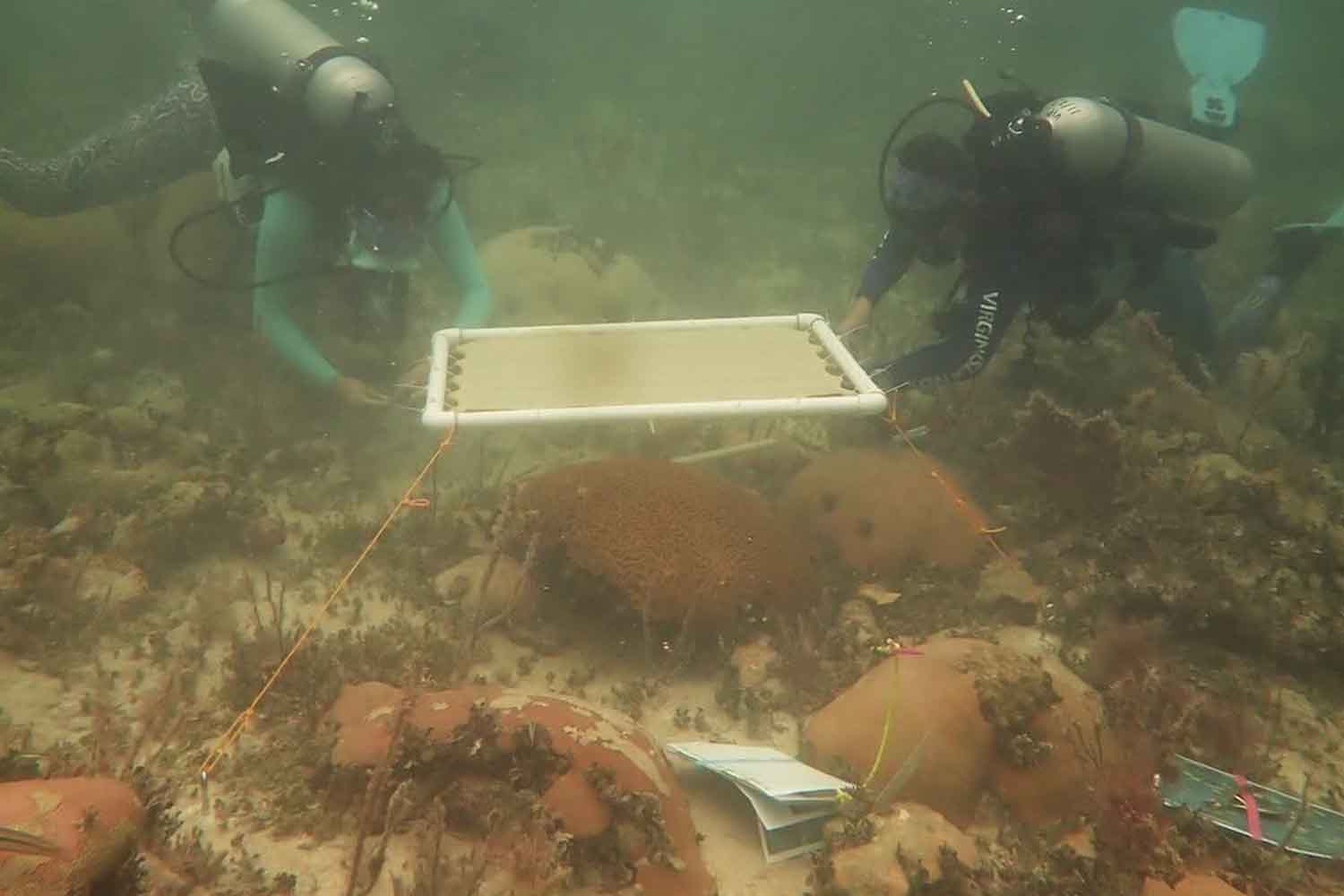
Twenty small umbrellas appeared about 30 centimeters above as many corals in the Florida Keys. They couldn’t cool the water, but they could remove some of the light which, combined with high temperatures, contributes to worsening bleaching. During the summer of 2024, the protected colonies lost less color and, at times, even began to regain it.
The result comes from a study published in Frontiers in Marine Science by Karen L. Neely, of the National Coral Reef Institute of Nova Southeastern University, together with researchers from the same university and the University of Miami. It is a small experiment, conducted on just two species of Caribbean coral, and the authors themselves set a limit that is rather difficult to ignore: covering a few colonies is possible, but putting a shade over an entire coral reef is decidedly less so.
The idea was born from the previous summer. In 2023, the Florida Keys were hit by exceptional sea temperatures: in many sites bleaching had affected practically all the corals and some branched species had suffered devastating mortality. In Newfound Harbor, the site chosen for the new experiment, 55% of the corals monitored had lost at least some tissue.
Twenty canopies suspended above the corals
The researchers selected 40 colonies belonging to two species of so-called brain coral, Pseudodiploria clivosa And Colpophyllia natans. For each species, ten colonies were covered and ten left exposed as a control group. The structures were rather artisanal: PVC frames filled with foam to keep them floating and covered with a UV-resistant high-density polyethylene agricultural sheet.
Each cover hovered about 30 centimeters above the coral and, according to the material’s specifications, blocked 60 percent of incoming light. The heat, therefore, remained where it was. The shade intervened on the other piece of the problem: excess solar and ultraviolet radiation can aggravate the damage caused by high temperatures and accelerate bleaching.
The experiment should have started earlier, when the cumulative heat stress had reached a threshold of 4 degree heating weeksa measurement used to estimate the intensity and duration of heat to which corals are subjected. However, the permits delayed the installation until August 16 and 17, when the value had already exceeded 7. By then the colonies had already begun to turn pale. An inelegant delay for an experiment, but also quite useful: it allowed us to check whether the shade could be useful when the bleaching had already started.
Under the shade the corals have recovered their colour
2024 was the second year with the greatest cumulative heat stress recorded in Newfound Harbor since 1985, behind only the disastrous 2023. NOAA satellite data used in the study indicates 61 days above the theoretical bleaching threshold of 30.5°C; sensors installed directly on the seabed recorded even more. Yet, the differences between covered and uncovered colonies became visible precisely in the hottest moments.
In the Pseudodiploria clivosa corals under the structures were significantly darker than controls during peak heat stress. After the covers were installed, their color index began to rise, while that of the colonies left exposed continued to decrease slightly. A similar dynamic appeared in Colpophyllia natans: Shaded colonies recovered color quickly, while control colonies continued to pale until temperatures began to drop.
No mortality due to bleaching was observed in either group during the experiment. A coral suffered serious damage after being detached and dragged about 30 meters by a tropical storm, which for once can be absolved of global warming and simply accused of doing its job.
The color improved, the biopsies were more cautious
Here comes an important caution. Corals owe much of their color and nutrition to the microalgae that live in their tissues. When stress breaks this symbiosis, the algae decrease or lose pigments and the coral appears increasingly pale, up to the typical white of bleaching.
Every two weeks the researchers also carried out small biopsies to measure the ratio of symbiotic algae cells to coral cells. On this front, the effect of shade was much less clear-cut: the study did not find a consistent increase in symbiont density attributable to roofing.
A possible explanation lies in the method itself. For reasons related to permits, samples could only be taken from the edges of the colonies, areas already partially in shade and less discolored than the upper surfaces. Visible recovery could also depend at least in part on the amount of chlorophyll present in the algae, and not simply on their number.
Then there is another peculiarity. Almost all the corals studied hosted mainly algae of this kind Durusdiniumknown for greater heat tolerance. The authors hypothesize that the colonies that survived the terrible 2023 may have maintained or acquired a particularly resistant community of symbionts. However, they do not know the composition of the colonies themselves before that event, so it remains a hypothesis. This also helps explain why, despite such high temperatures, bleaching remained mild to moderate overall in 2024.
$30 protection, as long as you choose who to protect
On a material level the system is economical. The authors estimate about $30 worth of components for each structure and report that the covers held up well during the experiment. They were only temporarily removed due to the passage of storms Helene and Milton.
The bill changes, however, when boats, divers, installation, maintenance and recovery come in. The project financed by the Florida Department of Environmental Protection also considers the technique above all as a targeted tool, suitable for particularly important or vulnerable colonies.
The structures may also interfere with fishing and navigation, pose a small risk of entanglement for marine animals, and may locally change water movement or sedimentation. These are not very spectacular details, but they become very concrete as soon as we move from experiments to the management of a barrier.
Most importantly, a drape does not solve the cause of the whitening. Neely and colleagues describe it as temporary protection during extreme heat events, while rising ocean temperatures continue to decide how many colonies will need to be protected. For some, therefore, an underwater umbrella could really buy time. The problem is that a coral reef contains a lot of coral and the sea, in the meantime, continues to warm.
