
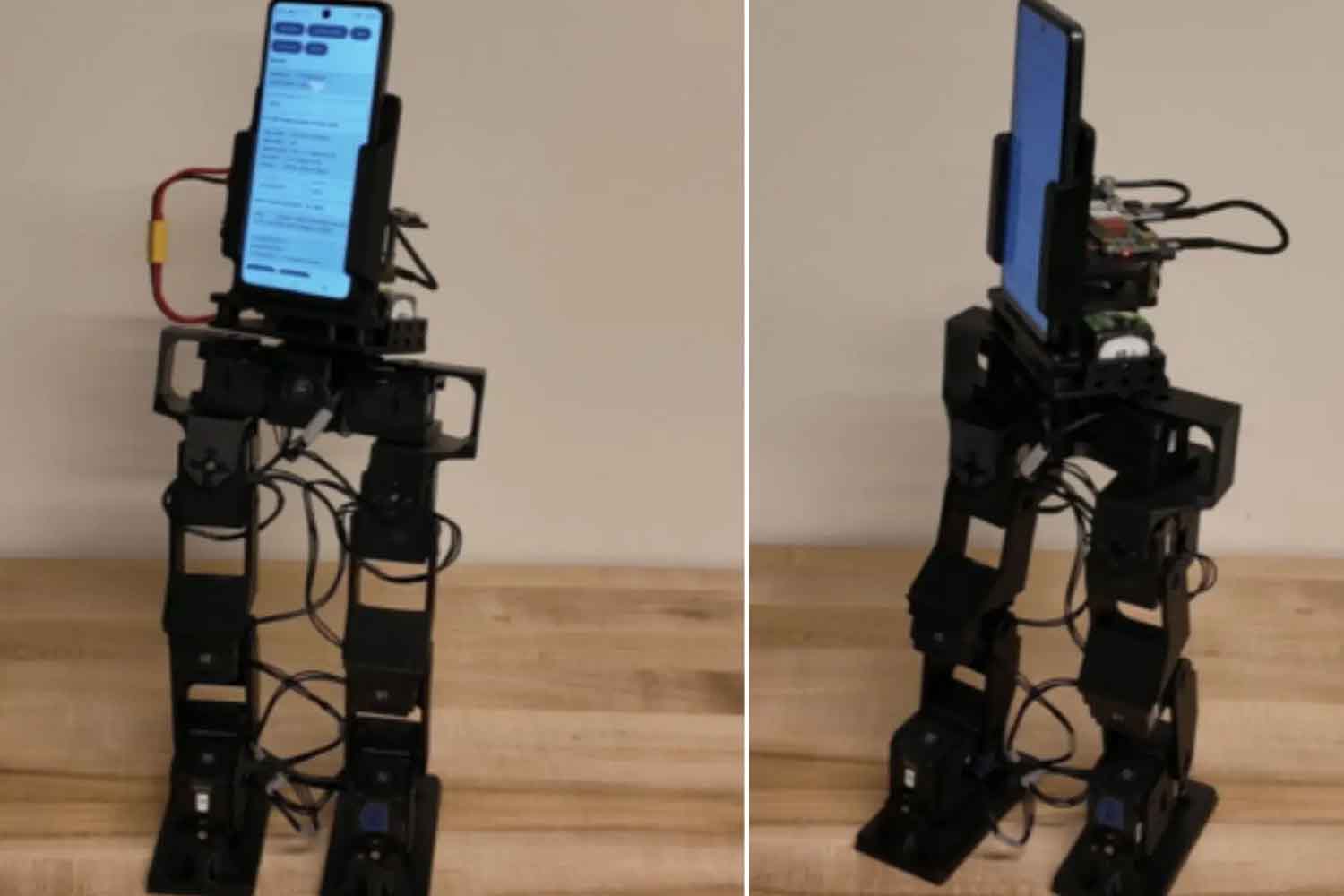
That smartphone that has been sleeping in a drawer for years could have a better track record than expected. Researchers at UCLA’s Robotics and Mechanisms Laboratory built PhoneBota small humanoid robot that uses a regular Android phone as its camera, motion sensor, interface, and main computing unit. The prototype walks, follows a person with its gaze and even manages to get up after falling face down.
The idea described in the preprint published on arXivwritten by Ruochen Hou, Quanyou Wang, Daniel Koh and Dennis W. Hong, starts from a very concrete observation: inside a smartphone there are already several components that a small robot would have to purchase and integrate separately. Camera, gyroscope, accelerometer, processor, wireless connection, screen. PhoneBot then tries to reuse that entire package instead of rebuilding it piece by piece. The work was uploaded to arXiv on October 6, 2026 and is, at present, a preprinttherefore not a peer-reviewed publication.
The phone really acts as the brain, even if it doesn’t work completely on its own
PhoneBot measures 48.3 centimeters tall and weighs 1.8 kilogramssmartphone and battery included. It has 13 motorized joints: six for each leg and a thirteenth that allows the torso to rotate. Precisely this last movement allows the phone camera to follow a person without forcing the entire robot to turn around every time.
The phone is fixed on the torso. Its inertial measurement unit, i.e. the set of sensors that detects orientation and movement, helps the robot understand how it is inclined; the camera is used to recognize people and the environment; the processor runs the neural network that controls locomotion. The touchscreen displays system status, images and commands. In short, it is not a smartphone used as a decorative face: it works a lot.
However, there is an important clarification. The phone does not directly control the servomotors through a cable: it communicates via Wi-Fi with a small computer installed on the robot, responsible for relaying commands to the joints. And for voice conversation the prototype still depends on an external laptop, on which the speech recognition and language model run. Movement, vision and various perception functions are processed on the smartphone. Calling him “brain” works, as long as you leave some colleagues around him.
First he learned to walk in a virtual world
Directly sending a cheap robot stumbling around the lab wouldn’t have been the most elegant method. The researchers then trained the movement policies in simulation through reinforcement learningmaking the system learn how to walk while also taking into account the real limits of the small motors used.
The team also worked on the symmetry of the walk. Without a particular “mirroring” system, the algorithm tended in some cases to put more weight on one leg. By duplicating the movements in mirror form during training, the walk became much more balanced and the learning more consistent. In tests on the physical robot, bipedal locomotion, the ability to follow a person with the camera and the ability to get up from the ground were then shown.
For now there’s a pretty comfortable floor under those feet. Locomotion policies have been trained on flat groundPhoneBot has no arms and the cheap servo motors limit both the load it can carry and its more dynamic movements. Among the developments indicated by the authors there are irregular terrains, light arms and greater autonomy also for linguistic functions.
It also works with a 2017 smartphone
The most interesting detail for those who keep forgotten phones comes from the hardware tests. The PhoneBot app was tested on four Android devicesincluding an Honor 9 released in 2017. Alongside the old top of the range, three cheap phones were used: a Moto G 2025, a Samsung Galaxy A16 5G and a Moto G 2024, purchased in the United States for amounts approximately between 50 and 90 dollars.
All four managed to manage sensors, communication with motors, neural network for movement, image processing and human-robot interaction. On the old Honor 9, only the SLAM function based on ARCore was missing, the system that allows the robot to locate itself and build a map of the environment, because the necessary Google services were not available on the tested device. Eight or nine years, for a smartphone, is almost a geological era. For PhoneBot they may still be enough.
A humanoid worth about $400
The choice of the telephone serves above all to lower one of the heaviest obstacles in educational and experimental robotics: the price. According to the comparison reported by the researchers themselves, PhoneBot’s hardware costs approx $400, smartphone not included. In the study table, other small humanoid research platforms considered by the authors range from around $3,500 up to $13,800 for the ROBOTIS OP3.
They are different systems in structure and capacity, so the comparison is not the same as saying that PhoneBot can replace them; However, it makes clear how much impact the reuse of components that millions of people already own can have. Hardware and software are also thought of as open sourcewith the stated goal of offering a playable platform to universities, schools and laboratories that could hardly afford much more expensive humanoids.
PhoneBot, therefore, will not automatically transform the world’s mountain of e-waste into a team of little robots. The study does not measure the project’s environmental impact or quantify how many phones could actually be recovered this way. However, it demonstrates something much more concrete: a device considered technologically old can still have enough cameras, sensors and computing power to make a humanoid walk. Before relegating it to the drawer of cables that “sooner or later might be needed”, at least this time that old smartphone has an alibi.
