
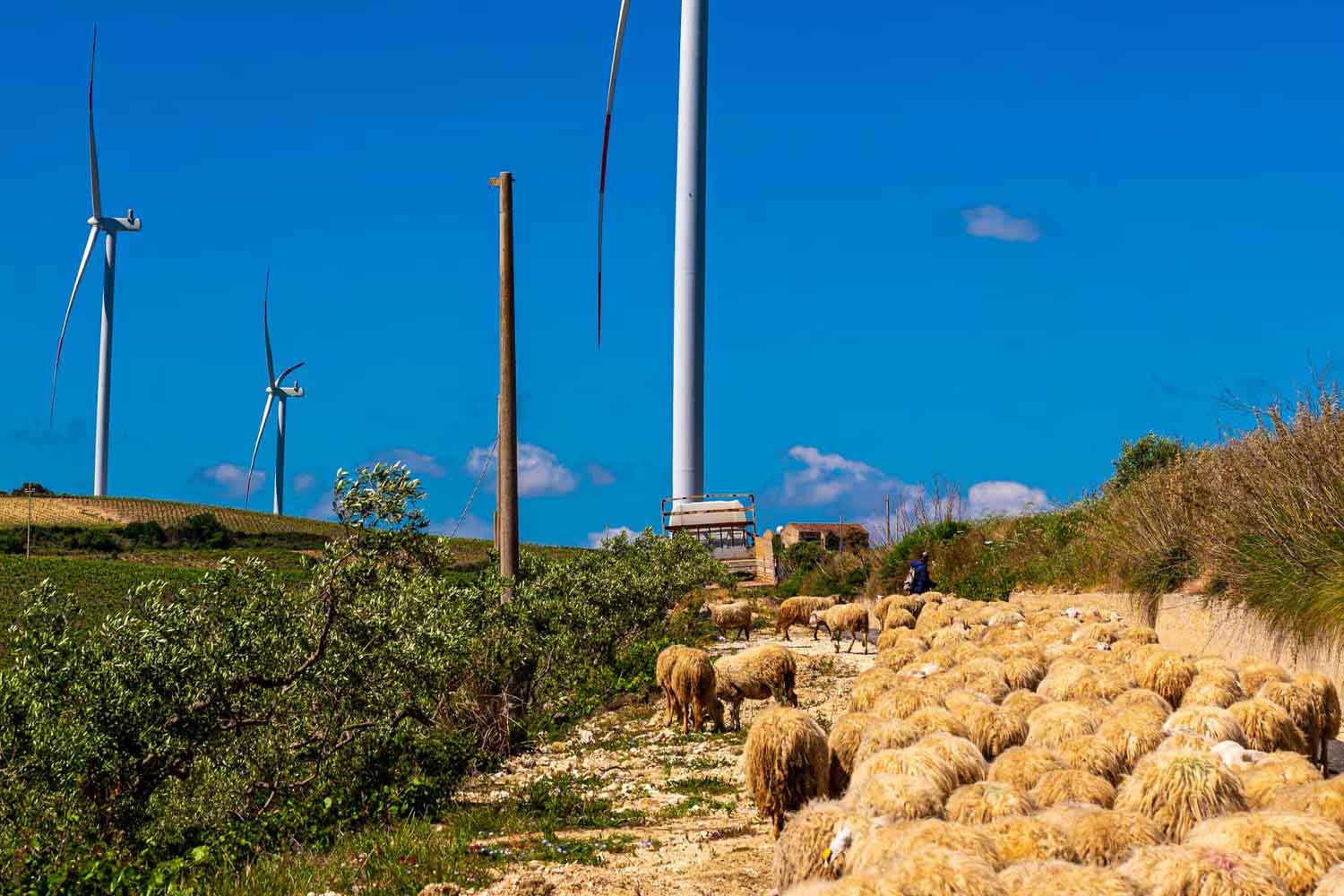
A wind farm is often seen from afar, like a presence on the ridge, a row of blades that changes the profile of the hills and marks the landscape. The new edition of the Parchi del Vento guide instead tries to bring the gaze closer: around the facilities there are paths, dirt roads, lakes, villages, rural areas, typical products and pieces of history that can become part of a slow journey, more attentive to the territories and their transformation.
The fifth edition of the guide, promoted by Legambiente in view of World Wind Day, maps 34 Italian wind farms, from north to south, describing them from both an energy and tourism point of view. The idea is simple: to show how renewable energy can coexist with internal areas and, when the systems are designed and managed well, also contribute to local valorisation.
The wind visits you
The guide does not simply indicate where the facilities are located. For each wind farm it collects practical information to reach it, suggestions on routes and paths, indications on what to see in the surrounding area, where to sleep and where to taste the local cuisine. These itineraries include trekking, cycling, horseback riding, climbing, rafting and birdwatching, together with villages, archaeological sites, agricultural landscapes and local traditions.
The result is a different way of interpreting wind power: not only as an energy infrastructure, but also as an access point to areas often less visited by traditional tourism. From the Sardinian plateau of Sa Turrina Manna to the ridges of Baselice, in the Benevento area, from the ancient route of the Appia in Puglia to the Verga places in Sicily, the journey proposed by the guide brings together clean energy and slow tourism, with particular attention to the communities that inhabit those landscapes.
In 2026 there will be seven new entries: four in Sicily, one in Sardinia, one in Campania and one in Puglia. In western Sicily, in the municipalities of Partinico-Monreale, Camporeale, Salemi and Castelvetrano, the parks also talk about the theme of repowering, that is, the replacement of old turbines with more modern and efficient machines. In these cases the number of blades can decrease, while energy production increases. From the ridges there are views of the Poma and Trinità lakes, while the itinerary connects the Cathedral of Monreale, the village of Salemi, the temples of Selinunte, the mosaics of Borgo Parrini, the olive groves of the DOP Val di Mazara and the local DOC wines.
In Sardinia, in the municipalities of Tula and Erula, the 80 MW Sa Turrina Manna wind farm is described as an example of integration between energy transition and slow tourism. The plant maintenance roads become paths for walking and cycling itineraries, with views of Gallura and Monte Acuto, between Lake Coghinas, the woods of the plateau and the traditions of the village of Tula.
Repowering and territories
One of the most interesting threads of the guide is repowering. In concrete terms, it means intervening on existing systems, replacing older turbines with new generation wind turbines. This allows us to increase the installed power, reduce the number of machines and make better use of areas already designated for energy production.
It is an important step because it allows wind power to grow while limiting the consumption of new land and improving the efficiency of already active sites. For local communities it can also become an opportunity to rethink the relationship between systems, landscape and economic activities, starting from tourism, maintenance, hospitality and local supply chains.
According to Legambiente, wind power remains a central technology for the Italian energy transition, especially in the areas of Southern Italy, where the climatic conditions are particularly favourable. Giorgio Zampetti, general director of the association, underlines the need to accelerate the construction of new plants, both on land and at sea, simplifying the authorization processes and involving local communities.
This guide – declares Katiuscia Eroe, energy manager of Legambiente – is an invitation to set out to discover wind energy done well: integrated into rural areas and natural contexts. A tangible example of how sustainability and development can proceed in parallel, also thanks to innovations such as repowering, which allows us to reduce the number of blades, increasing their power and reducing impacts on passage. The traveler will thus be able to enjoy slow and conscious tourism, which explores the potential of clean energy and the flavours, art and nature that embraces the facilities. All that remains is to choose
Still slow growth
The numbers of Italian wind energy show growth, even if the pace is still far from that needed to achieve climate objectives. In 2025, 608 new MW of wind power were installed, for a total of 13,598 MW. Annual production amounted to 21,360 GWh, enough to cover the needs of approximately 7.9 million families.
Compared to 2004, when the installed power was 1,131 MW, the change is evident. In 2025, wind energy contributed 16.7% to Italian renewable production and 6.9% to overall consumption, however recording a slight decline in annual production compared to 2024.
There are 6,169 wind farms in Italy, distributed across all regions. Puglia remains first in terms of number of plants, 1,427, and installed power, 3,674 MW, with 439 MW added in 2025 alone and 21 new wind farms. Followed by Sicily, Campania and Basilicata, three regions that continue to represent a significant part of national wind production.
The Parchi del Vento guide talks about this double dimension: on the one hand a renewable technology that must grow more decisively, on the other territories that can be crossed at a slow pace, without treating energy as something separate from everyday life. The blades remain there, visible. Around, however, there are roads, villages, woods, lakes, vineyards and set tables. The wind, sometimes, also takes you somewhere.
Download the new Wind Parks Guide 2026 here
You might also be interested in:
