
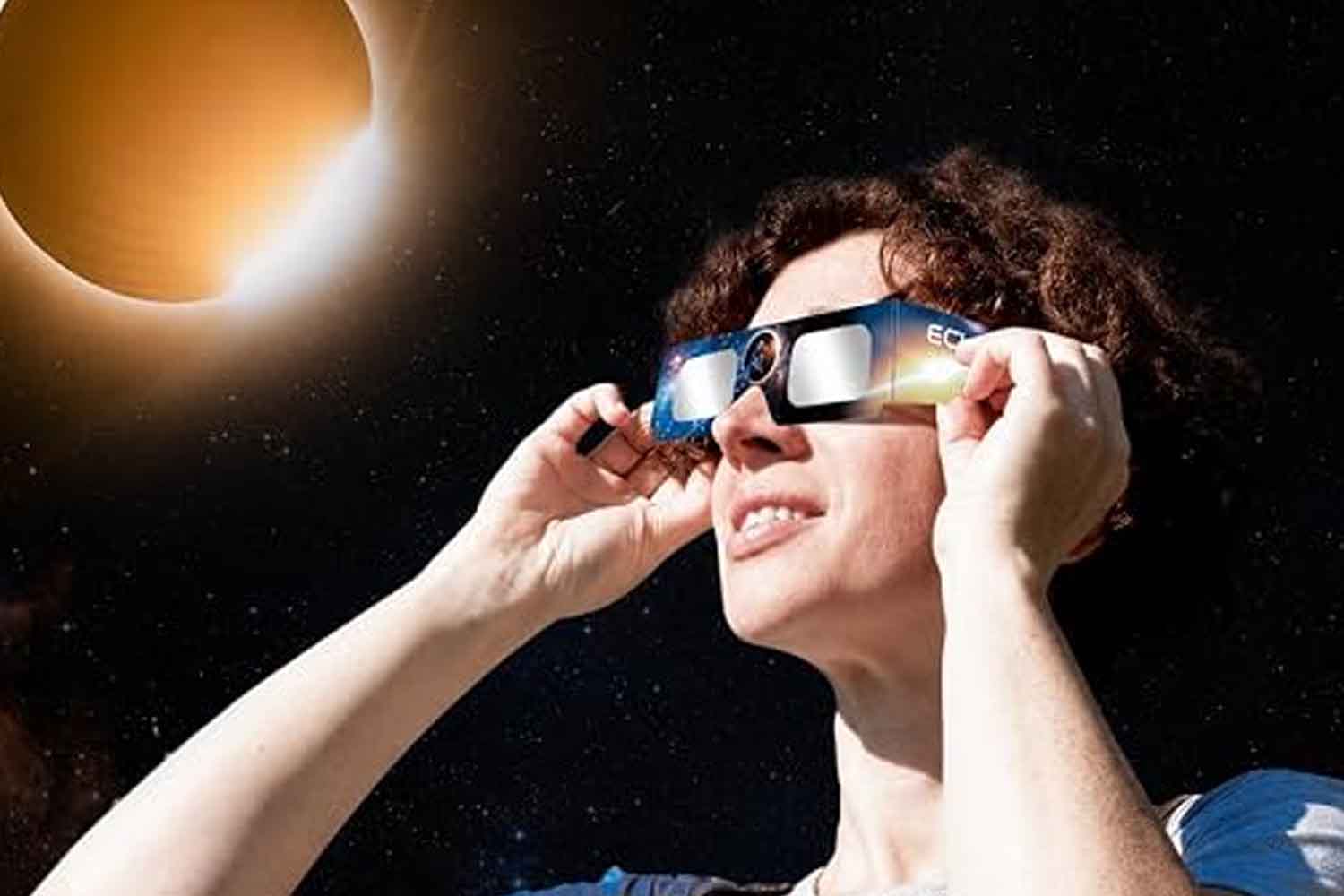
At 7.30pm on August 12th the Sun will already be low and will begin to lose an edge. In the north and west of Italy the Moon will be able to cover over 90% of it, while the maximum partial eclipse will arrive around 8.20pm, with some differences between one location and another. A clear western horizon will also be needed: a building, a hill or a mountain can bring the curtain down sooner than expected. Maps published by the National Institute of Astrophysics show where the eclipsed Sun will actually remain visible.
The eclipse will remain from Italy partial for its entire duration. The Sun will never be completely covered and your eyes must remain protected during every glance, including sunset. Ordinary sunglasses, even very dark ones, allow too much radiation to pass through for direct observation. Special ones are needed solar eclipse glasses.
ISO 12312-2 is the first check
You need to look for the acronym on the frame or packaging ISO 12312-2:2015the international standard for filters intended for direct observation of the Sun without magnification. The 2015 date may seem like an artifact, especially next to a package plastered with references to the 2026 eclipse, but that version is still in effect. A revision is in the approval path and has not yet replaced it.
The writing alone is not enough. An unscrupulous manufacturer can print on the packaging a standard that has never been verified by an accredited laboratory. The American Astronomical Society therefore recommends also checking the name of the manufacturer and the origin of the goods, favoring the manufacturer or one of its authorized resellers. Buying the first sponsored result because the thumbnail shows a nice orange Sun remains a quick method. To choose a filter, a little less.
Examples available online
Among the products available on Amazon Italy there are glasses packs HORRIBLEoffered at around 10 euros. The brand appears in the list of solar viewer manufacturers verified by the American Astronomical Society: it is still useful to check, once you have received the package, that the packaging, model and manufacturer’s information correspond to what is shown on the sheet.
ORRO Solar Eclipse Glasses 45 mm, Pack of 2/6/12, Black, Fits Over Prescription Glasses, Certified Eye Protection, EN ISO 12312-2:2015 Tested CE Marking – Edge Fit
Another possibility is the kit with ten glasses and three smartphone filters, attributed in the listing to Solar Optics. Solar Optics Group also appears on the AAS list of solar glasses and viewers manufacturers. However, accessories intended for the camera require specific verification: ISO 12312-2 concerns devices for directly observing the Sun without magnification and does not automatically certify the photographic filters present in the same package.
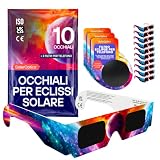
Solar Eclipse Glasses 10 Pack with 3 Filters for Smartphone – ISO 12312-2 and CE Certified, Complete Kit for Observing and Photographing the Eclipse, AAS 2026
Added to these is the Keyaluo pack of six or twelve glasses. The Amazon card declares compliance with the EN ISO 12312-2:2015 and the CE marking as category II personal protective equipment. Also in this case, at the time of delivery it is advisable to check that the name of the manufacturer, the reference standard, the instructions and warnings for use are legible on the product.
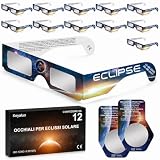
Solar Eclipse Glasses, 2026 Approved, 12 Pack Solar Eclipse Glasses for Direct Sun Viewing, ISO 12312-2:2015 (E) and CE Certified
These examples show some of the solutions available on the Italian market, with packages suitable for both a single family and small groups. Prices, sellers and availability can change rapidly in the days leading up to the eclipse; for this reason the final check must also be done on the product received, without stopping at the photographs on the sales page.
What to check when the package arrives
The filter must be intact, well fixed to the frame and free of scratches, holes, creases, tears or areas that allow light to filter through. At least the manufacturer, the reference to the standard, the instructions for use and the warnings should appear on the packaging. If the material is separating from the cardboard or plastic, the glasses should be returned or discarded. The certification does not yet have self-healing capabilities.
A preliminary check can be done at home. By wearing glasses in a room, furniture, walls and people should almost completely disappear; only very intense, strongly attenuated sources could remain visible. If you can easily make out the decor, the filter is too light.
This test serves to identify a clearly unsuitable product. It does not allow measuring the ability to block ultraviolet and infrared radiation, invisible to the eye. For that verification you need a laboratory and a reconstructable supply chain, two things that the smartphone flashlight, no matter how hard it tries, cannot replace.
Glasses from 1999 can stay in the drawer
In many Italian homes one still survives pair of glasses from the eclipse of August 11, 1999. The American Astronomical Society considers modern viewers less than ten years old, with verifiable provenance, documented compliance with ISO 12312-2 and filters that have remained perfectly intact, to be reusable.
The 1999 glasses are now twenty-seven years old and precede the standard published in 2015. It is often no longer possible to know who manufactured them, how they were preserved and what characteristics the filter had. They can therefore continue to do their job as souvenirs very well. To look at the Sun it is better to buy a recent pair.
Smartphones, binoculars and telescopes require other filters
The glasses must be put on before looking towards the Sun. Once you have finished looking, you turn around and only then take them off. With children you need to check that the frame fits well and that the filter does not slip, leaving their eyes uncovered.
Eclipse glasses should not be used when looking through binoculars, telescopes, spotting scopes or cameras. The lenses concentrate the radiation and can damage both the filter and your eyesight in a few moments. Optical instruments require specific securely mounted guards in front of the lens. Old filters that screw onto the eyepiece are dangerous and should be discarded.
Your phone also deserves an accessory designed for solar photography and properly attached in front of the cameras. Holding a pair of glasses in front of the lens with two fingers, hoping that it doesn’t move during the shot, produces above all a good opportunity to regret it.
Those who cannot find reliable filters can observe the eclipse in projection, keeping the Sun behind them. A small hole made in a piece of cardboard, a colander or the spaces between the leaves of a tree will project many images of the sickle-shaped solar disk onto a surface. You look at the projection on the ground, never at the Sun through the hole.
On August 12 the Sun will be low, perhaps orange, and in some regions it will appear reduced to a thin blade. It will continue to be the Sun. The glasses will remain on the nose until it has truly disappeared behind the horizon.
