
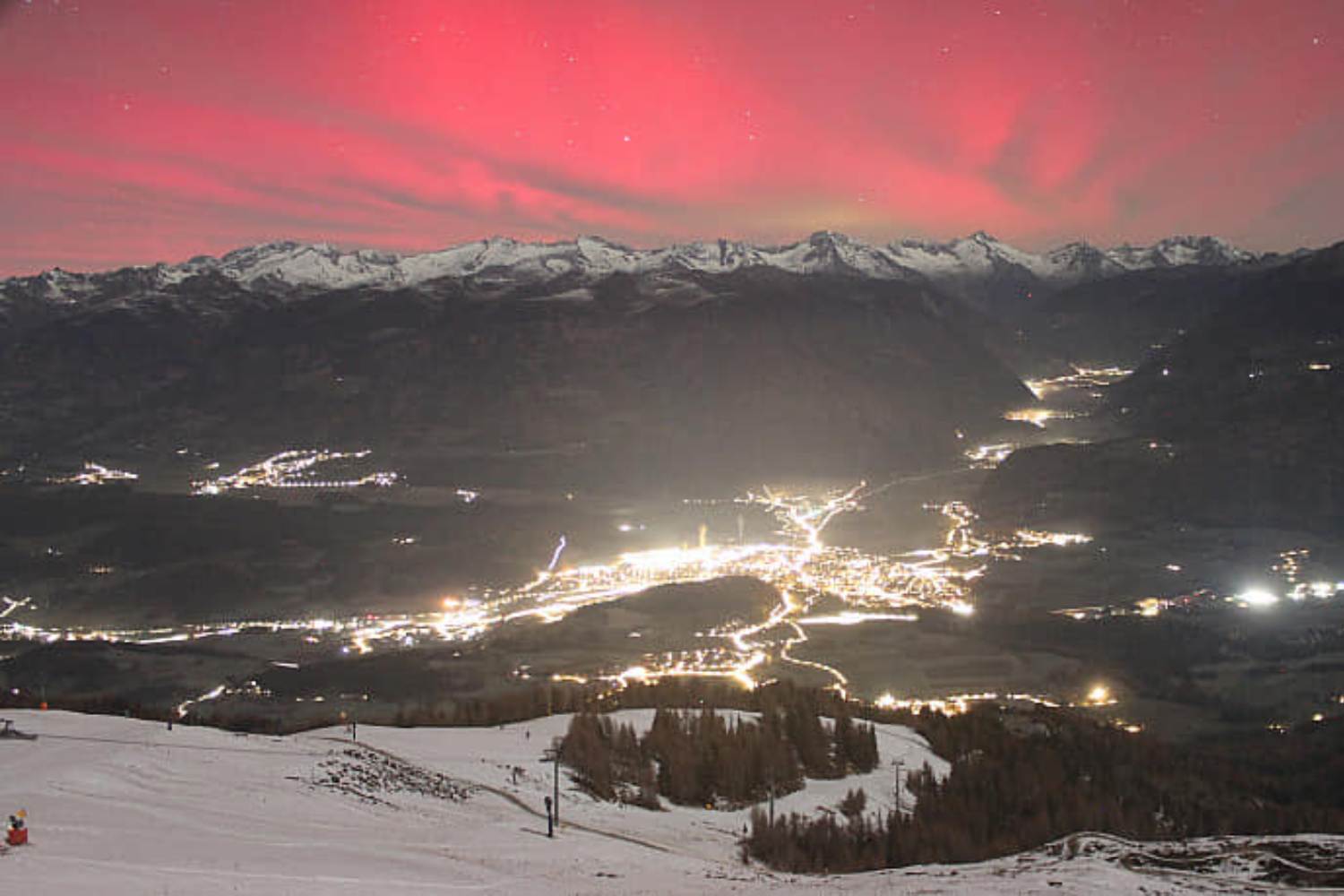
Between 4 and 5 June 2026 the Earth could be hit by the effects of one geomagnetic storm G3classified as “Strong” on the scale used by NOAA, the US agency that monitors space weather. The alert was issued after three coronal mass ejections, the so-called CMEs, expected in interaction with the Earth’s magnetic field in these hours. In practice, the Sun has expelled plasma and magnetic field into space, and some of that material travels in our direction. When it arrives, it can agitate the magnetosphere, disrupt some technological systems and push the aurora further south than usual. Even towards Italy, at least in the right conditions.
The G3 classification is for storm geomagneticthat is, the effect produced near the Earth by the activity of the Sun. The value to look at is the Kp, an index that measures how much the Earth’s magnetic field is disturbed: Kp 5 corresponds to G1, Kp 6 to G2, Kp 7 to G3Kp 8 to G4, Kp 9 to G5. For the period June 4-6, the NOAA forecast indicates an expected maximum of Kp 7therefore precisely G3 level.
The hours to keep an eye on
The forecast published on June 4 at 00:30 UTC reports G2-G3 geomagnetic storms likely between June 4 and 5 due to the combination of CMEs departing from the Sun between June 3 and 4. Converting times in Italy, the most interesting windows fall between 8pm and 11pm on Thursday 4 Junewhen Kp 6.67 is expected, close to the G3 level, and then between 2 and 5 am on Friday 5 Junewith Kp 7 full. They are forecasts in three-hour blocks, so the sky can decide not to respect the agenda with the precision of a Swiss train.
For Italy this means one thing above all: those who live in the North have an advantage. The best areas are those far from urban lights, with a clear northern horizon: Alps, Pre-Alps, open hilly areas, dark countryside of the Po Valley. Under sustained activity, the aurora may appear as a low-horizon glow, more red or purplish than green, often much more obvious in photographs than to the naked eye. In the Center the possibilities decrease considerably; Rome requires a very favorable combination of intensity, clear sky, darkness and orientation of the magnetic field. In the South and on the islands the chances remain lower, barring an intensification beyond the current forecast.
Anyone who wants to try must look north, away from street lamps, signs, busy streets and balconies lit like television sets. The smartphone can help more than the eye: night mode, stable support, long exposure, no shaking hands. Sometimes the aurora at these latitudes appears earlier in the photo gallery than in the pupil.
What can happen
A G3 geomagnetic storm can create disturbances on power grids, satellites, GPS navigation and high-frequency radio communications. These are the areas indicated by NOAA among the main targets of geomagnetic storms, together with space operations and auroral observation. Space weather works like this: very far from everyday life until a system that depends on signals, orbits, radio or electricity has to deal with a more nervous than usual terrestrial magnetic field.
The same forecast indicates, for June 4-6, a probability of 60% of radio blackouts R1-R2 and del 15% of R3 or higher events. Radio blackouts up to the R2 level had already been observed in the last 24 hours, with the largest event recorded on June 3 at 11:27 UTC. For solar radiation storms S1 or higher, however, the indicated probability remains at 10% for each of the three days.
The most unstable point remains the actual arrival of the CMEs. A coronal mass ejection can carry billions of tons of solar material and an embedded magnetic field; its speed can vary greatly, from less than 250 kilometers per second up to values close to 3,000 kilometers per second. When multiple CMEs move towards Earth in close time, they can add, interact, arrive earlier or later than the estimated window.
Aurora in Italy?
The aurora arises when charged particles linked to solar activity interact with Earth’s upper atmosphere along magnetic field lines. Usually the phenomenon remains close to high latitudes. During stronger geomagnetic storms, the auroral oval expands and the line of visibility may descend into unusual areas. NOAA’s auroral dashboard clearly links the increase in Kp to a more active aurora: Kp 7 is associated with strong auroral activity, while Kp 9 indicates a much more extreme situation.
Italy is located on a complicated latitude for the aurora. Far enough south that the sight is rare, far enough north that it can come into play during strong events, especially in the northern regions. The difference will be made by the actual intensity of the storm, the orientation of the interplanetary magnetic field, cloud cover and light pollution. A lit city also erases an interesting sky. A dark valley, on the other hand, can provide at least a streak of color.
It is best to check updates in the evening hours, because space weather forecasts change when solar material reaches monitoring satellites between the Sun and Earth. At that point the data on the solar wind and magnetic field become more concrete and it is better understood whether the aurora can really descend towards lower latitudes. Until then it remains a prediction with a wide margin, like almost everything that travels from the Sun to us.
For those in Italy, the areas to keep an eye on are above all those of Northin particular Alps, Pre-Alps and dark areas far from cities: Aosta Valley, upper Piedmont, alpine Lombardy, Trentino-Alto Adige, Venetian Dolomites and mountain Friuli. There are also some possibilities in the less illuminated countryside of Piedmont, Lombardy, Veneto and Friuli, as long as the horizon towards the north is clear. From the Center downwards the probability drops significantly: the Tuscan-Emilian Apennines, inland Marche, Umbria, Abruzzo and Apennine Lazio can only hope for an intensification beyond forecasts. In large cities, however, light pollution risks eating everything before it even reaches the eyes.
