
The Falcon 9 departed California on July 7, 2026 with 81 cargo on board. On board the shared mission SpaceX Transporter-17 traveling CubeSats, microsatellites, hosted payloads and vehicles intended to transfer other satellites into their respective orbits. Among these was also BOHR, a small orbital box built by the US company City Labs. Its dimensions resemble those of many other CubeSats already crowded above our heads. The content, however, required a decidedly less ordinary authorization process.
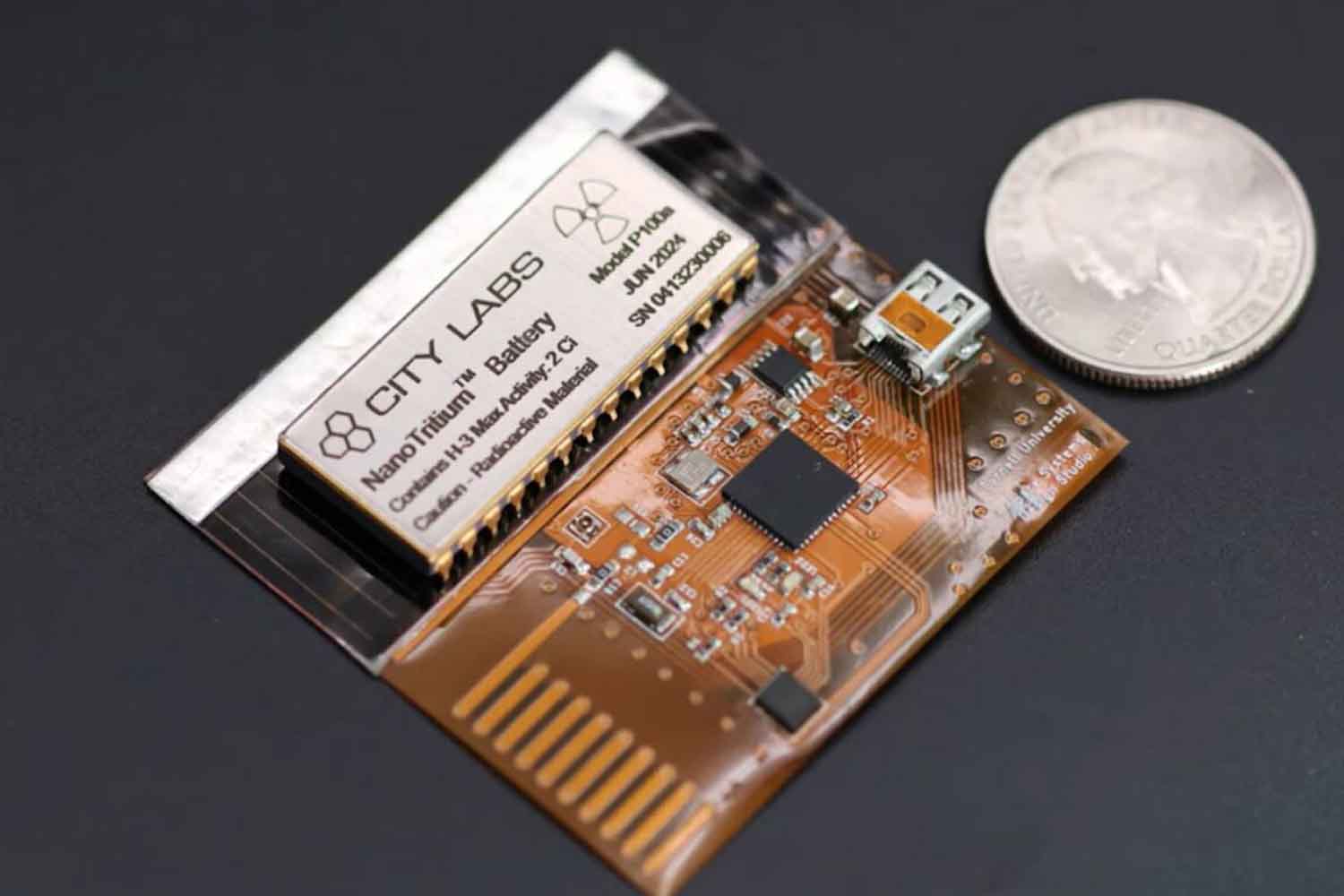
BOHR carries a tritium nuclear batterydesigned to produce a tiny, constant amount of current over very long periods. The full name, Betavoltaic Orbital High-Reliability, already tells a good part of the experiment: testing in orbit the reliability of a betavoltaic technology, capable of transforming radioactive decay directly into electricity.
City Labs presents BOHR as the first commercial satellite equipped with a nuclear source and as the first nuclear CubeSat. The record is therefore a company claim and the formula can make one imagine a vehicle powered entirely by tritium. The situation is more sober: the satellite continues to use solar panels for communications and normal on-board operations. The NanoTritium battery powers the experimental load which will have to prove to function correctly after launch and during its stay in space.
How a tritium battery works
Tritium is a radioactive form of hydrogen. Over time it decays and transforms into helium-3, releasing beta particles, i.e. electrons. A betavoltaic battery collects some of this energy through a semiconductor material and converts it directly into electric current.
The principle vaguely resembles that of a photovoltaic cell. In the solar panel the energy comes from light; in the tritium device it comes from the particles emitted during radioactive decay. The system works without combustion, turbines or moving mechanical parts.
BOHR therefore brings into space a technology that is very different from the generators used on the Voyager probes or on the Martian rovers Curiosity and Perseverance. Those devices, called RTGs, harness the heat produced by the decay of plutonium-238 and transform it into electricity. The City Labs battery instead uses tritium and works directly with its beta emissions.
The power also changes a lot. RTGs can power complex scientific instruments, computers and communications systems. The NanoTritium batteries developed by City Labs generally work between nanowatts and microwatts. The company has not publicly disclosed the exact power of the device installed on BOHR.
A microwatt is equal to one millionth of a watt, while a nanowatt is equal to one billionth of a watt. They are almost imperceptible powers in everyday life, where a light bulb can require several watts and a smartphone absorbs many while charging.
In space they can still be enough to keep a sensor, a memory or an internal clock active. Energy can also be slowly stored in a capacitor or secondary battery, then periodically turning on an instrument or transmitting a short signal.
Little current, for a very long time
The true quality of tritium lies in its durability. Its half-life is approx 12.3 years: after this period, the quantity of radioactive material still active and the power produced are reduced by half. The decline occurs gradually and allows a battery to continue to supply current for over twenty years, albeit with progressively lower power.
This source is of little use where a lot of energy is needed in a few seconds. It becomes invaluable in hard-to-reach places, where replacing a battery is impossible and a small instrument must remain listening for years. A sensor can remain almost always inactive, slowly accumulate energy and turn on only at the established moment or when it registers a particular phenomenon.
BOHR will serve to verify the performance and reliability of the battery after the stresses of launch and during operation in the orbital environment, characterized by vacuum, radiation and strong temperature variations. In orbit, a satellite rapidly passes from the direct light of the Sun to the shadow of the Earth. Materials heat up and cool down many times, while electronic components remain exposed to energetic particles capable of degrading them.
Where solar panels are of little use
The most interesting applications are found in areas where sunlight reaches poorly or disappears completely. Near the south pole of the Moon there are craters whose walls and depths remain in permanent shadow. In some of these areas, temperatures drop to extreme levels and the ground may retain deposits of water ice, an important resource for future missions.
There NASA funded a study also conducted with City Labs to develop small tritium-powered probes. The project, distinct from the BOHR mission, imagines devices about five centimeters wide, deployed on the lunar soil and left to work autonomously.
They could measure the presence of water, collect geological data or record environmental conditions inside dark craters. The expected power remains between one and ten continuous microwatts.
The same solution could be useful on Mars during dust storms that reduce the efficiency of solar panels, on an asteroid or on the icy moons of the Solar System. Tritium is unlikely to move a rover or directly power a large antenna. However, it could keep alive the sensor responsible for recording a lunar earthquake, a change in temperature or the passage of a particle.
The safety of radioactive material
The word “nuclear” recalls reactors, large plants and penetrating radiation. BOHR travels on a much smaller scale. Tritium emits very low energy beta particles, unable to penetrate the outer layer of the skin. The main risk arises when the material enters the body through inhalation, ingestion, wounding or absorption, especially in the form of tritiated water.
This does not mean that the material is harmless. The external radiological risk is limited, but tritium can become dangerous if it is released and introduced into the body through inhalation, ingestion or absorption, in particular when it binds to oxygen forming tritiated water. For this reason, hermetic containment remains an essential part of the device.
The most delicate step concerns the launch. A rocket may explode or fall back into the sea during the early stages of the mission. The container must therefore keep the material confined even in extreme conditions.
According to City Labs, the Federal Aviation Administration cleared the cargo on September 30, 2025after a safety analysis subjected to review and validation with the support of Sandia National Laboratories, one of the US federal laboratories also involved in nuclear safety.
The project also received funding linked to the US defense sector. Sensors capable of operating for years without maintenance are of interest to scientific missions, infrastructure monitoring and military applications. BOHR therefore fits into a sector where space exploration, energy research and national security often end up in the same container.
Nuclear energy has accompanied space missions for decades, but the novelty claimed by City Labs lies in the size and commercial nature of the project: a small radioactive source inserted inside a CubeSat, built to power circuits that consume very little.
On board BOHR the solar panels continue to do almost everything. Inside, a tritium battery tries to demonstrate that even an amount of energy in the order of nanowatts or microwatts, supplied without interruption for years, can have its weight.
