
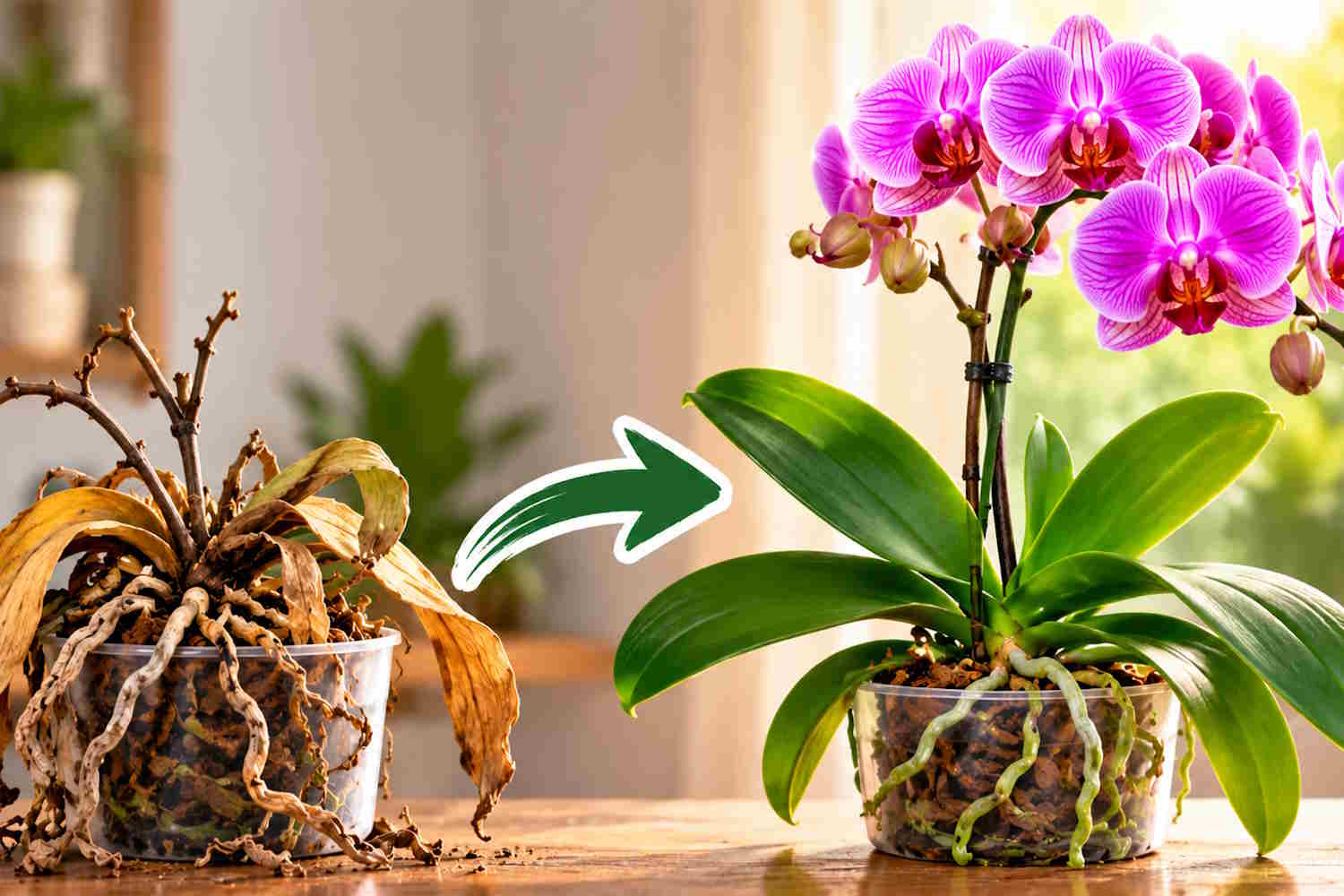
When an orchid loses all its flowers, the stem begins to yellow and the plant seems immobile for weeks, it’s easy to think that it’s time to get rid of it. In reality, in most cases, it does not mean that the orchid is dead, because it may have simply finished the flowering cycle and find itself going through a resting phase, during which it accumulates energy to produce new flowers. Before throwing it away, therefore, it is worth checking some details that can make the difference and allow the plant to recover.
Light is needed, but it must not be too strong
The orchid loves bright environments, because it needs a good amount of light to grow and prepare for a new flowering, but this does not mean that it must be exposed to direct sun for many hours. If it is left in front of a window where the rays directly hit leaves and roots, especially on the hottest days, it risks suffering stress and burns. On the contrary, a position near a bright window, perhaps with a light curtain that filters the light during the most intense hours, is often the best solution. The most common mistake is to place it in a dimly lit corner of the house thinking that, being an indoor plant, it can live even with little light: the orchid can stay indoors, but it still needs to receive a lot of light.
Before giving it water, look at the roots
One of the most frequent mistakes with the orchid concerns watering, because we often tend to give it water following a fixed routine, while this plant needs to be observed before receiving more water. The roots are the best indicator for understanding when to intervene: if green, it means that they still have a good water reserve, while when they become silvery-grey it means that the time has come to water.
Even the material inside the pot, generally bark, should always be practically dry before watering again. At that moment it is preferable to immerse the pot in water for about 10-15 minutes and then let it drain well, because the roots need to hydrate but are very sensitive to stagnation.
A more humid environment can help her feel better
The orchid comes from environments where the air is naturally more humid than that present in our homes, especially during the winter when radiators and heating tend to make environments very dry, for this reason it may be useful to slightly increase the humidity around the plant, but avoiding overdoing it with water on the leaves or creating conditions in which the humidity stagnates for too long. A small trick could be to place the pot on a saucer with expanded clay and a little water, making sure that the roots or the bottom of the pot do not remain in direct contact with the water.
Cut the stem only when it is really dry and wait
When the orchid stem becomes completely yellow and dry, it can be cut at the base using clean scissors, so the plant can focus its energy on the roots and new growth. However, if the stem is still green, it is better not to remove it immediately, because in some cases new buds or small shoots called “keiki” can grow from the nodes, i.e. new seedlings that can develop into independent orchids. After pruning, patience is needed above all, because an orchid does not bloom again overnight and could take several months before returning to produce new flowers. The fact that it is no longer colorful and full of buds, however, does not mean that it is finished. Often it is enough to learn to read the signals, because a healthy orchid continues to communicate its status through its roots, leaves and the way it grows, long before showing a new flowering.
