
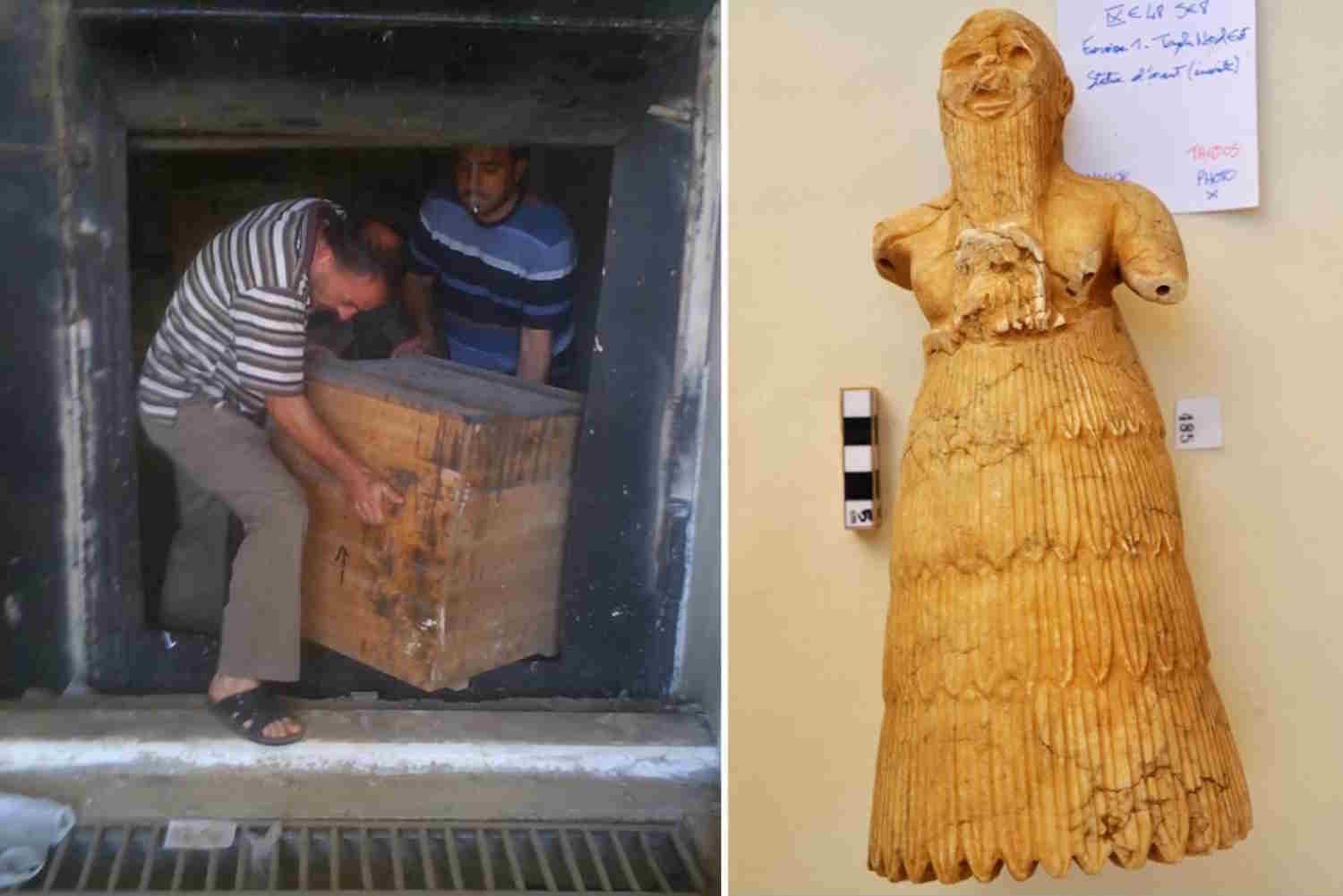
In 2014, as ISIS advanced towards Deir ez-Zorthousands of artifacts began leaving the city museum in crates headed for Damascus. The operation was repeated in 2015. In the end they were taken away approximately 30 thousand archaeological objectstaken from a war that was already swallowing up museums, archaeological sites and entire pieces of history in Syria and Iraq.
Rebuilding that race against time is Maamoun Abdulkarimthen director general of the General Directorate of Antiquities and Museums of Syria and now professor of Archeology and History at the University of Sharjah. In his study published on Museum Management and Curatorship tells how the transfer of the collections was organized and above all how decisions are made when waiting for better conditions could mean arriving too late.
The Deir ez-Zor museum housed finds from some of the most important sites of ancient Mesopotamia: Halaf, Dura-Europos, Mari, Tell Terqa. Among the documented objects there is also a necklace of agate beads dating back to the second millennium BC. Thousands of years of history locked in boxes while a contemporary war was being fought outside.
Two evacuations in a besieged city
Deir ez-Zor is located on the Euphrates, in eastern Syria, in a region rich in oil and gas which became one of the most contested territories in the country during the civil war. With the expansion of ISIS since 2014, the situation worsened further.
The museum had already been closed after the start of the war and the works on display had been taken to the most protected rooms of the building. By 2013, parts of the city had come under the control of ISIS. The Freie Universität Berlin project dedicated to the digitization of the museum’s inventory reminds us that the dividing line with the Syrian forces passed just 200 meters from the building.
Furthermore, the connection with the military airport passed through a narrow and vulnerable corridor. Taking out thousands of objects therefore meant moving inside a city at war, with fragile communication routes and security conditions capable of changing rapidly.
Yet they moved. The first evacuation occurred in 2014. The second in 2015. The collections were packed, documented and transferred to Damascus, while the Syrian antiquities authorities continued to review routes and procedures based on what was happening on the ground.
An ancient statue from the site of Mari, dating back to the second millennium BC @Yaarob Abdullah
Thirty thousand objects, thousands of years
Those months coincided with some of the starkest images of the destruction of Middle Eastern cultural heritage. In 2014, ISIS captured Mosul, Iraq; in the following months came the looting and destruction of artefacts and sites linked to Nineveh and the ancient Assyrian civilisation. For those involved in Syrian museums, the time for theoretical precautions was definitely over.
Deir ez-Zor preserved collections built thanks to decades of Syrian and international archaeological missions. The museum, founded in 1974 and moved to a new building in the early 1990s, had become one of the reference points for finds from eastern Syria.
Taking away around 30 thousand artefacts meant saving tablets, ceramics, jewelery and objects belonging to civilizations that lived along the Euphrates thousands of years before the appearance of modern borders.
Abdulkarim, who led the General Directorate of Antiquities and Museums until 2017, says that during his tenure they were transferred to places considered safer around 300 thousand objects from Syrian museums. Those from Deir ez-Zor represented a huge part of the operation:
We didn’t save 30,000 objects simply to save 30,000 museum pieces.
The goal, in his words, was to protect thousands of years of memory that the war risked erasing.
When waiting became the greatest risk
Abdulkarim’s study also tells about a less visible part of these operations. To save a museum during a war you need crates, means of transport and safe places, of course. Even before that, we need inventories, documentation and people capable of deciding when normal procedures have stopped making much sense.
It is one of the reasons why in 2014 the Syrian leadership and the Freie Universität Berlin started a project to digitize the inventory of the Deir ez-Zor museum. Photographs, cards and registration numbers could be stored in multiple locations and become tools for identifying any missing, stolen or destroyed items.
The German project started from 21,867 finds officially registered with an inventory number, to which were added other objects preserved in the museum and yet to be integrated into the database. In a war where even archives could disappear together with collections, having a copy of the museum’s memory became almost as important as having the museum itself.
Abdulkarim also returns several times to another, much less technological resource: trust. During a conflict, he explains, decisions must be made quickly by people capable of working together even when information is incomplete and the situation changes from one hour to the next. Waiting until you have all the certainties, in similar cases, can be the most dangerous choice.
At Deir ez-Zor they did not wait for them. Between 2014 and 2015 the crates left, the finds arrived in Damascus and around 30 thousand pieces of the history of the Euphrates left a city that was about to be devoured by war. Sometimes saving a museum also means knowing when it’s time to empty it.
This is honestly an incredible story.
As ISIS closed in on the Syrian city of Deir ez-Zor in 2014 and 2015, a small group of archaeologists were quietly trying to get 30,000 priceless artifacts out of the city before they could be looted or destroyed.
They moved the… pic.twitter.com/vBjAAR786Z
— Mario Nawfal (@MarioNawfal) September 28, 2026
