
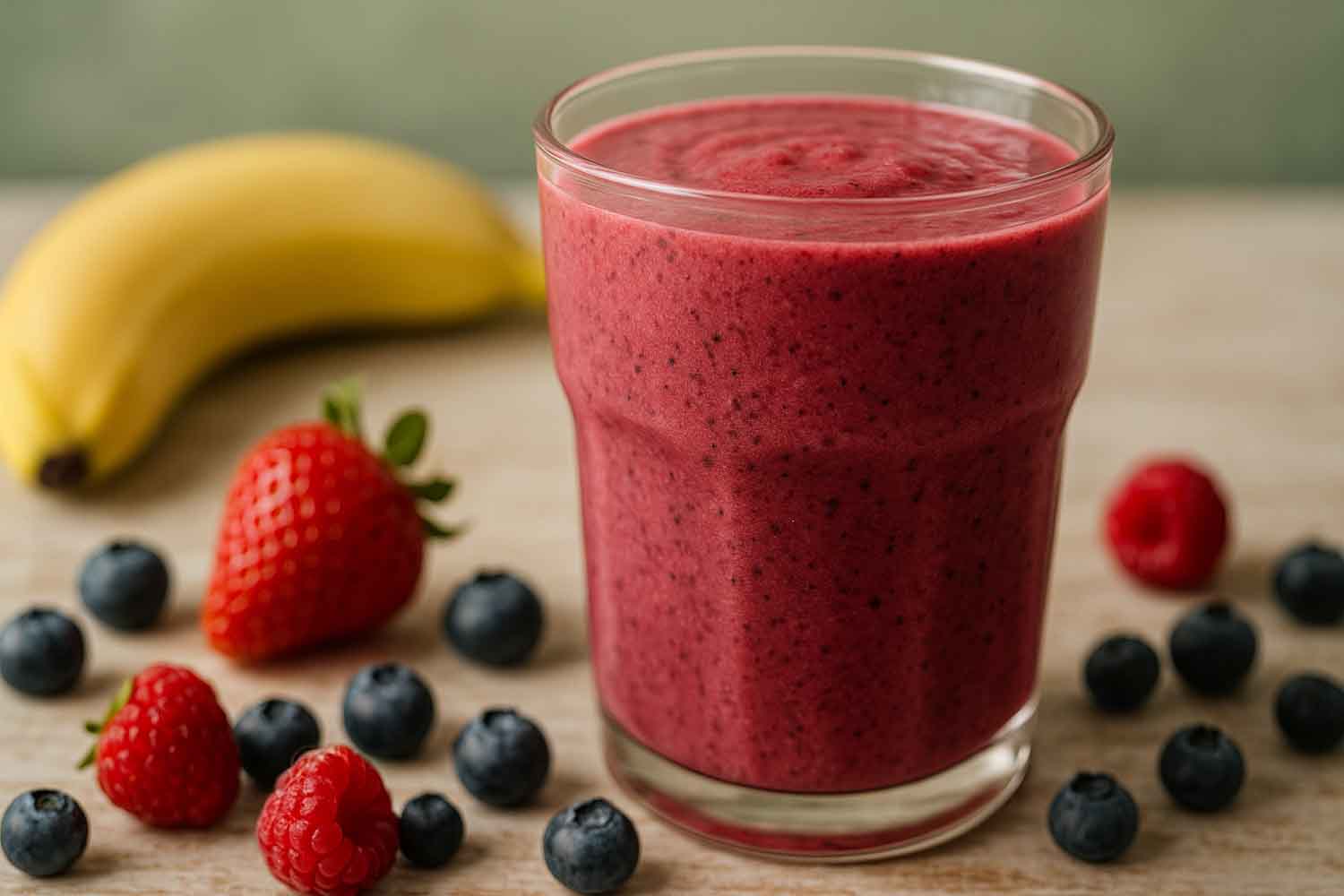
There are those who drink it every morning convinced that they are making the best possible choice: banana, berries, maybe a little vegetable milk and off you go. An automatic, reassuring, almost healthy gesture by definition. But no. A recent scientific study suggests that this popular combination could dramatically reduce the nutritional benefits we think we’re getting.
This is not a demonization of the banana, nor an attack on homemade smoothies. It’s a question of food chemistry, the kind that rarely ends up in everyday conversations, but which affects what our body actually absorbs more than we imagine.
What happens when we blend banana and berries
Researchers have focused attention on what is called food matrixthat is, the way in which the ingredients interact with each other once cut, crushed or blended. The idea that “the more healthy ingredients I put together, the better” doesn’t always work.
The crux of the matter are flavanols, bioactive compounds present in abundance in berries, cocoa, apples and tea. They have been studied for years for their role in protecting the heart and brain, so much so that nutritional guidelines suggest taking precise quantities every day.
The problem arises when these flavanols come into contact with an enzyme called polyphenol oxidase, which is very present in bananas. It is the same enzyme responsible for blackening fruit when cut. In the blender, however, this process accelerates: the cells of the banana break down, the enzyme is released and begins to oxidize the flavanols, with a rapid and significant loss of these beneficial compounds, in a matter of minutes.
The study
To understand how significant the effect was, a group of US and British researchers involved eight healthy men, subjecting them to three different tests on separate days. In one case they took flavanols in capsule form. In another they drank a berry-only smoothie. In the last one, a smoothie with banana, always with the same amount of flavanols added.
The results were very clear. With the capsule and with the berry smoothie, the levels of flavanols in the blood were practically comparable. When banana came into play, however, the peak of flavanols absorbed dropped by over 80%.
It is therefore not a marginal difference. It is a clear change, which occurs immediately after preparing the smoothie. The researchers themselves admitted that they were surprised by the speed of the phenomenon, underlining how the combination of foods and the way we prepare them matter as much as the choice of ingredients.
Bananas yes or no?
At this point it is worth clarifying: banana remains a healthy food. It is a good source of potassium, fiber and energy, it is economical and practical. The study doesn’t say that it’s bad for you, but that it’s not a good companion for foods rich in flavanols.
If the goal is a smoothie based on berries or cocoa, it is better to avoid banana and focus on alternatives that do not interfere with these compounds, such as yogurt, avocado or mango. If, however, you want a banana smoothie, no problem: you can drink it easily, perhaps with milk or peanut butter, without expecting a significant intake of flavanols.
The message that emerges is simple and, at the same time, a little uncomfortable: it is not enough to eat “healthy”, we must also pay attention to how we combine foods. A small change to habits can make a big difference, especially when we think we are making the best choice possible every day.
You might also be interested in:
