
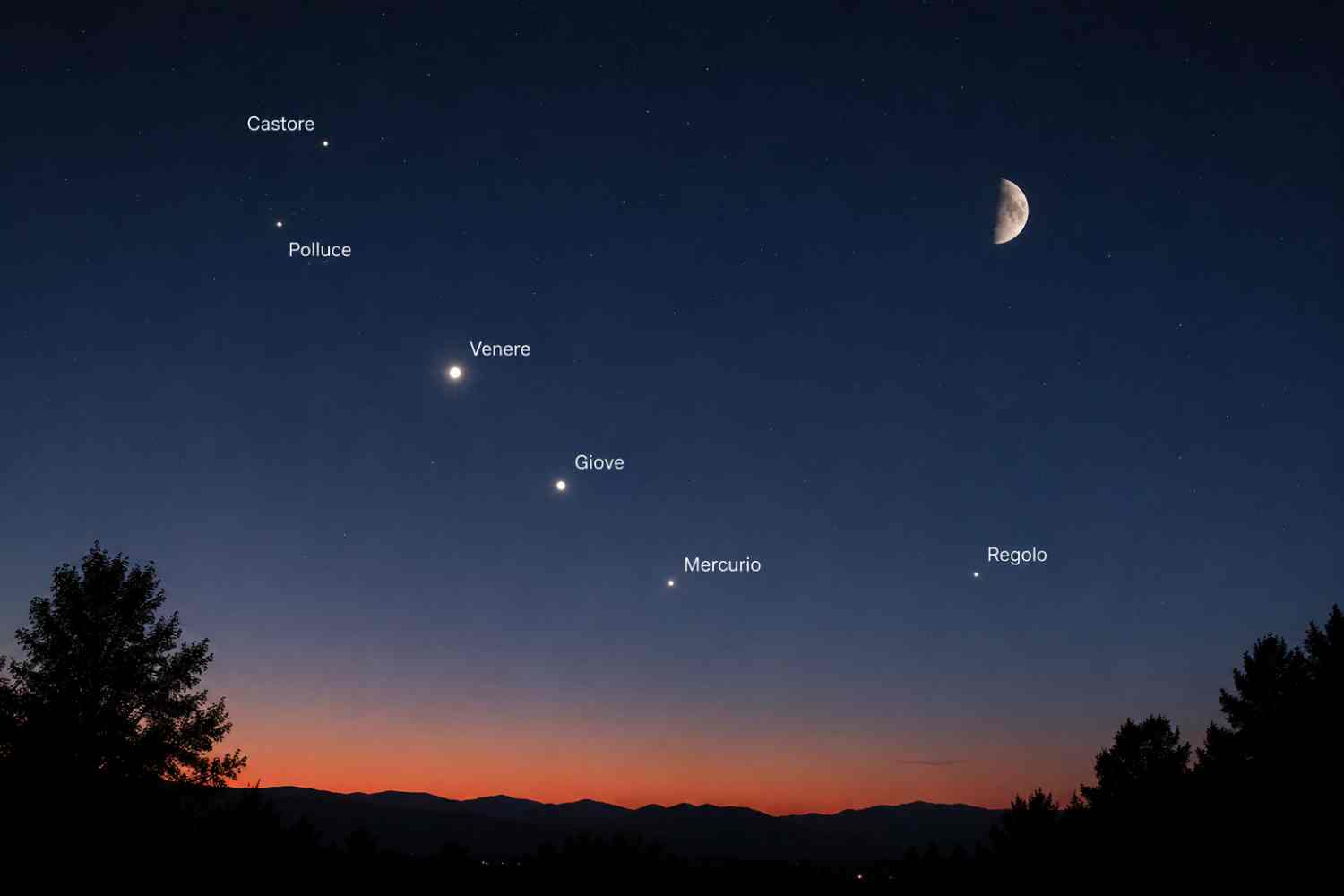
With the solstice at 10.24am today, Sunday 21 June, astronomical summer officially began. What will make this day even more special will be the evening sky, which will offer a particularly suggestive alignment between planets, stars and the Moon, which can also be observed with the naked eye.
After sunset, looking west, it will be possible to identify Venus, Jupiter and Mercury arranged along the same apparent line. Castor and Pollux, the two brightest stars in the constellation Gemini, will also appear alongside the planets, creating a particularly spectacular configuration.
To complete the picture there will be the star Regulus, in the constellation of Leo, and the crescent Moon, which will reach the First Quarter phase in the late evening of June 21st.
When to observe the phenomenon
The best time will be between 30 and 60 minutes after sunset. The times vary slightly from city to city, but in most of Italy the show will be visible approximately between 9pm and 10pm. For optimal viewing it is advisable to choose a place with the western horizon free from buildings, trees or reliefs.
How to recognize the protagonists of the sky
Venus will be the brightest and most easily identifiable star. Not far away Jupiter will shine, while Mercury will appear lower on the horizon and may be less evident due to the residual light of twilight. Castor and Pollux will complete the scene a little higher up, while Regulus will be visible along the line leading towards the Moon.
Astronomers point out that June 2026 is a particularly favorable month for observing Venus, Jupiter and Mercury in the evening sky, thanks to their close position along the ecliptic.
