
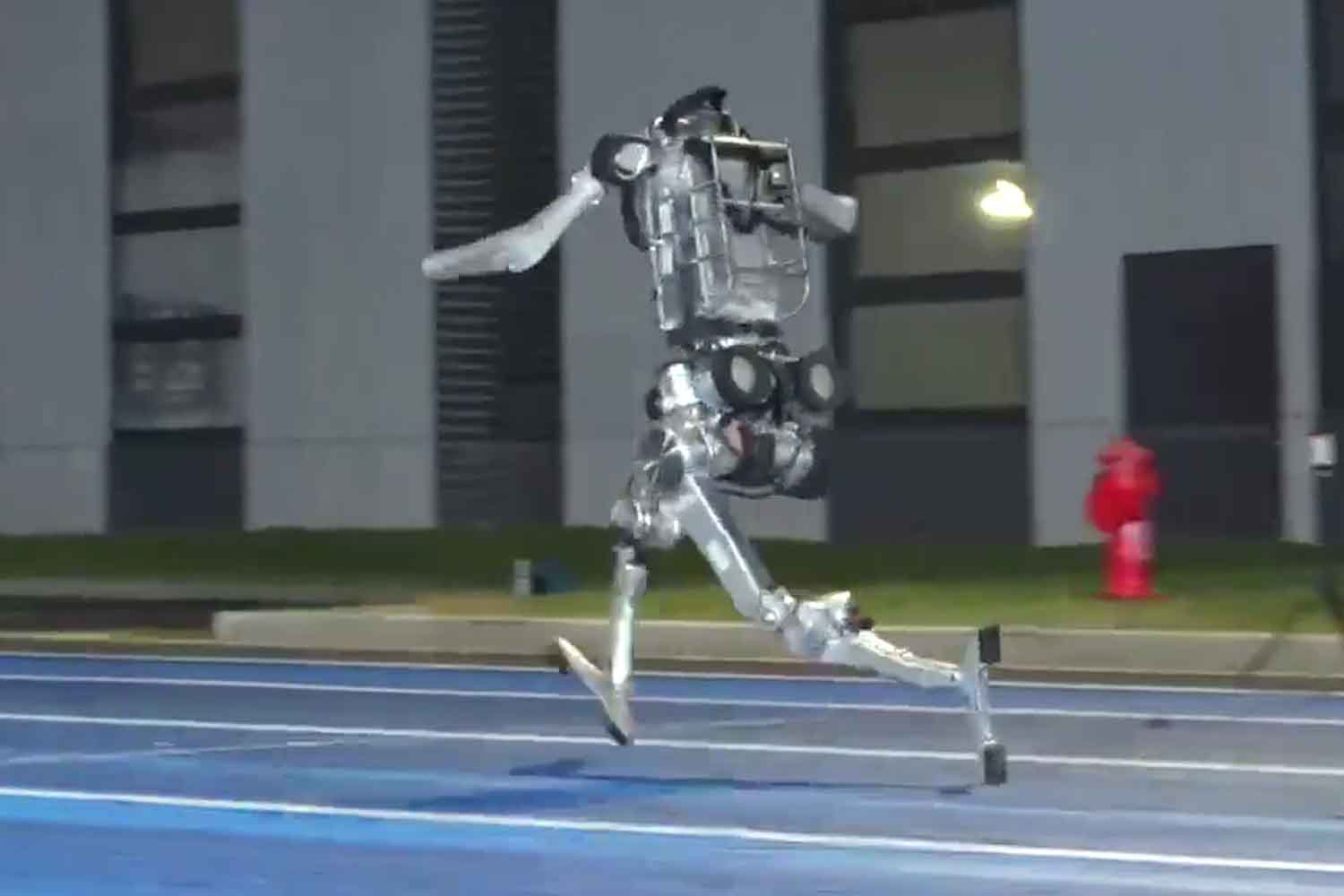
He runs at more than 45 kilometers per hour, crosses the finish line and tries to stop. Try it, in fact. The legs begin to break down, the body continues to move forward and a few moments later Superman crashes into what looks like an electrical cabinet. Unitree’s new humanoid robot just showed how fast Chinese robotics is advancing and, in the same video, how much work remains to be done. Brakes included.
The Hangzhou company presented it on August 17, 2026 with a video published on its profile 12.66 meters per second, approximately 45.6 km/hwith legs 85 centimeters long. Unitree also claims that it can perform a two meter jump from a standing position. All after just over three months of development, with the company itself warning that the machine still has “significant room for improvement”. The last part of the video seems to have taken the task of demonstrating this.
Unitree New Robot Preview: “Superman” Breaking the Limits of Humanity
Standing high jump 2 m, top speed 12.66 m/s (0.85 m leg length)
Surpassing the standing high jump and running speed records of all humans around the world
This new machine has only been in development for a… pic.twitter.com/12i80ITU6p— Unitree (@UnitreeRobotics) August 17, 2026
Faster than Bolt, yes. But he didn’t break his own 100m record
The comparison with Usain Bolt it’s inevitable and Unitree hasn’t done much to avoid it: in the post he explicitly talks about performance exceeding human running records. But there’s a pretty big difference between running faster for a stretch and breaking a 100-meter record.
Bolt ran the 100 meters in 9.58 seconds at the 2009 World Championships in Berlin, a record that still belongs to athletics. His average speed over the entire race was approximately 10.44 meters per second; the biomechanical analyzes of the race place his maximum speed around 12.3 meters per secondwith slight differences depending on the measurement method. A subsequent study based on LAVEG laser data estimated a peak of 12.32 m/s.
THE 12.66 m/s declared by Unitree they therefore exceed the maximum speed measured for the Bolt. However, they do not mean that Superman ran the 100 meters in less than 9.58 seconds. We do not know of a certified full-distance performance from the footage, nor has Unitree published independent verification, raw test data, or a protocol that allows the two performances to be compared under the same conditions.
In short: Superman can claim, based on the company’s test, a top speed higher than that achieved by the fastest sprinter in history. Bolt’s world record can continue to sleep peacefully. At least until the robot also learns to cross a real finish line and stop without using the surrounding technical furniture.
In April Unitree had already reached over 10 meters per second
The leap, however, is notable. Only a few months ago Unitree had taken its humanoid H1 beyond the 10 meters per second. The company records that test in its official timeline as April 11, 2026, calling it a new world record for a humanoid robot at the time. However, the commercial datasheet for the H1 continues to indicate a much lower ordinary speed, equal to 3.3 m/s: the extreme tests are used to measure what the hardware can do in specific configurations, not what a robot purchased today will normally do while walking around a warehouse.
Superman raises the bar another two and a half meters per second. And he does it with a rather particular style: torso reduced to the essentials, legs that skim the ground at a very high frequency and very little interest in elegance. At 45 kilometers per hour, moreover, poise comes later.
Braking tells perhaps the most interesting part of the test. Accelerating a humanoid without causing it to fall requires dynamic control, powerful motors and algorithms capable of continuously correcting the balance. Decelerating it while keeping it stable is another problem of the same kind: when the legs stop producing thrust, the body conserves momentum and the system must dissipate it without losing its buoyancy. In the video Superman tries to do it, he lengthens and changes his steps, then the race towards the obstacle wins.
It doesn’t mean that Unitree built a robot that couldn’t brake. It means that this prototype, in this very high speed test, was unable to stop in the available space. A less entertaining distinction than the video, but a necessary one.
The prototype arrives while Unitree is also racing on the stock market
The choice of the moment is not secondary. Superman was shown two days before Unitree’s debut on the STAR market of the Shanghai Stock Exchange. The company had collected 6.1 billion yuan, about 905 million dollarswith retail investor demand more than 8,000 times greater than available shares. On August 19th the stock closed the first session with a rise of 460%.
Behind the jumps, races and inevitably viral videos there is therefore a very real industrial competition. Chinese companies are pushing humanoids away from spectacular demonstrations and into logistics, factories and services, where running like Bolt counts for far less than move for hours without falling, recognize obstacles, manipulate objects and work close to people safely. Unitree itself defines Superman as a project still in development.
For now the newcomer has already solved half the cinematic problem of robots of the future: if he decides to chase us, running won’t do much good. It remains a rather real possibility. Stand behind an electrical control unit.
