
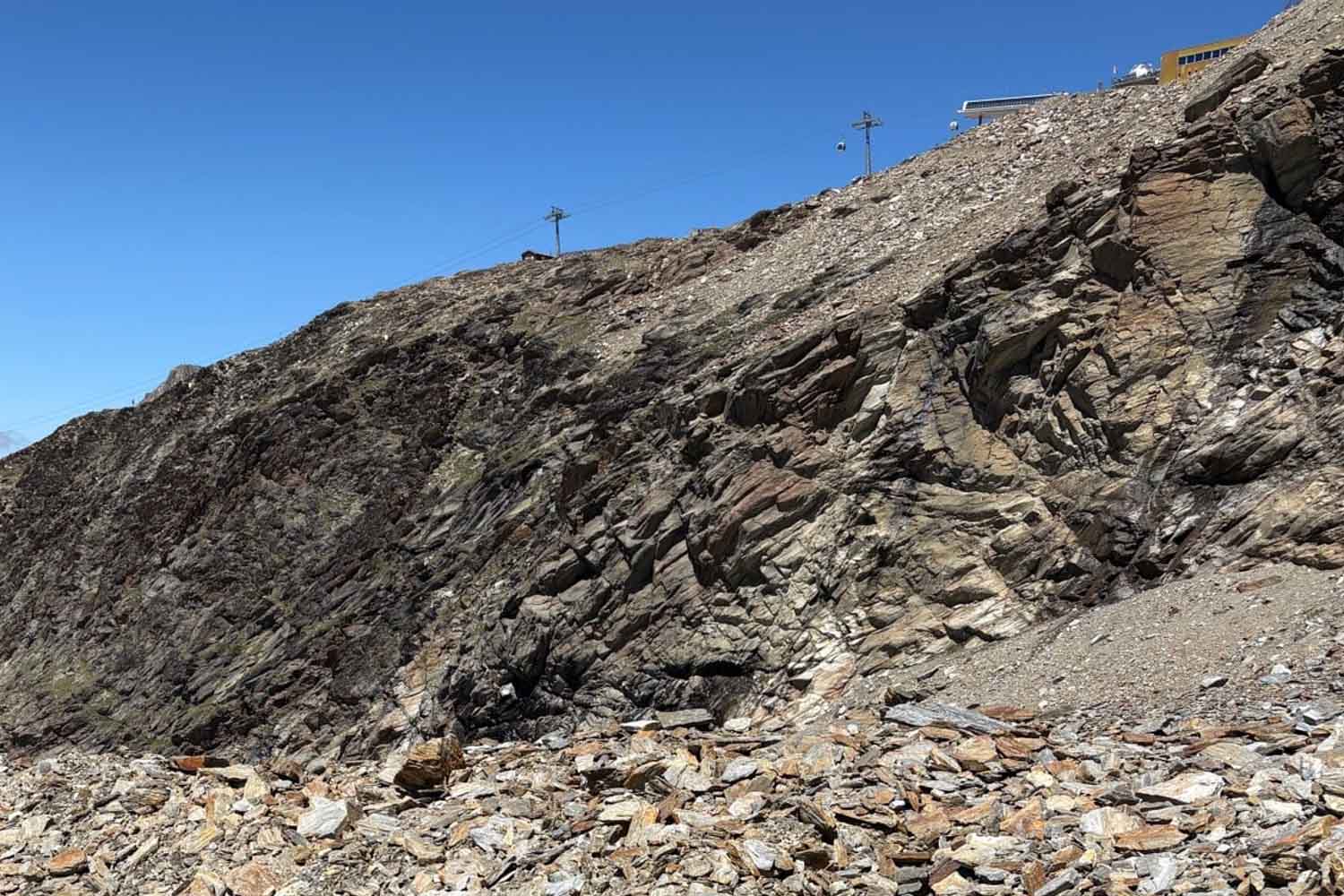
A hiker walks on the Trift Glacier and finds human remains freshly freed from the ice. It happens on July 26, above Saas-Grund, in the canton of Valais. The recovery begins, the remains arrive at the Institute of Forensic Medicine at the Valais Hospital in Sion, then DNA does the rest. They belong to two Belgian mountaineers who disappeared in 1992. They were 39 and 41 years old. 34 years have passed.
The Valais cantonal police, who communicated the identification on August 19, used very precise words: the bodies had been exposed by the melting of the glacier. Trift has retreated enough to expose what research in the 1990s had failed to find.
©Cantonal Police of Valais
In 1992 they disappeared during the crossing of the Weissmies
It was September 4, 1992. The two men had started from the Weissmieshütte and wanted to reach the Almagellerhütte via the Weissmies, a peak that today Switzerland Tourism indicates at 4,017 meters. During the journey the weather worsened and the two never arrived at the planned refuge. In the following months several searches were organized. A backpack was found. Of them, nothing.
The file remained open along with many others. In fact, the Valais police have kept reports of missing people since 1925, mostly men and women who disappeared in the high mountains or in the rivers and lakes of the canton. And in the same note on Trift he adds a detail that now appears more and more often in press releases of this type: by receding, the glaciers bring to light people who had disappeared decades earlier.
It also happened in October 2025 on the Obergabelhorn glacier above Zinal. Some climbers found bones and personal items during a climb. The analyzes identified a Swiss man, born in 1969, who disappeared together with a companion in 1994. The other was found in 2000. It took another 25 years and a lot less ice to close that case.
By June, the Swiss glaciers had already run out of winter snow
The Swiss glacier calendar has jumped ahead this year. On June 29, 2026, considering them as a whole, they had already consumed the snow accumulated during the winter. From that day on, every additional liter of water lost through melting began to directly affect the glacial mass.
Swiss scientists call that date Glacier Loss Day. According to ProClim, of the Swiss Academy of Sciences, 2026 arrived exceptionally early: only in 2022, the year of extreme melting, did it fall earlier, on 26 June. Between 2003 and 2022, around 200 square kilometers of ice have already disappeared, an area almost as large as the canton of Zug.
This does not mean that the heat of 2026 caused the death of the two climbers, which occurred 34 years ago, nor does it allow their discovery to be attributed to a single summer. It means something much simpler: today there is less ice covering where they were left. It’s the same distinction that makes the story stronger without having to load it with anything else.
The long-term numbers are already enough. In 2025, Swiss glaciers lost another 3% of their remaining volume, the fourth largest annual decline since detailed glaciological measurements began in the 1950s. In the last ten years, from 2015 to 2025, approximately 24% of the glacial volume has disappeared. And between the 2016 and 2023 inventories, 159 small glaciers completely disappeared.
Looking further afield, MeteoSwiss estimates that the country’s Alpine glaciers have lost around 65% of their volume since 1850. The freezing point has moved towards increasingly higher altitudes together with the warming of the Swiss climate, which is proceeding more rapidly than the global average.
On the Trift this transformation has just had a very concrete consequence. A hiker found what remained hidden from search teams in 1992, and a DNA match returned two names to their families.
