
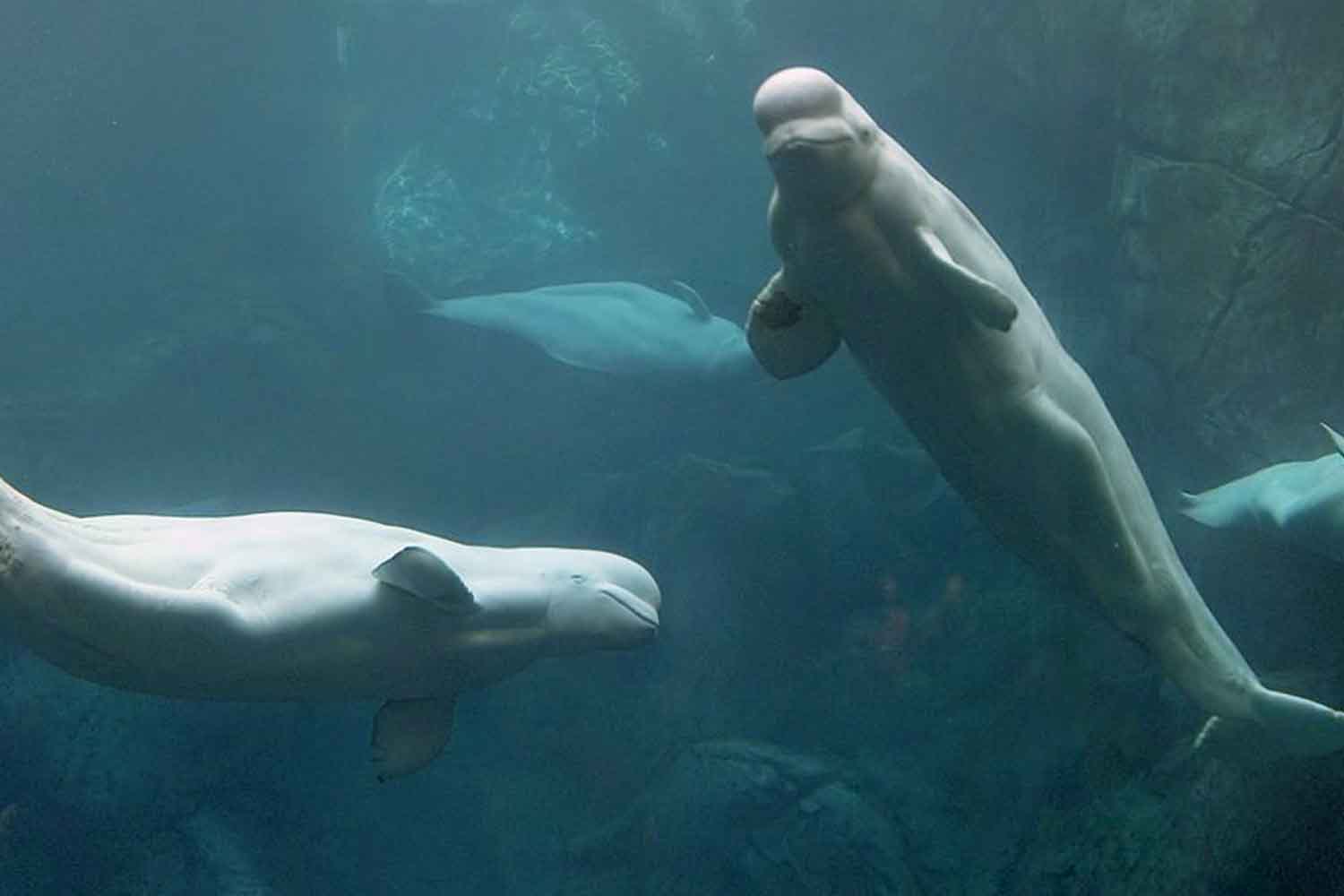
There is a scene, after all, which is very simple: a white whale approaches a mirror and stays there. It looks, it moves, it produces bubbles, it opens its mouth, it rotates on itself. Except that beneath the surface of the water that scene soon stops looking like any other game. Because Natasha and Maris, mother and daughter hosted at the New York Aquarium, began to behave in front of that mirror as if they were observing their own bodies.
A new study published in PLOS One brings belugas into the small group of animals for which there is evidence of mirror recognition, an ability long considered almost exclusively human. The test involved four belugas, exposed first to a mirror and then to control surfaces. Two of them, Natasha and Maris, showed a series of behaviors directed towards their own image: playing with bubbles, rotations, neck movements, open mouth in front of the reflection, manipulation of objects near the mirror. The other two animals, however, showed little interest and for this reason were not taken to the next phase of the experiment.
The bubbles in front of the glass
The most curious part concerns precisely what Natasha and Maris did in front of the mirror. The two belugas soon began producing bubbles from their mouths or blowholes, then “biting” them as they saw their reflections. They performed barrel rolls, those full body rotations that look like small aquatic somersaults, and oriented their mouth, head and neck towards the reflective surface. According to the authors, these behaviors suggest that the animals were using the mirror as a tool to observe themselves, a bit like we do when we approach a shop window to understand if we are really looking at our image.
In Natasha’s case, even a stronger result arrived: during a mark test, the classic sign test used in mirror recognition studies, the adult beluga oriented the marked area behind the right ear towards the reflection. In practice, he seemed to use the mirror to inspect a part of the body that he otherwise would not have been able to see. The younger Maris failed the sign test, but showed a wide range of self-directed behaviors, including playing with a rope in front of the mirror. For researchers, this also remains an important clue, especially in an animal that has no hands with which to easily touch the marked spot.
A rare ability
Mirror recognition was first studied in chimpanzees in 1970. It has since been observed, with varying levels of evidence and scientific discussion, in great apes, bottlenose dolphins, Asian elephants, Eurasian magpies, and cleaner fish. Now belugas enter this short list, and they do so with a detail that matters: they are very social, vocal, intelligent cetaceans, used to living in complex environments, where relationships, communication and attention to others have enormous weight.
This doesn’t mean turning Natasha and Maris into little people with flippers and round foreheads. It means recognizing that the animal mind continues to stay one step ahead of our patterns. Belugas are already known for the variety of sounds, for their articulated social behavior, for that mobile and almost expressive head that makes them immediately recognisable. Seeing them use a mirror to look at their mouth or follow their body in rotation adds a neat piece: self-awareness, at least in some forms, may be more distributed across the animal world than we’ve been willing to admit.
The study remains cautious, as it should be. The sample is small, just four animals, and only two showed convincing behavior. Research on mirrors, then, brings with it an ancient problem: each species perceives the world in its own way. An animal that thrives on smell, sound or touch may not find the same sense in a mirror that a human does. In cetaceans, however, these results are part of a story already started with dolphins and strengthen the idea that very different brains can arrive at similar abilities through distant evolutionary paths.
The most beautiful thing in this story is also the least spectacular. Natasha and Maris don’t do anything theatrical. They come closer, they try, they come back, they look at each other, they play. A bubble, a rotation, a mouth wide open in front of the glass. Minimal, almost funny gestures, which however shift the boundary between observing an animal and accepting that that animal can have a relationship with itself. The mirror, in this case, does not serve to make them more similar to us. If anything, it serves to remind us how little we still know about them.
View this post on Instagram
You might also be interested in:
