
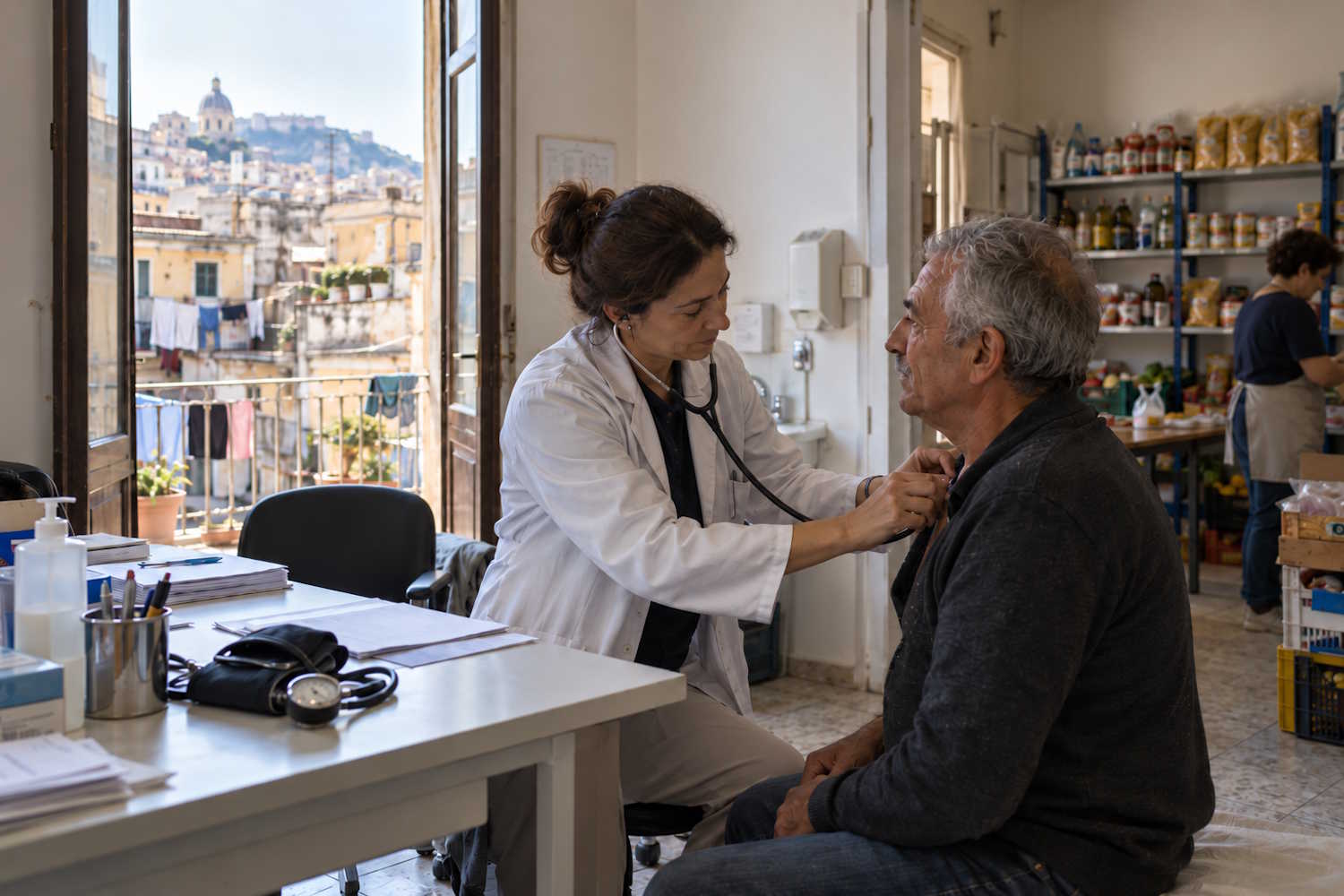
In Naples the suspended coffee changes shape, as it has already done many times before. We no longer just leave a cup already paid for for those who come later: today, faced with families who struggle to even cover healthcare costs, solidarity reaches all the way to the clinics.
This is how “suspended treatments” were born: specialist visits, diagnostic tests and consultations offered free of charge by doctors and associations to those who cannot afford to pay for them. It is one of the most obvious signs of economic fragility that no longer just concerns the shopping cart. In the Neapolitan capital, both requests to Caritas solidarity stores and requests for free healthcare are increasing.
When income is no longer enough, in fact, quality food, but also a medical visit or specialist check-up can be put off. And it is in these that a network made up of volunteers, doctors, associations, parishes and third sector entities tries to intervene.
The “suspended treatments”: in Bagnoli and Soccavo doctors visit for free
The idea starts from a deeply Neapolitan tradition: that of suspended coffee. Those who can leave something to those who, at that moment, cannot afford it. Only instead of coffee there are medical visits. In the Bagnoli area, the Auser (voluntary association) has opened a social clinic in the Spi Cgil headquarters, where specialist doctors make their skills available free of charge. Other consultations are also offered at Villa Medusa.
In the Soccavo district, however, the Medici di Strada association and the Madonna de La Salette parish have created a clinic that can count on 15 specialists and operates on reservation.
These are experiences created to intercept those who risk leaving their health on hold because a private visit costs too much or because, simply, other expenses come first in the family budget. The concept of “suspended treatment”, then, takes on an almost literal meaning: to prevent a diagnosis, a check-up or a visit from being postponed exclusively for economic reasons.
In Naples, the number of families shopping in solidarity stores is also increasing
The same difficulty emerges when observing solidarity stores. In the city, there are seven Caritas supermarkets: small supermarkets where people in difficulty can choose food and essential household products for free. And the requests are increasing. At the emporium “Dew Drops” of Poggioreale, the accesses would have increased from around 20 to 50 per day. The ones asking for help are mainly Neapolitan families, including the younger ones. The emporium also collaborates with two supermarket chains in the area which also supply products close to their expiry date, thus making it possible to combine support for families with the recovery of surplus food.
In the eastern outskirts of the city, between San Giovanni a Teduccio and Barra, the San Giuseppe Solidarity Emporium provides permanent assistance to around 240 families, to which are added another 80 assisted occasionally. In the last year alone it distributed around 90 tonnes of food and another 10 tonnes of household products and personal effects. In all, around 100 tons of goods. Requests would have increased by about 20%.
View this post on Instagram
How to shop without paying
The functioning of solidarity stores is different from the traditional distribution of food parcels. The families are first met by the operators and, based on the composition of the family and the economic situation, they receive a credit expressed in points with which they can enter the store and independently choose what they need.
The cart, therefore, is not prepared by someone else: each family chooses the necessary foods and products. And this is precisely one of the elements that distinguish solidarity stores from more traditional forms of assistance: the objective is not only to distribute goods, but to try to preserve autonomy and the possibility of choice.
Other food support projects are also active in Naples. In 2026 the Prosolidar Foundation funded “Never Hunger Again”, aimed at 100 families from Forcella and the Quartieri Spagnoli. The Cesvi-Intesa Sanpaolo project, active from March to November, instead financed 4 thousand food parcels intended for over 400 Neapolitan families, approximately half of which were addressed to 200 households in Municipality 7.
Solidarity emporiums in Italy
What is happening in Naples is part of a phenomenon now widespread nationwide. According to the Euricse report “Solidarity emporiums in Italy: beyond food distribution”, in May 2025 there were 309 solidarity emporiums active in Italy. In 2021 there were 193. In four years they have therefore increased by over one hundred units, a growth also linked to the increase in people and families in conditions of economic fragility.
The distribution, however, is not uniform. Approximately 48% of the emporiums are located in Northern Italy, 29% in the Center and 23% in the South, where more traditional forms of assistance, such as food parcels and canteens, continue to be more widespread.
@Euricse
Lombardy, Piedmont, Veneto and Emilia-Romagna alone account for over 48% of the emporiums surveyed. They are no longer just solidarity supermarkets
Furthermore, according to the Euricse report, emporiums are progressively ceasing to be exclusively places where you can get free pasta, milk, preserves or hygiene products and in many cases are becoming real “community hubs”, where food distribution is accompanied by after-school activities, Italian courses, cultural activities, neighborhood dinners, career guidance desks, psychological support and initiatives against food waste.
Some also organize consumer education courses, helping people to think about their food choices and distinguish between what is necessary and what is superfluous. The model therefore tries to move away from the idea of purely passive assistance: those who enter do not simply receive a box prepared by others, but maintain a part of autonomy.
Material need remains the starting point, but networks capable of responding to health, educational and work problems can develop around the distribution of food. And Naples is proof of this: here the transition from “suspended spending” to “suspended care” photographs a boundary that is shifting and pushes us to an urgent question: doesn’t the fact that volunteer doctors are needed to guarantee care to those who cannot pay for it also say a lot about the size of the need that that network is trying to respond to? This seems to us to be a fairly concrete sign of how high costs of living are transforming essential needs into expenses that are increasingly difficult to bear.
