
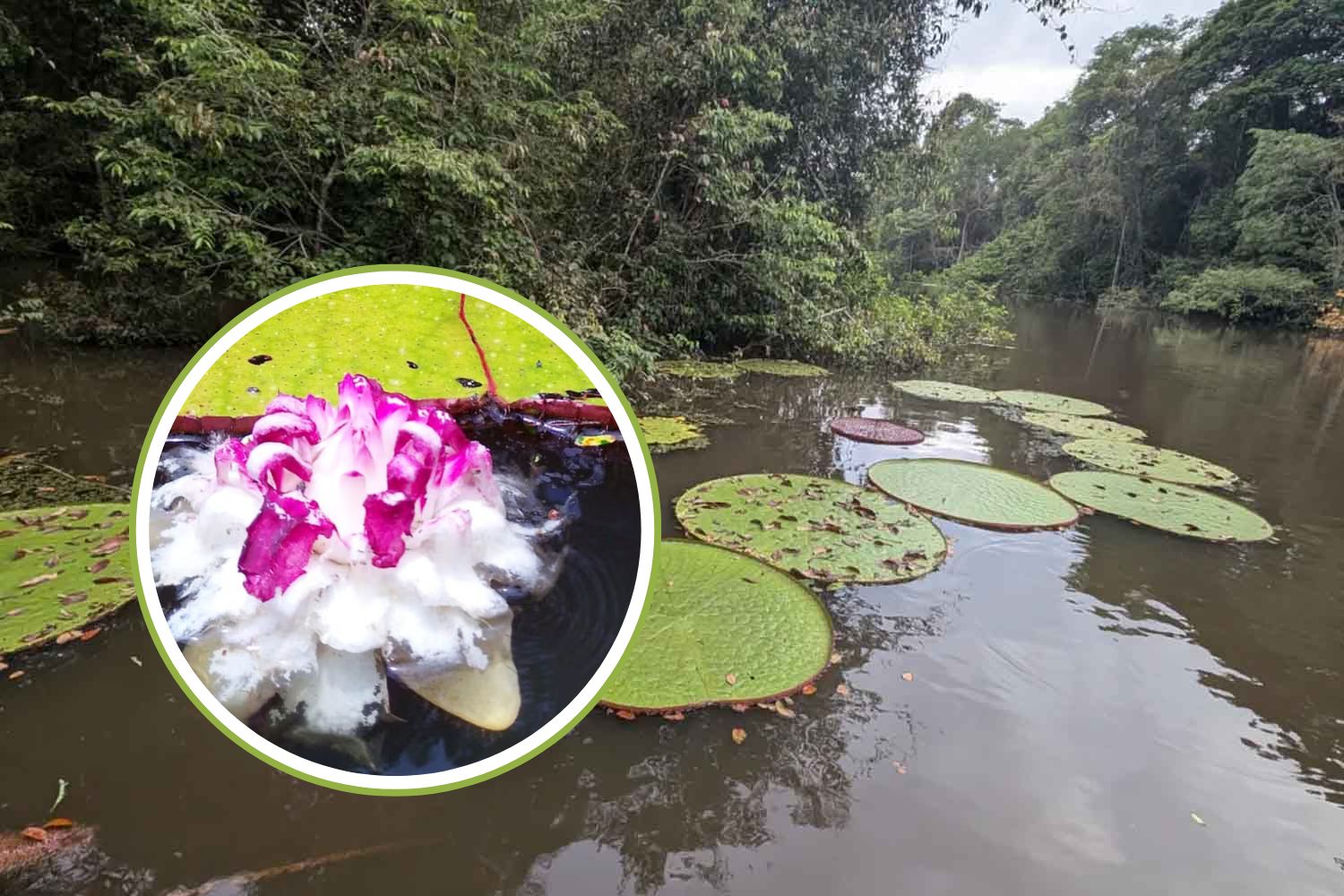
To discover a new species of giant water lily, a photograph published on Instagram was enough. To find one in bloom, however, it took five days of research, a boat that left at one in the morning and an indigenous navigator who knew those places much better than any map.
The plant today has a name, Colombian Victoriaand was officially described in a study published in the scientific journal Phytotaxa. It grows in lakes in the Inírida River region of eastern Colombia and produces floating leaves that can reach two meters in diameter. Large enough to be recognizable in high-resolution satellite images. Yet, according to the researchers’ initial estimates, there could be as few as 30-50 specimens in nature.
A plant capable of being seen by satellites, therefore, had until now managed to escape botanical classification. With some responsibility too, given how little we still know about the ecosystems in which it lives.
A photograph on Instagram and something that didn’t add up
The story begins in December 2021, when Jeremiah Harris, an American nurseryman specializing in carnivorous plants, published some photographs taken in the Colombian region of Guainía. They display huge floating green leaves, attributed to the species Victoria amazonicaone of the best-known giant water lilies in South America.
Carlos Magdalena, a botanist at the Royal Botanic Gardens in Kew, UK, sees those images and notices a suspicious geographical detail. The plants are found in the upper Orinoco basin, outside the known range of the species of Victoria.
He decides to check. He opens the satellite images, examines the course of the Inírida River and the surrounding lakes, until he spots some large leaves on the surface of the water. The botanical genre is the right one. To understand if it is really an unknown species, however, you need to reach it.
Magdalena contacts Mauricio Bernal Rodríguez, from the José Celestino Mutis Botanical Garden in Bogotá. Together they organize an expedition with the involvement of the indigenous communities of the area. Among the collaborators are Nilo Rodríguez, Jaime Hernández and Gustavo Melo, who are also among the authors of the scientific study.
Rodríguez had known those water lilies since childhood. For science they had yet to be identified, for those who lived along those rivers they were plants that had already been observed for years. A distinction that deserves a lot of attention in this story.
Five days of searching and a departure at one in the morning
After almost two years of preparations, the expedition arrives in the Colombian forest. The researchers have five days to find the plants, collect samples and document their characteristics. The problem presents itself immediately. They identify only two specimens, both without flowers.
To correctly distinguish giant water lily species, botanists must also examine the floral structures. The leaves, however enormous, are not enough. Furthermore, the rainy season arrived late and with particular intensity, making the searches more complicated. On the last evening everything seems lost. The return flight to Bogotá is scheduled for nine the following morning and the expedition risks ending without the necessary material.
At eleven in the evening Magdalena tells the situation to Gustavo Melo, the driver of the boat, belonging to the Tucano indigenous community. Melo claims to know another place where those plants grow. At one in the morning the group sets off again, entering the flooded forest. Just before dawn he reaches a small lake and finds five new specimens. One is in bloom. That’s what they were looking for.
In total the expedition documents seven plants distributed across two lakes, collects the necessary material and even manages to catch the morning flight. The samples are then deposited in the herbarium of the Botanical Garden of Bogotá, where the work of taxonomic identification begins.
The photograph on Instagram had sparked suspicion. This was confirmed by botanical observations, collected samples and comparisons with already known species. With a decisive part of the work entrusted to those who already knew where to look.
The giant water lilies become five
The description of Colombian Victoria adds a new piece to the classification of these South American aquatic plants, famous for their circular leaves with raised edges.
Until 2022, only two species of the genus were recognized Victoria: V. amazonica And V. cruziana. In that year, again thanks to the work of Magdalena and other researchers, Victoria boliviana was identified, the species that holds the record for the largest leaves, capable of reaching 3.2 meters in diameter. The new study proposes to recognize two other distinct species: Colombian Victoriain the upper Orinoco basin, e Victoria mattogrossensisin the Pantanal region of Brazil.
The latter had already been described in 1907 as a form of Victoria cruziana. The authors now propose to consider it an autonomous species. With this revision, the genus includes five species according to the classification presented in the research. There is also an interesting geographical aspect. Scholars believe that the isolation of the large South American river basins, together with the changes in the course of the rivers that occurred over time, may have favored the differentiation of these plants.
It is an evolutionary hypothesis supported by the comparison between the distribution and morphological characteristics of the species. For giant water lilies, rivers are particularly important because, according to researchers, they represent the main route for seed dispersal through water and floods.
There may be as few as 30-50 specimens left in the wild
The discovery brings with it a concern. Subsequent analyzes of satellite images made it possible to identify a third lake where it grows Colombian Victoriabut known populations remain extremely limited. According to estimates communicated by Kew Gardens, there may only be 30-50 plants in nature.
It is a preliminary assessment, to be verified with further reconnaissance. The researchers directly observed seven specimens during the expedition and believe that more may be spotted through more detailed satellite images, especially as the water level drops.
The group considers the species potentially at extremely high risk of extinction and is working to obtain an official rating in the category Critically Endangeredi.e. critically endangered. To protect it, various possibilities are being evaluated, including the creation of a population in a more accessible lake within indigenous territories and cultivation at the Bogotá Botanical Garden. The researchers also hope to be able to grow it in Kew Gardens in the future.
These are projects yet to be developed, which will depend on the collection of seeds, knowledge of the plant’s needs and collaboration with local communities. For now Colombian Victoria it finally has a scientific name, a documented territory of origin and a botanical description. How many plants still live in Colombian lakes, however, remains an open question. And to answer we will need to return to the place.
View this post on Instagram
