
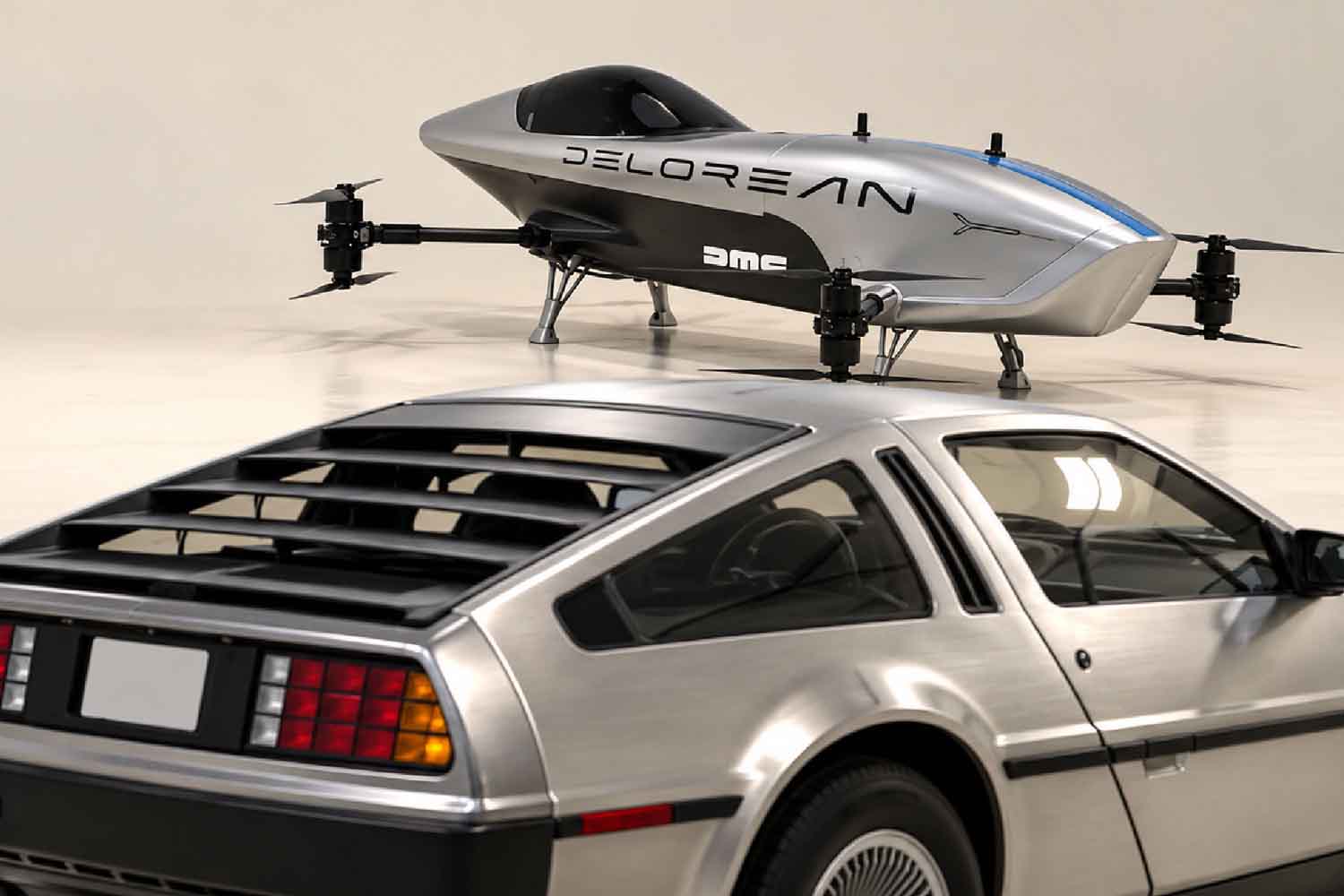
“Roads? Where we’re going there’s no need for roads!”. It took more than forty years, but Doc Brown’s famous line in Back to the future seems to finally be getting closer to reality. There DeLorean prepares to take flightthis time without special effects, channel flux or plutonium. The car brand that accompanied Marty McFly on his time travels has announced its entry into the Airspeeder International Seriesa championship dedicated to electric flying cars. The debut is scheduled for November 2026.
The announcement came on October 13th during TechCrunch Disrupt in San Francisco. As explained in the official Airspeeder press release, the DeLorean Motor Company will become the first American manufacturer to participate in the competition, with a team that will bear its name: DeLorean Airspeeder Team.
For those nostalgic for the Eighties, there is a small clarification: it will not be the original DMC-12, the one with the gull-wing doors and stainless steel bodywork, that will fly, but rather a new electric aircraft with the brand’s colours. An understandable choice, considering that transforming a 1981 coupe into a flying vehicle would have been a rather challenging job even for Doc Brown.
The new DeLorean will fly thanks to eight electric rotors
For the 2026-2027 season, the team will use theAirspeeder Mk3Can electric vertical take-off and landing aircraft, belonging to the eVTOL category. The device derives from the Mk3 developed by the Australian company Alauda Aeronautics and works through electric rotors that allow it to lift, accelerate and change direction without the need for a traditional runway.
The Mk3 prototype presented in 2021 already had quite interesting features: eight rotors, a 96 kW propulsion system, a weight of around 100 kilograms without a pilot and a declared speed of more than 120 kilometers per hour. The final configuration of the Mk3C that will run under the DeLorean brand will be presented before its debut.
The aircraft will be controlled remotely by a pilot on the ground. Competitions with pilots physically on board represent one of the subsequent stages of the Airspeeder project. In short, no driving with the steering wheel clutched in your hands like Marty McFly did. For the rest, the idea of seeing a DeLorean hovering in the air already has its charm.
How flying car races will work
Let’s forget for a moment the car circuits, the curves on the asphalt and the traditional pit stops. In Airspeeder competitions the track is drawn digitally in the airspace, through virtual doors that the competitors must cross respecting trajectories and altitudes.
The vehicles move in three dimensions: they can go up, down, accelerate and tackle tight curves also taking advantage of vertical movements. A sort of Formula 1 of the skies, as the organizers themselves define it. Of course there is a problem that presents itself in a slightly different way on car tracks: preventing two flying machines from colliding in the air.
This is why aircraft are equipped with obstacle detection, communication and collision avoidance systems. Sensors, radars and AI-assisted technologies contribute to safety during races. And then there are the batteries. The organizers have developed rapid replacement systems to allow vehicles to return to the race after a stop, just as happens with tire changes in car racing.
The project was founded by the Australian entrepreneur Matt Pearsonconvinced that racing can accelerate the development of technologies destined, one day, also for civil air transport. On the other hand, many solutions now present in common cars first came from circuits. Airspeeder would like to apply the same principle to electric air mobility, using races to test engines, batteries and control systems.
From 2027 DeLorean wants to build its own aircraft
Entry into the championship represents only the first phase of the project. For the 2027-2028 season, DeLorean plans to participate in the development of a new device together with groups of engineering students from some American universities, including UC Berkeley and Georgia Tech.
The objective is to involve young designers in the creation of an aircraft capable of combining performance, innovation and design. And this last element could become particularly interesting.
The original DeLorean, designed by Giorgetto Giugiaro, was already an unconventional automobile when it was produced between 1981 and 1982. Its stainless steel body, angular lines and distinctive doors made it instantly recognisable, well before Robert Zemeckis transformed it into cinema’s most famous time machine.
The 1985 film gave it a second life, probably much longer than the one imagined by its builders. And today that legacy comes in handy to talk about a new technological adventure, as Cameron Wynne, head of the DeLorean brand, underlines when presenting the new team:
People have been imagining a DeLorean in the sky for forty years. We decided it was time to stop imagining it.
To see these vehicles become a daily transport system, technological progress, infrastructure and authorizations will still be needed. The sporting debut, meanwhile, is announced for November. In 1989, Back to the Future – Part II imagined flying cars for 2015. We are also eleven years late compared to the future invented by Hollywood. But at least, this time, we have a date for the first race.
