
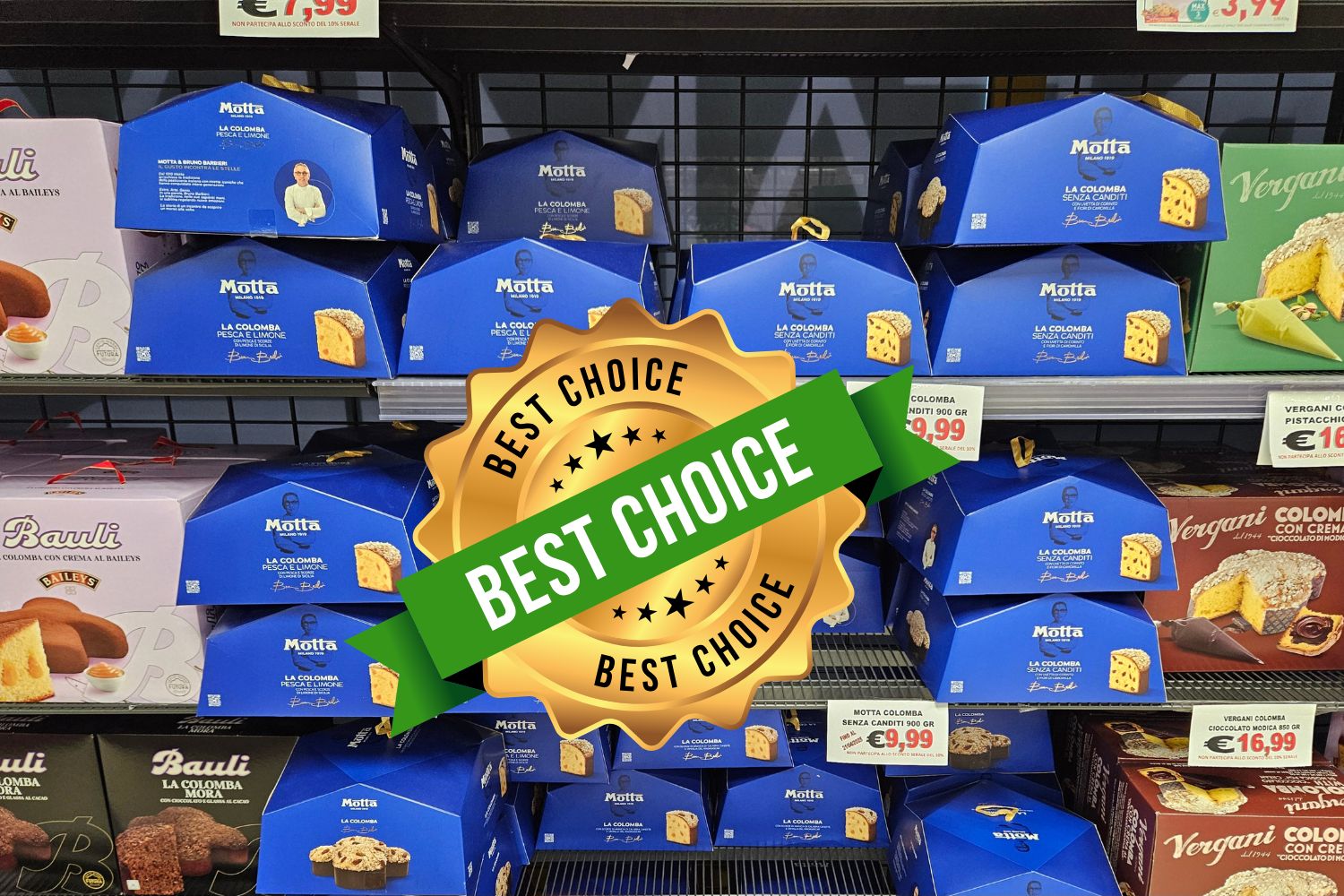
Just as pandoro and panettone are inseparable from Christmas, the dove is the undisputed symbol of Easter. It has been occupying supermarket shelves for weeks, but finding your way around so many products is not easy. Altroconsumo took care of clarifying this by testing 12 different doves, evaluating them according to precise criteria and drawing up a definitive ranking.
How the test was carried out
The tasting sessions were held in March 2026, in three separate events: two in Milan and one in Vico Equense. Two hundred testers participated in the initiative, each tasting six products completely anonymously, without knowing either the brand or the price of what they were evaluating. At the end of each tasting, the participants filled out an online questionnaire expressing their opinion on the appearance, aroma, flavour, consistency and quality of the candied fruit. Each dove was examined by approximately one hundred people. The general verdict is clear: the ideal dessert is rich but not heavy, with a defined but not excessive character.
The two winners
At the top of the ranking there is not just one winner: Giovanni Cova and Tre Marie tied for first place. Giovanni Cova’s colomba convinced with its soft and well-leavened dough, the generous presence of candied fruit and a balanced taste, capable of being delicious without being tiring. Tre Marie instead seduced the testers with the softness of the dough, the pleasant aroma and the perceived quality of the candied fruit. Some found the aroma slightly too strong and the sweetness a little high, but these are marginal observations in an overall very positive picture. Both are in the price range of around 13-14 euros per kilo.
Good value for money doves
One of the most interesting surprises in the ranking concerns the products of large-scale distribution, which have defended themselves rather well despite their low prices. Coop’s Colomba (6.90 euros), Eurospin’s Duca Moscati (5.74 euros), Lidl’s Favorina (5.70 euros) and Esselunga’s Le Grazie (5.69 euros) were all classified in the top half of the ranking. Bauli won third place, confirming a solidity that consumers already know.
The great absentee: character
If almost all the doves tested passed the pass mark, the problem with most of them was the lack of personality. Eight out of twelve products, despite obtaining a positive evaluation, were judged to be unmemorable: pleasant but anonymous, with a weak aromatic profile, scarce or poorly distributed candied fruit. Maina, Melegatti and Motta fall into this category, correct doves but unable to leave their mark.
The chart flops
The most painful notes concern two historic brands: Balocco and Bistefani. The first was disappointing due to a dough judged to be dry, a lack of intense aroma and candied fruit considered insufficient. Things went even worse for Bistefani, the only one that didn’t reach the pass mark: the testers described it as too dry, poor in candied fruit, with a weak and sometimes artificial taste. It is also the cheapest in the test, under 4 euros per pack. A saving which, in this case, was clearly felt on the palate.
The complete ranking
- Giovanni Cova & C. – Classic Colomba with candied fruit
- Three Marys – The traditional dove
- Bauli – The classic dove
- Coop – Classic Colomba
- Duca Moscati (Eurospin) – Colomba
- Favorina (Lidl) – Classic Colomba
- Le Grazie (Esselunga) – Classic Colomba recipe
- Maina – The classic dove recipe
- Melegatti – Classic Colomba
- Motta – Traditional Colomba Bruno Barbieri
- Balocco – The classic recipe dove
- Bistefani – Traditional Colomba with candied fruit
