
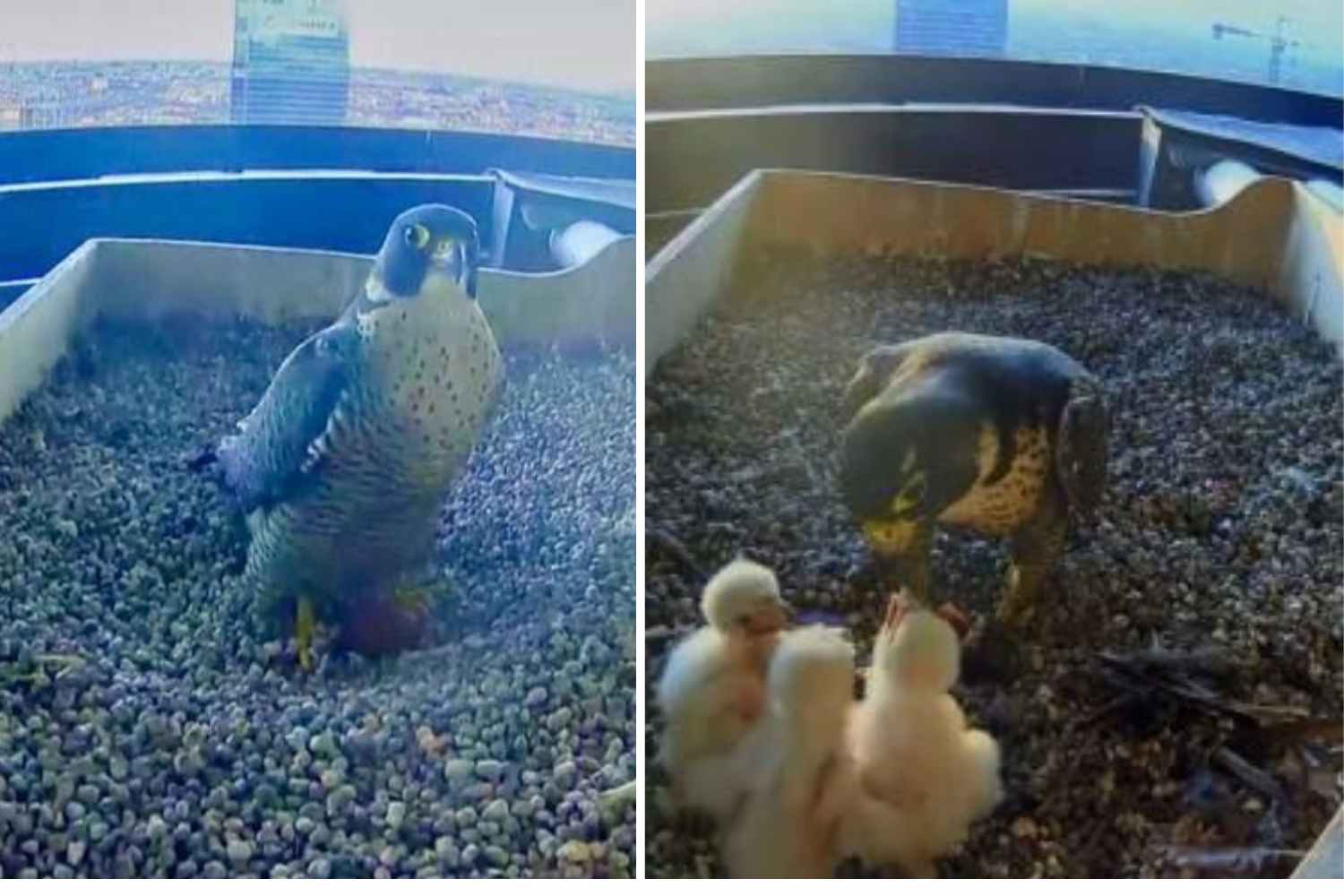
For years they remained confined to the niches of researchers, ornithologists and birdwatchers. Today, nature webcams have turned into a mass phenomenon, an unexpected digital antidote to the frenzy of social media.
There are thousands of people who spend several minutes glued to the screen to watch a stork setting up its nest, an Iberian lynx prowling furtively in the woods or a hawk feeding its chicks on top of a skyscraper. No editing, no tear-jerking soundtrack, no algorithms. Just wild life flowing, in its own time.
The phenomenon, recently relaunched by a Euronews report on the dizzying growth of live streaming in Spain, has its roots in the days of the lockdown. But the real surprise is that, years later, the trend has not lost its bite. Indeed: the platforms that broadcast 24 hours a day from national parks, lagoons and protected reserves now have millions of views.
One case is that of SEO/BirdLife, a historic Spanish environmental organization that positioned the first cameras way back in 2006. The operation requires surgical precision: the devices are installed and camouflaged months before the breeding season so as not to disturb the animals. The result? On the one hand, a goldmine for science, with volunteers collecting valuable data on incubation and behavior; on the other, a magnet for the public.
But what is the real secret of their success? “No scripts, no cuts, no post-production. This is nature, naked and raw”, proudly claim the creators of the Directo Natura platform. In a digital ecosystem designed to continually intercept our attention, wildlife imposes us back to an ancient and stubborn temporality.
View this post on Instagram
The Pirellone hawks
Italy also has its very own naturalistic soap opera. For twelve years, a couple of peregrine falcons, Giò and Giulia, have chosen the roof of the Pirelli Skyscraper in Milan, 125 meters above sea level, as their home. Two webcams focused on the nest broadcast their routine twenty-four hours a day: the hatching, the hatching of the eggs, the first acrobatic flights of the chicks.
That of the Milanese birds of prey has become a city saga. The Milanese follow the birth of their babies with the anxiety and affection that they would reserve for the protagonists of a Netflix series. As reported by the Lombardy Region, this year the family has recently expanded with three more little ones, bringing the total number of little falcons born in the shadow of Pirellone since 2014 to 34.
Giò and Giulia have transformed a symbol of productive, cement and business Milan into an urban observatory on biodiversity. Proving that our connection with nature doesn’t need expensive exotic safaris. A fixed shot is enough, along with a good dose of patience.
Wild life doesn’t have to sell us anything. While the smartphone screen wants to capture our next click, that motionless nest 120 meters above sea level doesn’t care about our time. Thus, in our digital ecosystem saturated with noise, the superb silence of animals and landscapes becomes the only spectacle that is impossible to resist.
