
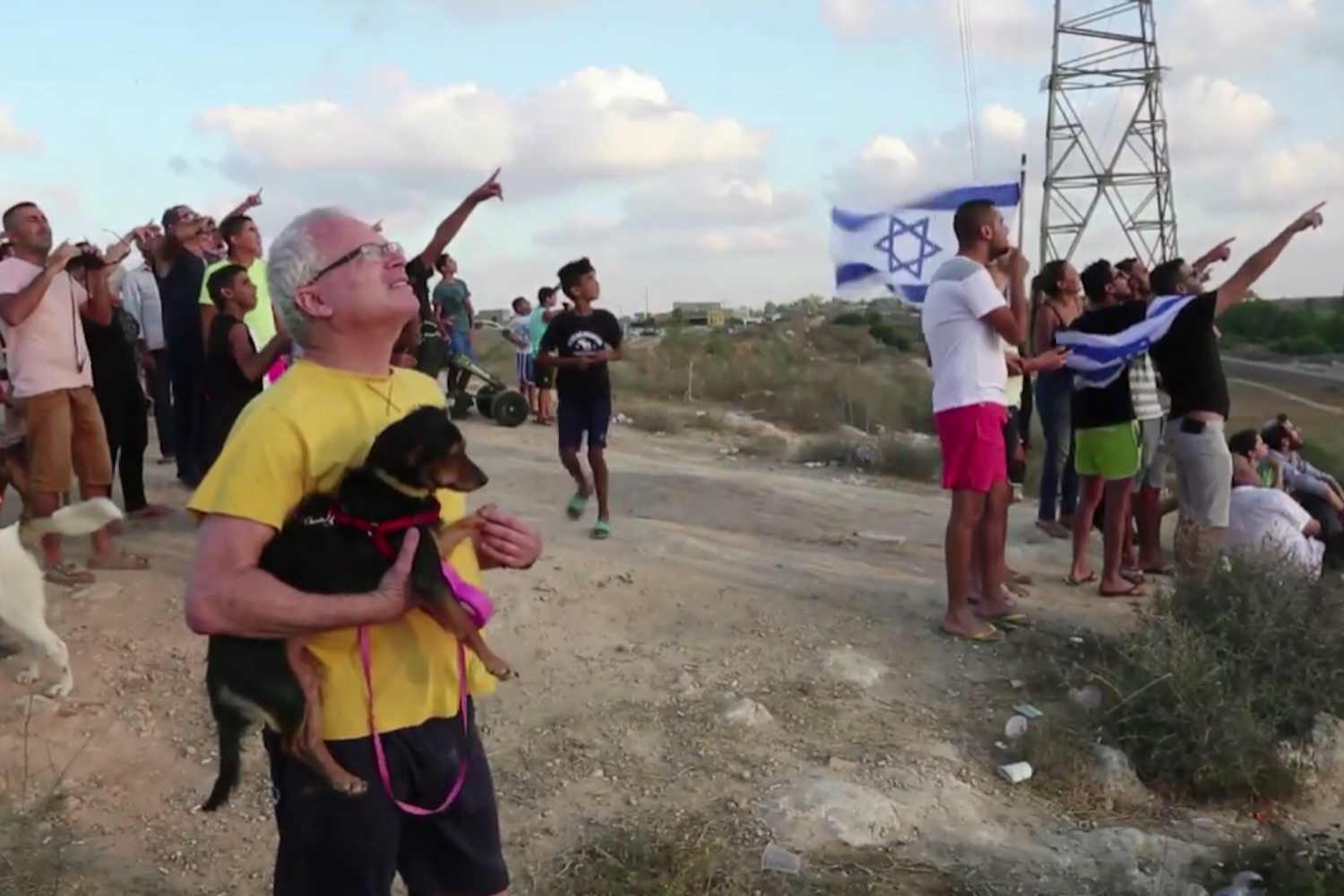
Indeed, there would not be a need for binoculars, given the scope of total destruction. But it seems that from here, from the Sderot hill, you can enjoy a breathtaking view and precisely through a telescope you can admire the long stunning expanse of collapsed buildings and tenth neighborhoods.
That’s right, the Kobi hill, the point that dominates the city of Sderot – a ghost city evacuated by the Government of Israel on the border with the Gaza strip in 2023 – has been transformed into a memorial of October 7, but for at least a decade has become a destination for voyeurism, of the spectacularization of death, the black news, of the genocide.
Here, on this hill of horrors, the envoys of the international press from all over the world arrived at first to film what happens in the Gaza Strip. Then the inhumanization took over (but for years): right in front, 1 kilometer away, after the highway, some fields and a separation barrier, are Beit Hanoun and the north of the Gaza Strip, bombed relentlessly for almost two years.
And thousands of Israeli tourists (probably those who once went to the Nazi fields to attend the remains of the genocide committed against them), gather there to look for five shekel, a little more than a euro, through a telescope, the rubble and the smoke of the bombs in the distance. The view is called “the best show in the city”. While the Monde reports that some Israelis call him “Sdero’s cinema“.
A significant passage, I would say, from the role of victim to the role of executioner.
This disturbing phenomenon, an authentic “genocide tourism”, does not end here. A video clip of the documentary “Holy Redemption: Stealing Palestinian Land ” It has recently circulated on social media and shows the Israeli settlers who organize boat trips to observe the rockets launched by Israel towards Gaza, demolishing buildings and causing hundreds of civil victims:
View this post on Instagram
Israeli tourists who intentionally observe the horrors of war and genocide and transform them into a sort of show reveal a deep sense of barbarism and a perverse pleasure derived from the suffering of others, says Abaher El-Sakka, researcher and sociologist.
The tourism of the genocide is deeply intertwined with the religious and colonial elements of Zionist ideology, explain the experts, but has become particularly relevant during this war, personified by many Israeli figures such as the Minister of National Security Itamar Ben-Gvirthe Minister of Finance Bezalel Smotrich – known for its recent words on the new Gaza of the future – e Daniella Weissthe founder of the organization of the Nachala settlers.
SDerot Cinema. Israelis Bringing Chairs 2 Hilltop in Sderot 2 Watch Latest from Gaza. Clapping When Blasts are Heard. pic.twitter.com/wyzquv62o7
– Allan Sørensen (@Allansorensen72) July 9, 2014
War tourism
Yet war tourism – strictly related to “dark tourism” or “black tourism” is not new: from Waterloo to Gettysburg, the armies that gather on the battlefields have always been followed by branchs of impatient and curious spectators. Generally, tourists actually have always visited areas of conflict or war sites to see the remains of tanks or war planes, with the aim of “reflecting” on the atrocities and on the genocides lived by the nations.
A phenomenon, known as “Tourism of the genocide”, which gained popularity in the 90s, when about half a million tourists visited the concentration camp of Auschwitz, in Poland every year.
As marketing tools, the genocide tourism has taken on a different trajectory. What is new, says Philip Stone, director of the Institute for Dark Tourism Research at the University of Central Lancashire in the United Kingdom, is its marketing.
This phenomenon has historical precedents. It can be argued that with some of his very first tourist groups, Thomas Cook led people to see the hints in Cornwall – he says referring to the founder of the homonymous travel agency and public executions that were common in England in 1700 and 1800. But what is changing is the way these travels are formalized through the tourism industry, as well as the fact that the fact that the technology and the Internet are also resuming.
But is all this legal?
Tourism to promote the narrative of Israeli employment
The tourism of the genocide is not considered a legal practice, according to Azzam Salameh, a specialist in tourist affairs in Palestine.
International law does not recognize the legality of the settlements, as they constitute a violation of article 49 of the Geneva Convention and are against international declarations – he says. Therefore, any Israeli activity conducted on these lands is equally illegal. The goal of genocidal tourism is to mislead, distort and steal by spreading the narrative of employment and strengthening its historical and earth control policies.
Whatever the reason, in front of this reality that leaves dismayed, we cannot remain indifferent.
Transforming pain and suffering into a show to be observed with a telescope means losing sight of what makes us human: empathy, respect, the ability to recognize the other as part of us. The places affected by the war should never become tourist attractions, but spaces of memory, reflection and warning to build a different future.
Because the real act of courage, today, is not to look at the destruction from the hills, but to work – together – to turn off the weapons and return dignity, life and peace to those who have only seen rubble for too long.
Sources: Le Monde / Raseef22 / The Atlantic
