
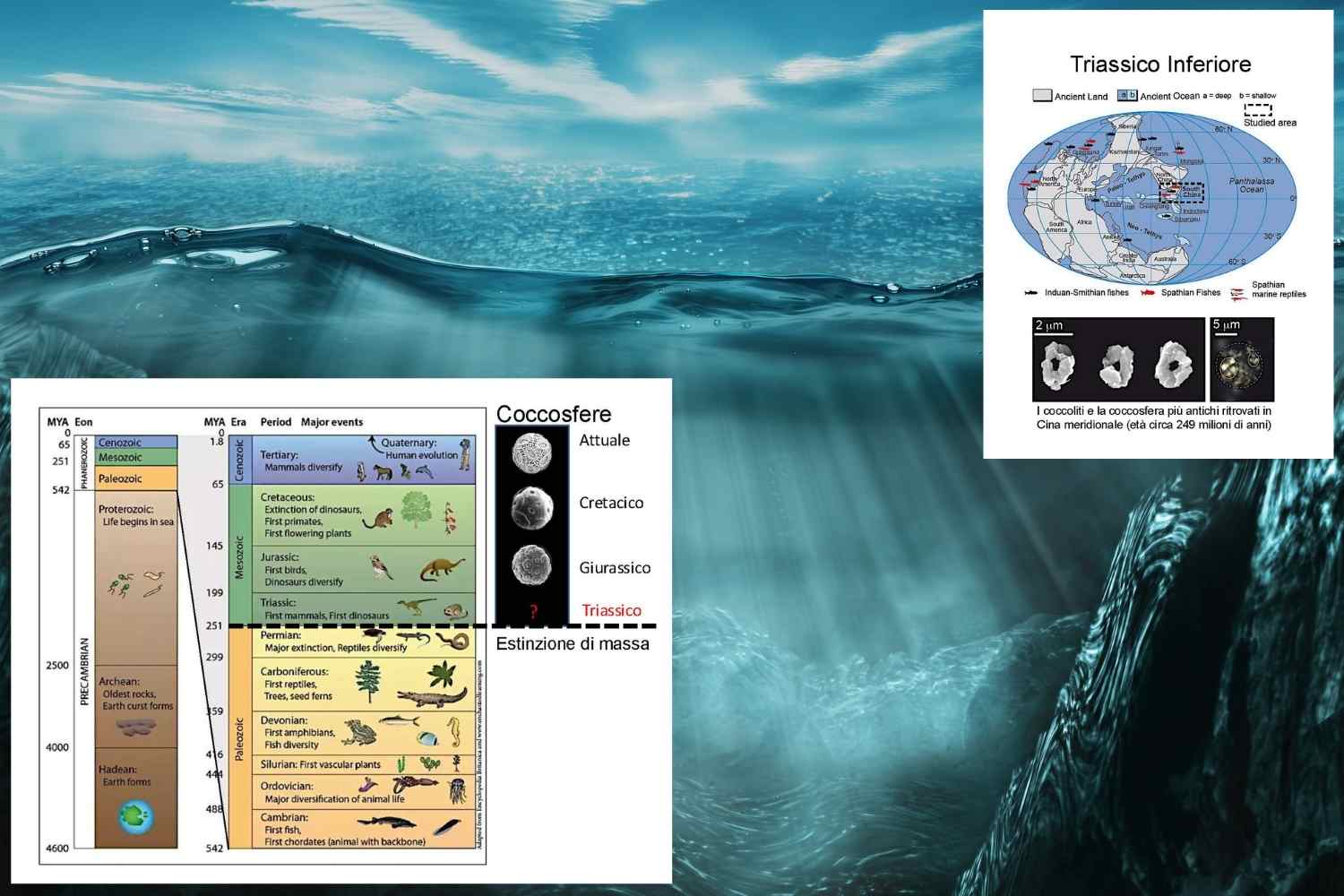
A discovery that comes from a very remote past rewrites the story of one of the main biodiversity tanks in the world. The ocean, as we know it today, with its complex food chains and its biochemical balances, could be much older than we have always thought. Not a few thousand years, but of 40 million. The merit is of an all-Italian intuition and an almost detective investigation, conducted on ancient rock samples from southern China, which revealed the presence of an unexpected protagonist: an ancient micro-algae, the ancestor of organisms that are still the invisible engine of marine life today.
The research, coordinated by the Department of Sciences of the “Ardito Desio” Earth of the State University of Milan in collaboration with the University of Beijing, the University of California and the Center of Geoscienze Marine (Geomar) of Kiel (Germany) and published in the Italian magazine of Paleontology and Stratigraphy, has brought to light the oldest tracks ever found of CoccolitoForoids, a type of limestone phytoplacton. These are single -celled algae, a few thousandths of a millimeter, which have a unique feature: they build around them a spherical shell made up of tiny calcium carbonate plates, cuddles. When they die, we read in the study of the Milanese university, these microscopic skeletons slowly precipitate towards the seabed, accumulating in layers of sediment which, during the geological eras, become rock and, for paleontologists, a very precious archive.
Until now, the oldest finds of these limestone nannofossili dates back to about 210 million years ago (therefore in the era called superior triassic). The new Chinese champions, however, moved the hands of the time back to 250 million years ago, immediately after the most devastating mass extinction of history, that of the end allowed, which canceled over 90% of the marine species. It is precisely in this apocalyptic scenario that the key to everything is hidden.
The double role of the micro-alga
But why is the dating of a micro-alga so important for all of us? The reason is twofold. First of all, the cuddlyoforids are the basis of the ocean food chain: they are the “lawn” of the seas, the primary food for larger organisms which, in turn, nourish fish and marine mammals. Their appearance has started a complete renovation of ecosystems, laid the foundations for modern marine fauna.
Secondly, and this touches us even more closely, play a crucial role in the carbon cycle. Through photosynthesis, they absorb carbon dioxide (CO₂) from the atmosphere. In addition, to build their kicita shells (calcium carbonate), seize carbon and carry it permanently on the ocean seabed. In short, for hundreds of millions of years they have contributed to regulating the climate of the planet. Understanding when they started doing it means understanding when the ocean started working as the great “blue lung” that we know. And, consequently, like our own breath.
The study suggests that their evolution was triggered precisely by the consequences of the Permian catastrophe. The colossal volcanic eruptions in Siberia had filled the atmosphere of CO₂, making the oceans more acidic and poor in oxygen. At the same time, however, the widening of the emerged lands, accelerated by a crazy climate, poured a huge amount of nutrients into the sea. In this extreme but fertile environment, some algae developed a brilliant survival strategy: calcification. The shell not only offered protection, but allowed to thrive in a chemically different sea.
The word to science: “A turning point for the history of the oceans”
“The discovery of cuddly and coccosfere dating back to about 249 million years ago, in marine sediments of the lower Triassic of southern China, represents a turning point for paleontology and history of the oceans”, explains Elisabetta Erba, professor of Paleontology and Paleoecology of the University of Milan and first author of the study in the study. “These primitive, small (2–2.5 microns) and simple cuddles suggest that the calcification emerged immediately after the end of the end of the end of the end, favored by new environmental conditions and free ecological niches that have pushed the croccoliing algae towards adaptive innovations”.
This discovery is not a detail for a few specialists. He demonstrates how, even after the most dramatic of events, life is able to find new and resilient paths, reorganizing himself and giving rise to completely new ecosystems. The expansion of this phytoplankton, during the triassic, went hand in hand with that of fish and large sea reptiles, confirming a very close link between the base and the top of the food pyramid.
As Cinzia Bottini, co -author of the study and professor at the same department, concludes, “our discoveries date the birth of the modern ocean at the dawn of the Mesozoic and underline the profound interconnections between geological processes, oceanic chemistry and biological innovation. The emergence of crocolitogenesis immediately after the end of the end of the end of the permian is a spectacular example of close correlation between geological processes and geological processes evolution of life “.
Don’t you want to lose our news?
