
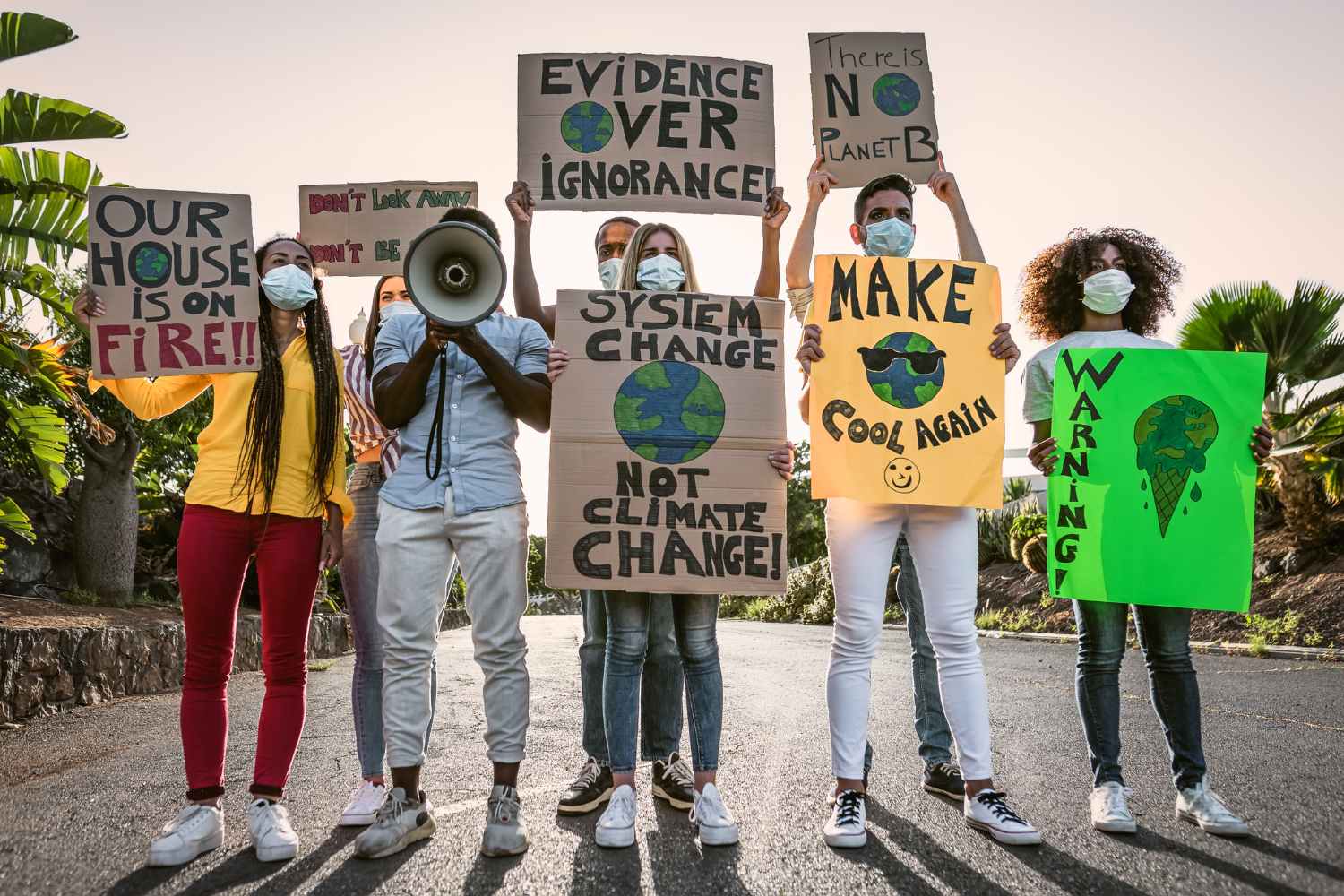
International Youth Day was celebrated on 12 August. And this year there is a fact that stands out between all: in Italy, almost one in two young men (46%) considers the environment and climate change the absolute priority for the European Union. More than in any other EU country, rather than in Denmark (44%) and France (40%), and even more than the cost of living, which still remains an urgent problem.
The figure emerges from the European investigation on Youth 2024 of the European Parliament, made on 25,863 boys and girls between 16 and 30 years in the 27 Member States. At European level, the ranking of concerns sees the increase in prices first (40%), followed by the environment and climate (33%) and the economic situation and work creation (31%). But in Italy the climate beats all the other categories.
It is not a simple generic sensitivity. The report highlights that environmental awareness is more marked among those who have completed postsecondic or higher education paths. It is therefore not only a “generational” question, but also of cultural tools to read the climatic crisis and connect it to European policies.
This has concrete consequences: countries where climatic priority is more felt could be those where green investments find greater social support. A signal also for governments and companies, which must consider environmental measures not as a luxury, but as a perceived and shared urgency.
Values and expectations
The same investigation shows that, in addition to the environment, young Europeans attribute great importance to the protection of human rights, democracy and peace (45%) and freedom of speech and thought (41%). These values define expectations towards EU and companies, especially in terms of governance and social responsibility.
31% of young people interviewed are in favor of the EU and its current operation, 32% favorable but critical on management. Compared to 2021, the “convinced” grew by four points.
Information
Most of the young people (42%) are especially informed through social media, more than television (39%). Instagram, Tiktok and YouTube are the dominant platforms. But this digital preference has a downside: 76% say they have come across disinformation in the last week. Despite this, 70% feel capable of recognizing it.
For institutions and those who communicate environmental issues, this means that credible messages must be present where young people are already active – and in a language that speaks their own visual and narrative grammar.
Technology and participation
The investigation also photographs a massive adoption of artificial intelligence tools: 57% used them in the last year, especially for study or research (36%). On the political front, among those who have not voted in the European elections of June 2024, the main reasons were other commitments (16%) and the lack of information (16%).
Climate and cost of living: a balance to be found
The picture that emerges is clear: the measures to improve economic accessibility remain fundamental, but cannot be disjointed by the action for the climate. The challenge for the EU and governments will be reconciled the two priorities, avoiding that one be perceived as one brake to another.
For Italy, 46% of young people who put the climate in the first place is not just a statistics: it is a political and cultural signal. It means that a substantial part of the new generations does not consider ecological transition a passing fashion, but a matter of survival and justice.
And on the occasion of the International Youth Day, perhaps the strongest message is precisely this: to protect the planet is not a distant ideal but the priority most felt by who the future will have to live in it.
Don’t you want to lose our news?
