
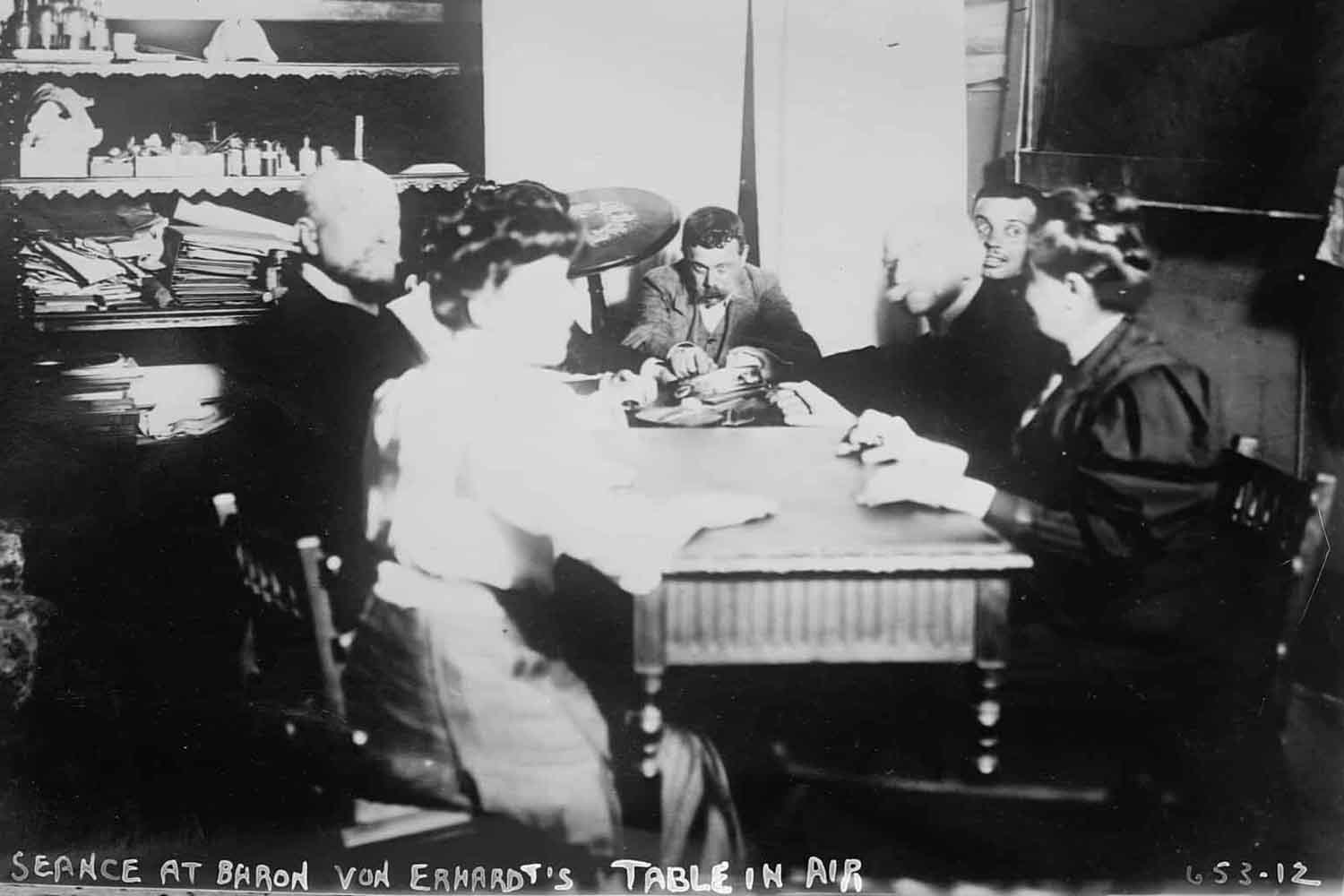
In November 1857, during a séance in Jersey City, United States, the medium Leah Brown reported having seen lights appear so intense that she felt her hands burning. He ran to cool them under the water, then went out into the garden and sunk them into the earth which was still damp from the rain. The next evening, in that very spot, the landlady said she had found some luminous granules. It was phosphorus.
The story appears in The Missing Link in Modern Spiritualismthe memoir published in 1885 by the same medium, who in the meantime had become Leah Underhill. According to the woman, those particles had been produced spontaneously by her body thanks to the intervention of spirits. An explanation that left even some of those present perplexed, so much so that a friend wrote to her asking for clarification.
The suspicion was quite simple: that Brown had brought the phosphorus with him and had used it during the session. She denied any accusation and recounted other similar episodes, including that of a doctor who apparently burned his fingers trying to collect some granules that appeared during a subsequent demonstration.
We cannot know for sure how the phosphorus got into those rooms. The supernatural explanation, however, had a decidedly more concrete competitor, known to chemists and anyone who worked with that substance. To make something mysterious appear, all you had to do was turn off the lights.
Because white phosphorus glows in the dark
White phosphorus has a characteristic that, in a nineteenth-century room lit by candles, must have made a certain impression: it can shine even when everything else is immersed in darkness. It happens because it reacts with oxygen in the air, producing a faint glow. It’s called chemiluminescence: the energy released by a chemical reaction is also emitted in the form of light.
A small amount of phosphor, in the dark, could therefore appear as a hovering glow, a luminous hand, or something that seemed to move without explanation. For those who were already convinced they were participating in a séance, the connection with the world of the dead could be quite convincing.
Too bad that white phosphorus is also extremely toxic and flammable. As the National Institute for Occupational Safety and Health (NIOSH) explains, it can ignite spontaneously in contact with air and cause serious burns. Exposure can cause poisoning and damage to various organs. A rather challenging material to handle, especially if the goal was to convince someone that they had met a deceased relative. And its dangers were already known in the nineteenth century. Especially from those who worked in match factories.
The poison of the ghosts was the same that made the workers sick
For much of the 19th century, white phosphorus was used in the production of matches that could be lit by striking them on various surfaces. They were practical, economical and in great demand. Above all, the people who produced them paid the price. Many women worked in British factories, often for very low wages and in precarious hygienic conditions. Breathing phosphorus vapors for years could cause a disease called phossy jawa form of phosphorus necrosis that affected the mandible or maxilla.
It started with toothache and swelling, then there could be infections, abscesses and the progressive destruction of bone tissue. In the most severe cases, the disease caused permanent facial deformations and could be fatal. The British National Archives preserve documents that describe the conditions of the workers of the Bryant & May factory in London, protagonists of a strike in 1888 against low wages, arbitrary fines and working conditions.
Among those documents there is also a report relating to the period 1882-1897: in people affected by phosphorus necrosis, the mortality recorded in the factory reached 19.15%. Almost one in five. The toxicity of the substance, therefore, was far from unknown. Yet its use continued, so much so that in 1898 the company ended up in court for failing to report several cases of poisoning.
Of course, attending a few seances is not the same as spending years in a match factory. We have no evidence that mediums developed the same disease as workers. But the risk of burns and poisoning was real even during the alleged apparitions.
Luminous paints and scientists chasing ghosts
Not all luminous ghosts, however, required such dangerous substances. In 1877 the British inventor William Henry Balmain patented a phosphorescent paint based on calcium and sulfur compounds in England. The principle was different from that of white phosphorus: the material absorbed energy from light and continued to emit it for a certain period in the darkness.
The 1882 US patent described numerous applications, from signs to room lighting. It was enough to expose the paint to light and wait for darkness to see it shine. Similar materials could also be used to create scenic effects, without the need for any spirit to intervene. The question intrigued even the most respected scientists of the time.
In 1874 the British chemist William Crookes published his research on spiritistic phenomena, in which he described luminous objects, flashes and alleged apparitions observed during various séances. He knew it was possible to produce artificial effects using oil containing phosphorus and claimed to have taken precautions to avoid any deception. Crookes was an accomplished scientist and took his investigations very seriously. Yet, despite knowing the possible tricks, he remained convinced of the authenticity of some observed phenomena.
Historian Richard Noakes, in the book Physics and Psychicsreconstructed precisely this relationship between physics and spiritualism in Victorian England. The scholars attempted to apply experimental methods to the alleged supernatural manifestations, while those who organized the sessions often resorted to scientific language to give credibility to their stories. Science was looking for explanations. Spiritualism sought confirmation. And in some cases the same people were doing both.
Sherlock Holmes also encountered a phosphorus ghost
One of the most famous literary examples appears in the novel The Hound of the Baskervillespublished by Arthur Conan Doyle between 1901 and 1902. In the story, a huge dog looks like a hellish creature, with its eyes and muzzle surrounded by ghostly glows. The mystery is solved when Sherlock Holmes discovers that the animal has been treated with a phosphorus-based preparation. A rather cruel ploy, given that the material used to terrorize the victims could also harm the dog.
The curiosity lies above all in the author. Conan Doyle, creator of the detective who sought rational explanations for even the most absurd events, was deeply interested in spiritualism. Over the years he became a staunch supporter, dedicating books and conferences to the possibility of communicating with the deceased.
In short, the creator of Sherlock Holmes was much less skeptical of his character. Today we are accustomed to fluorescent skeletons, glowing ghosts and glow-in-the-dark Halloween decorations. In the nineteenth century, however, an illuminated hand in the middle of a session could convince those present that they had witnessed something supernatural.
To achieve that effect, in some cases, all that was needed was a chemical substance. The same one that, outside the darkened rooms of seances, caused match workers to lose their teeth, jaws and even their lives. Ghosts have never needed a doctor. Unfortunately, those who worked with phosphorus did.
