
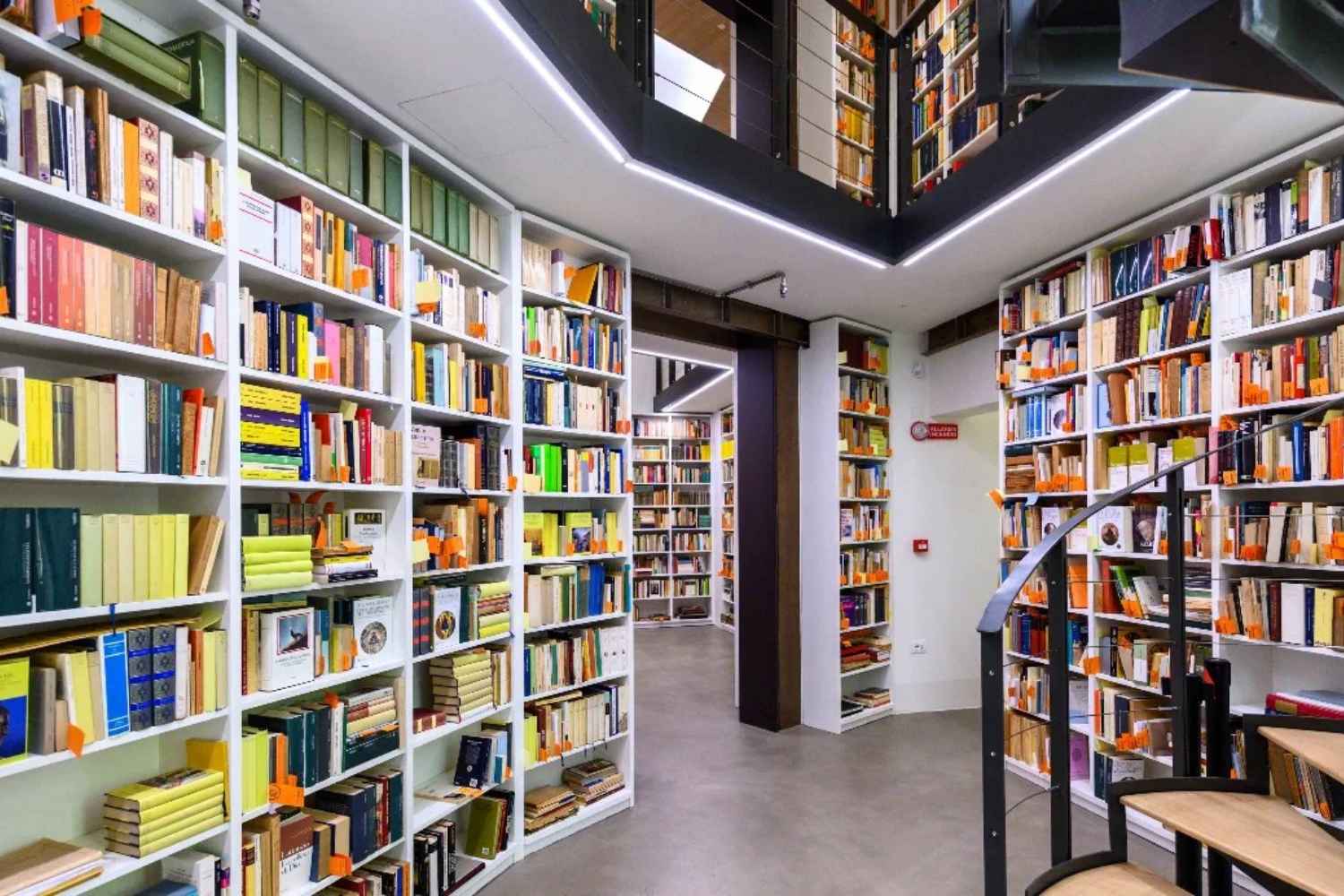
Exactly ten years after the death of the famous semiologist and writer Umberto Eco, the city of Bologna celebrates the birth of one of the most important author documentation centers of the contemporary era. In fact, the Eco Library has officially opened its doors, a cultural treasure chest located in the twentieth-century wing of the historic Palazzo Poggi, with main access from Piazza Puntoni 2.
The monumental complex houses the endless collection of texts that accompanied the teacher during his life, previously kept in the long corridor of his Milanese home in Piazza Castello. The operation, made possible thanks to the donation of the heirs formalized in 2020 in favor of the Italian State and granted on loan to the University of Bologna, represents a crucial piece for the academic memory of the Alma Mater, where the intellectual held the chair of semiotics from 1971 to 2007.
Over 32,000 volumes and more to come
The first block to arrive in the city has over 32,000 volumes, waiting for the collection to be definitively completed with the subsequent transfer of the texts kept in the country house in Monte Cerignone, in the Marche region. Proudly welcoming this immense heritage was the mayor of Bologna, Matteo Lepore, who underlined how the collection constitutes in all respects a shared laboratory of ideas, capable of ranging from medieval philosophy to great novels, up to the most unusual disciplines. The new location in Bologna acts as a natural extension of a scientific path that has trained generations of academics in Emilia-Romagna.
@Municipality of Bologna
The good neighbor law and three-dimensional readings
The truly extraordinary element of the project lies in the faithful mapping of the home space. Before the transfer, the entire Milanese bookshop was surveyed and photographed shelf by shelf, to document the thematic sequences and the geometric order established by the author. The technicians thus applied the famous principle of the good neighbor to Palazzo Poggi, a methodological theory formulated by the art historian Aby Warburg and deeply shared by the owner himself.
According to this vision, the book you need is almost never the one you are looking for, but rather the one positioned immediately next to it, capable of stimulating interdisciplinary references and unpredictable mental connections. The geography of the thematic rooms allows for a double reading of humanistic knowledge. Moving horizontally and diachronically, the visitor crosses the timelines of individual national literatures (from the Anglo-Saxon tradition to the French, Slavic or Spanish-American one).
By instead moving vertically and synchronically, it is possible to understand the trend of a specific era in different countries around the world at the same historical moment. Apparently bizarre juxtapositions thus reveal the writer’s mental structure: Jonathan Coe’s novels rest alongside those of Alice Munro and Vladimir Nabokov, just as Danilo Dolci’s texts border on the works of Milo De Angelis and Roberto Di Marco.
From tarot cards to Linus: the secrets of a creative laboratory
The rooms in Bologna preserve the primary sources that fueled the writing of world literary masterpieces. The shelves host an endless section dedicated to cabala, alchemy, magic, occultism and conspiracy theories, fundamental study subjects for the narrative architecture of novels such as Foucault’s pendulum or The cemetery in Prague. Even original tarot decks used for research emerge from the volumes dedicated to esotericism. Alongside the most rigorous non-fiction there is an immense collection of popular culture and classic comics, including the complete collection of the magazine Linusof which the teacher was co-founder in 1965.
The university fund also hosts over 2,000 works written or edited by the semiologist, translated into dozens of languages, and around 600 degree and doctoral theses focused on his thought. Of absolute value are the working copies of his novels, such as the fourth Italian edition of The name of the rosefull of handwritten corrections and notes in the margins. This authorial heritage, now accessible to scholars and the public through guided tours upon reservation, presents itself as a dynamic map of knowledge, an intellectual labyrinth that has remained intact in its original charm.
You might also be interested in:
