
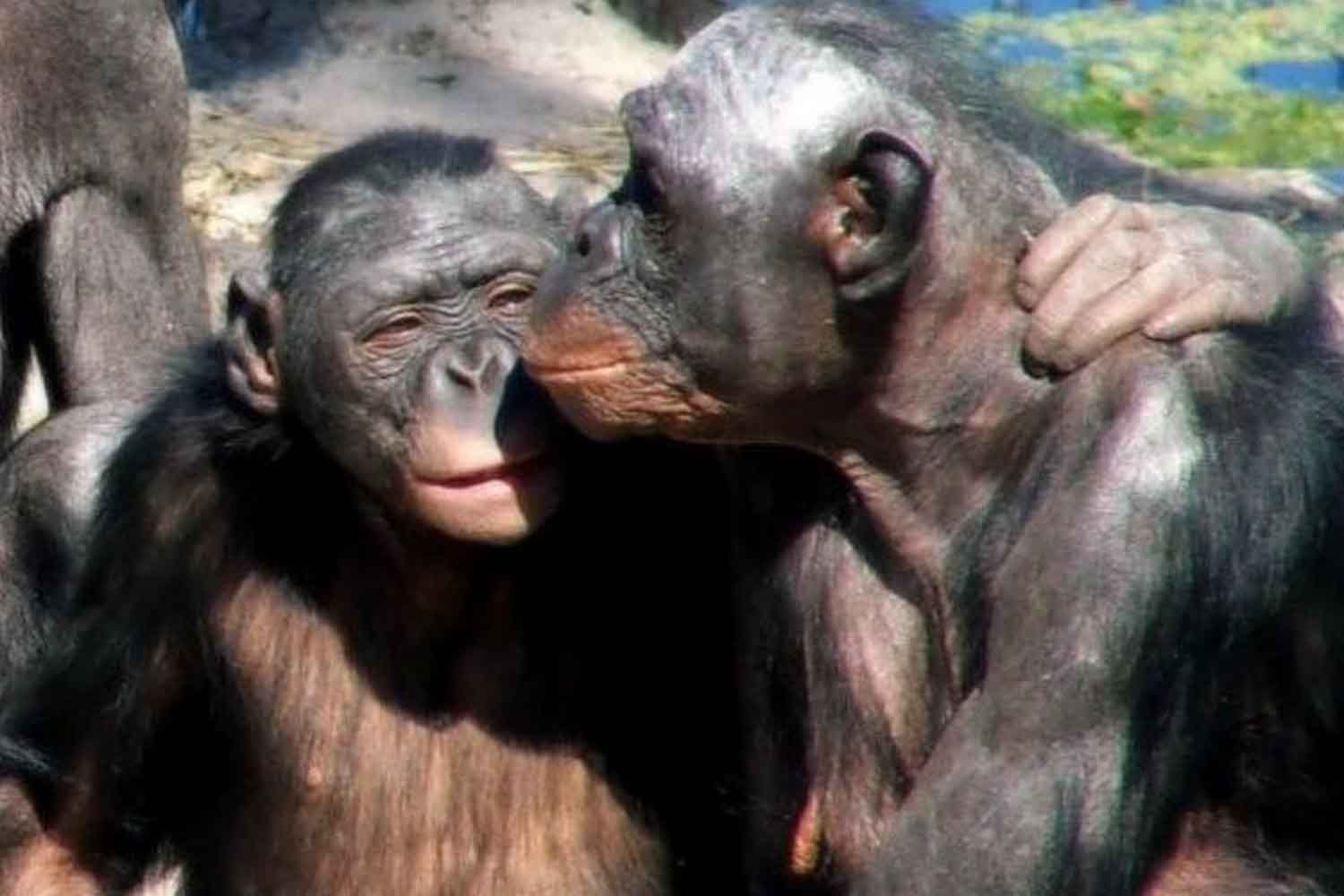
The first kissthat gesture that we today associate with intimacy and romance, could have much older roots than we imagined. According to new research, the origins of pressing lips together date back as far as over 21 million years agowhen a common ancestor of humans and great apes would have already practiced this behavior.
Scholars have tried to solve an evolutionary enigma that has long intrigued the scientific community: why do humans (but also many other species) kiss, even though the gesture does not seem to offer a clear advantage for survival?
The first kiss in the history of evolution
To build a credible picture of the origin of the first kissthe researchers had to start from an extremely precise definition. In the study published in the journal Evolution and Human Behaviorthe kiss is described as touching non-aggressive oral-oralwith movement of the lips (or equivalent parts in animals) without exchanging food. A scientific definition, perhaps not very romantic, but necessary to compare similar behaviors in the most diverse species.
By analyzing videos, field observations and ethological documentation, scholars have identified real “kisses” in an incredible variety of animals: chimpanzees, bonobos, wolves, prairie dogs, polar bears – known for being particularly exuberant, with abundant use of their tongue – and even albatrosses. This widespread presence of the gesture has allowed us to reconstruct an “evolutionary tree of the kiss”.
According to researcher Matilda Brindle, an evolutionary biologist at the University of Oxford, the presence of behavior in chimpanzees, bonobos and humans suggests with good probability that their common ancestor also practiced it. Hence the hypothesis that the origin of the kiss dates back to approximately 21.5 million years agothe era in which great primates were evolving.
The link between Neanderthals and Homo sapiens: a prehistoric kiss?
The study opens up another fascinating scenario: even i Neanderthalour very close cousins who became extinct about 40,000 years ago, may have kissed.
Previous genetic research has in fact identified a identical oral microbe in the mouths of Neanderthals and modern humans. Sharing that bacterium is only possible in one case: prolonged exchange of saliva over hundreds of thousands of yearswell after the evolutionary separation between the two species.
In other words, not only did Neanderthals kiss… they might have exchanged kisses with the first Homo sapiens.
Why do we kiss?
The new study tells us When the first kiss was born, but not Why. The hypotheses remain different and fascinating: it could derive from the rituals of grooming present in primates, could serve as a tool to evaluate the Healthsmell, immunity or compatibility of a partner or it could be a social behavior born for consolidate ties and reduce conflicts.
For scientists, understanding the kiss means understanding something profound about our very nature and the roots of emotions.
As Brindle concludes:
It’s a behavior we share with many non-human species. It deserves to be studied, not ridiculed just because in us it has a romantic meaning.
