
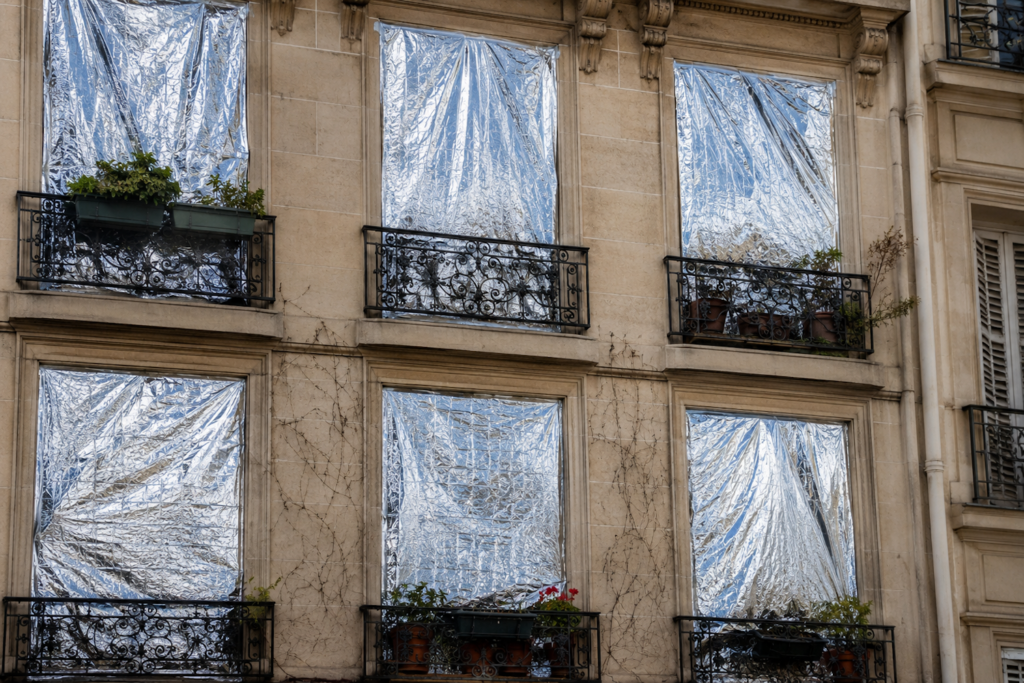
Thermal emergency blankets, the ones we usually see in migrant landings (in the days when rescues were permitted, ed.) hanging from the windows, car sunshades transformed into home insulation, fans pointed outwards and wet towels in front of the openings. In France, where the June 2026 heat wave is breaking historical records, anti-heat creativity has become a collective and…viral phenomenon!
On French social networks, from TikTok to Instagram, thousands of people share improvised solutions every day to make apartments designed to retain heat in winter and not to face 40 degree summers livable.
Thermal blankets on the windows: from a symbol of emergencies to a shield against the sun
The image that is most striking to French public opinion is that of the silver thermal blankets – the same ones distributed during humanitarian emergencies and migrant landings – fixed to the windows of houses, hospitals and attics.
The logic is simple: the metallized material reflects a significant part of solar radiation and limits the overheating of environments. The practice has become so widespread that it is covered by national newspapers such as Le Parisien, which defines it as one of the cheapest and most effective solutions against extreme heat.
Videos of people covering windows and skylights with these silver sheets are multiplying on French social media. Some users claim to be able to lower the internal temperature by a few degrees, while admitting a non-negligible side effect: living practically in the dark.
The “D system” against the heat
In France there is a widely used expression: système D, where the “D” stands for débrouille, to make do.
And making do is precisely the key word for summer 2026.
In non-air-conditioned hospitals, thermal window coverings are used to protect patients and staff from excessive temperatures. In many homes, however, old car sunshades are recovered to be fixed to the most exposed windows.
Other Frenchmen experiment with increasingly elaborate setups with fans and air currents. Among the most shared techniques online is that of the “air tunnel”: an open window on one side of the apartment and a fan facing outwards on the other, in order to expel the hot air accumulated inside.
View this post on Instagram
From social media a collective guide to climate survival
Social networks have become a sort of participatory urban survival manual.
View this post on Instagram
Videos and tutorials explain how to use reflective sheets, wet towels, ice in front of the fans or homemade screens built with recycled materials. According to several French media, the network has transformed into a gigantic database of practical advice for dealing with temperatures that are increasingly difficult to bear.
However, behind the almost ironic aspect of these do-it-yourself solutions lies a very serious problem: millions of French people live in buildings without air conditioning and often poorly adapted to new climatic conditions.
When the heat changes the face of cities
The proliferation of “silver windows” speaks of something that goes beyond the simple search for refreshment. For many French observers, it is the visible sign of a society that is trying to adapt, often in an improvised way, to a climate that changes more rapidly than infrastructure. As thermometers continue to rise and heat waves become more frequent and earlier, thermal blankets hanging from balconies and skylights are becoming one of the most striking symbols of the 2026 French summer.
