
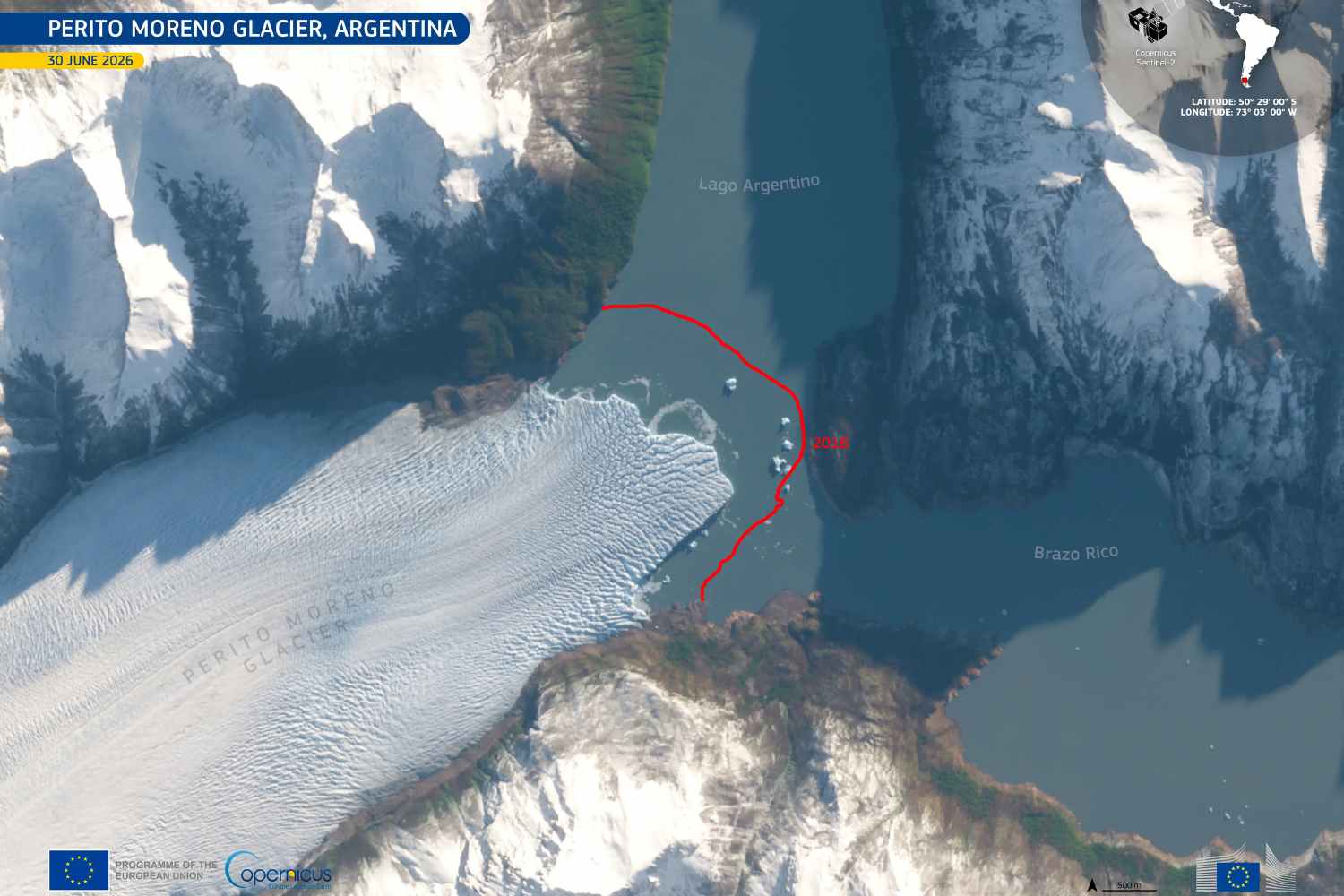
The comparison is contained in a single satellite image, which shows the position of the Perito Moreno front in 2016 and that detected on 30 June 2026 by the European Sentinel-2 satellite and shows us the movement of a mass of ice which for decades had followed a different behavior compared to most of the large glaciers on the planet.
In Los Glaciares National Park, in Argentina’s Santa Cruz province, Perito Moreno has begun to retreat. A change awaited by scholars, but which remained unexpected for a long time precisely due to the characteristics of this glacier, considered one of the few capable of maintaining a substantial balance while other glacial areas were rapidly losing surface area.
Data collected through satellite observations and scientific studies indicate a new phase. In 2025 the glacial front retreated by approximately 385 metres, the highest value recorded since 1997. Since 2019 the overall retreat has exceeded 800 metres, while between 1997 and 2023 the glacier has lost over 3 square kilometers of surface.
#EcoImpacto #Patagonia The glacier that seemed eternal began to change
385 meters in 2025. The mayor will be relegated from the series.
El Perito Moreno —"one of the planet’s great glacial exceptions due to its relative stability"according to the investigator Rodrigo Abarca of… pic.twitter.com/tMKf16rJHk
— El Paraguayo Independiente (@EPInoticias) July 16, 2026
Monitoring from space photographs the change
The evolution of Perito Moreno over the last thirty years was reconstructed by a study published in the journal Progress in Physical Geography and conducted by researchers from the University of Concepción, in Chile. The analysis of satellite images made it possible to follow the variations of the glacial front and to identify the acceleration of retreat in more recent years.
According to Rodrigo Abarca del Río, researcher in the Geological Sciences department of the Chilean university, the current behavior of the glacier probably represents “a transition towards a new condition”, more similar to that of the other glaciers of the Southern Patagonian Ice Field, which have been receding for some time.
The change also affects the physical structure of the glacier. For a long time, Perito Moreno maintained a natural support point thanks to a submerged rocky ridge that helped stabilize the front. The thinning of the ice has changed this balance: the glacial mass has lost part of its contact with the seabed and the water from Lake Argentino can penetrate more easily to the base, favoring fractures and detachments.
Patagonia is experiencing the effect of global warming
Studies link the new phase of Perito Moreno to the increase in temperatures and changes in regional climatic conditions. Over the last thirty years the average summer temperature in Patagonia has increased by around 1.2 degrees centigrade.
The Argentine case takes on particular value because it concerns a glacier long considered an exception. Its retreat in fact reduces the distance between the situation of Perito Moreno and that already observed in many other glacial systems in the world.
The same signal comes from the Alps
From Patagonia to the European mountains the picture remains that of an accelerated loss of ice. In the Swiss Alps, the WSL, the Swiss Research Institute for Forest, Snow and Landscape, has detected a “Glacier loss day” in 2026 brought forward to June 29th: from that moment the seasonal snow is no longer sufficient to protect the ice accumulated in previous years.
The lack of winter snow and high temperatures favored faster melting. Even in Italy, the monitoring of the Italian Glaciological Committee records critical conditions, with freezing temperatures often above 4,000 meters during the hottest periods.
Perito Moreno is no longer just the glacier of spectacular images and periodic ruptures of the ice arch. The new measurements tell of a natural system that is changing, observed today with a precision that was unthinkable until a few decades ago thanks to satellites and continuous monitoring.
