

No, it’s not a joke, but a centuries-long enigma that has even provoked heated debates among some of the world’s most important botanists.
The confusion surrounding the two genres, Hamaryllis And Hippeastrumstems from their complex history dating back to the 18th century, and the true identity of these colorful blooms is still considered a gray area for many experts.
To put things into context, the beautiful winter flower we’ve all come to love – with its lush petals, warm, vibrant colors and festive connotations – is not the Amaryllis, but the Hippeastrum.
Confused? To put it simply, the true Amaryllis is a bulb from South Africa with only one species in the genus, namely Amaryllis belladonna.
In contrast, Hippeastrums come from Central and South America with 90 species and over 600 cultivars in the genus – and these are the flowers sold around Christmas.
But it took botanists on both sides of the Atlantic half a century to reach this decision – which was made at the 14th International Botanical Congress in 1987 – and even today the name Amaryllis is most commonly used to incorrectly describe Hippeastrum.
The name Hippeastrum was coined by the English botanist, the Reverend William Herbert, and derives from Greek hippeus (knight) e astron (star) due to the flower’s resemblance to the “knight’s star”, a medieval weapon.
There is a simple and immediate way to distinguish the two plants without having to consult a botany manual: just observe the floral stem. The Hippeastrum has a hollow stem inside, while that of the Amaryllis belladonna is full and solid. An apparently minor detail, but extremely useful for anyone who wants to identify them with certainty simply by holding them in their hand.
A little history
It is not clear whether the plant cataloged by Linnaeus as Amaryllis was a true Amaryllis (Amaryllis belladonna) from South Africa or a Hippeastrum (Hippeastrum equestre) from South America.
Scientists often argued until finally in 1987 the International Botanical Congress decided that the flower sold as Amaryllis was actually Hippeastrum. But despite this the name Amaryllis remained.
Amaryllis
The true Amaryllis – Amaryllis belladonna – is also known as the Jersey lily or nightshade lily. Its leaves do not appear until the flower has bloomed. The flowers are not as large as the many Hippeastrum cultivars, but the colors are just as intense.
There is only one species of Amaryllis, Amaryllis belladonna, and it is native to South Africa. The plant remains dormant during the summer, remains bare until mid-August, and then flowers in autumn.
Another characteristic is the scent of the flowers, whose color ranges from white to dark pink, which are always open and facing the sun.
Hippeastrum
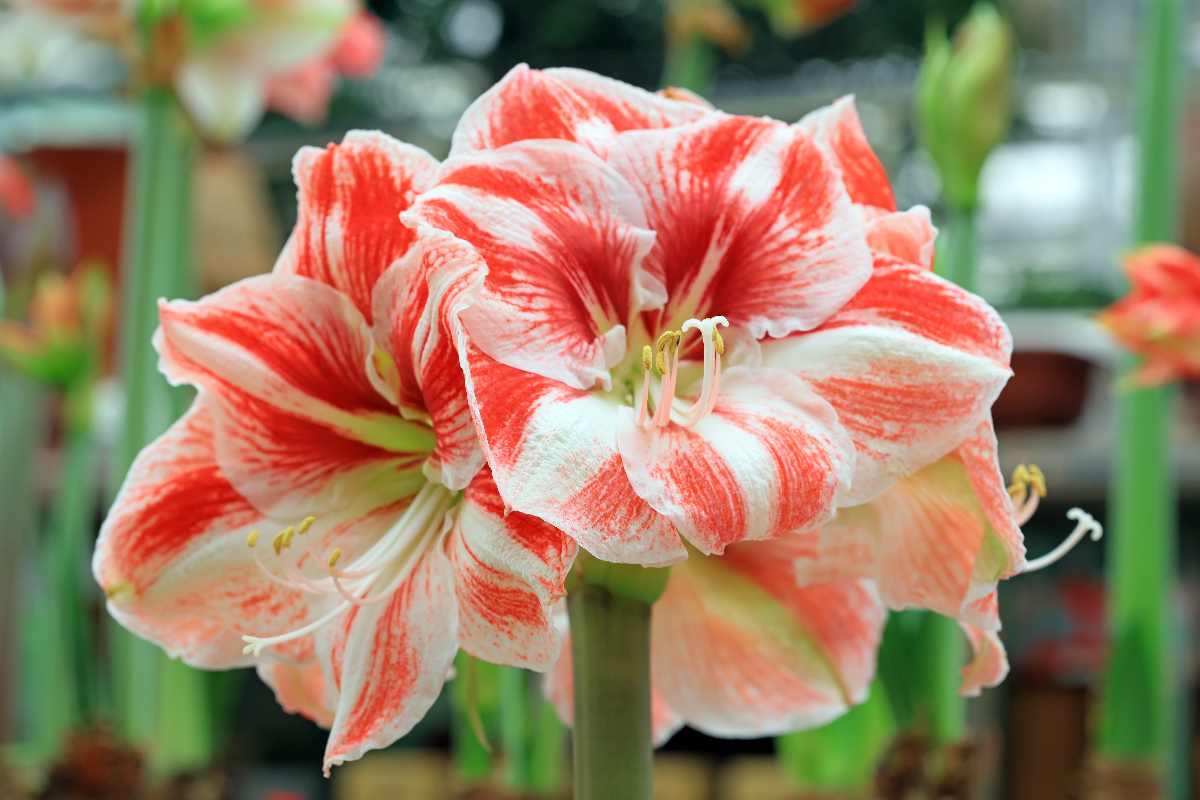
Hippeastrums are native to South America, and available in a variety of cultivars.
Sources state that there are approximately 600 different Hippeastrum hybrids (all most likely mislabeled as “Amaryllis”).
Most Hippeastrums have no scent, unlike Amaryllis.
Furthermore, the flowers of the Hippeastrum are generally 4 per stem and arranged in a cross. The leaves emerge after flowering and wither during the cold season.
Petals range from the thin, spiky tendrils of Hippeastrum ‘Evergreen’ to the giant crepe paper-like petals of Hippeastrum ‘Ferrari’ or Hippeastrum ‘Minerva’. As for the color, the Hippeastrum petals range from bright red to yellow, up to the mottled and bicolored species.
Plants can be propagated by seed, bulb or cuttings. The seeds take a few years to mature enough for flowering.
Amaryllis and Hippeastrum: how to grow them
Amaryllis and Hippeastrum are also distinguished by their cultivation method.
In fact, Amaryllis must be grown in open ground and prefers clay or sandy soil, the important thing is that it is well draining. It prefers warm and mild temperatures, cannot tolerate cold and frosts, and does not require frequent watering.
Hippeastrum can be grown both in pots and in the ground, and prefer soil very rich in organic substances.
In winter, watering must be reduced because the plant becomes dormant, just think that it usually turns yellow during the cold season and then blooms again in spring.
Are they toxic?
There is one aspect that should not be underestimated, especially for those who have pets or children at home: both plants are toxic. They contain alkaloids, including lycorine, which can cause vomiting, excessive salivation and, in severe cases, convulsions. Dogs and cats are particularly sensitive to even small amounts ingested. Considering that Hippeastrum is purchased in large quantities during the Christmas period, it is a precaution worth knowing before placing the vase on the windowsill.
You might be interested in:
