
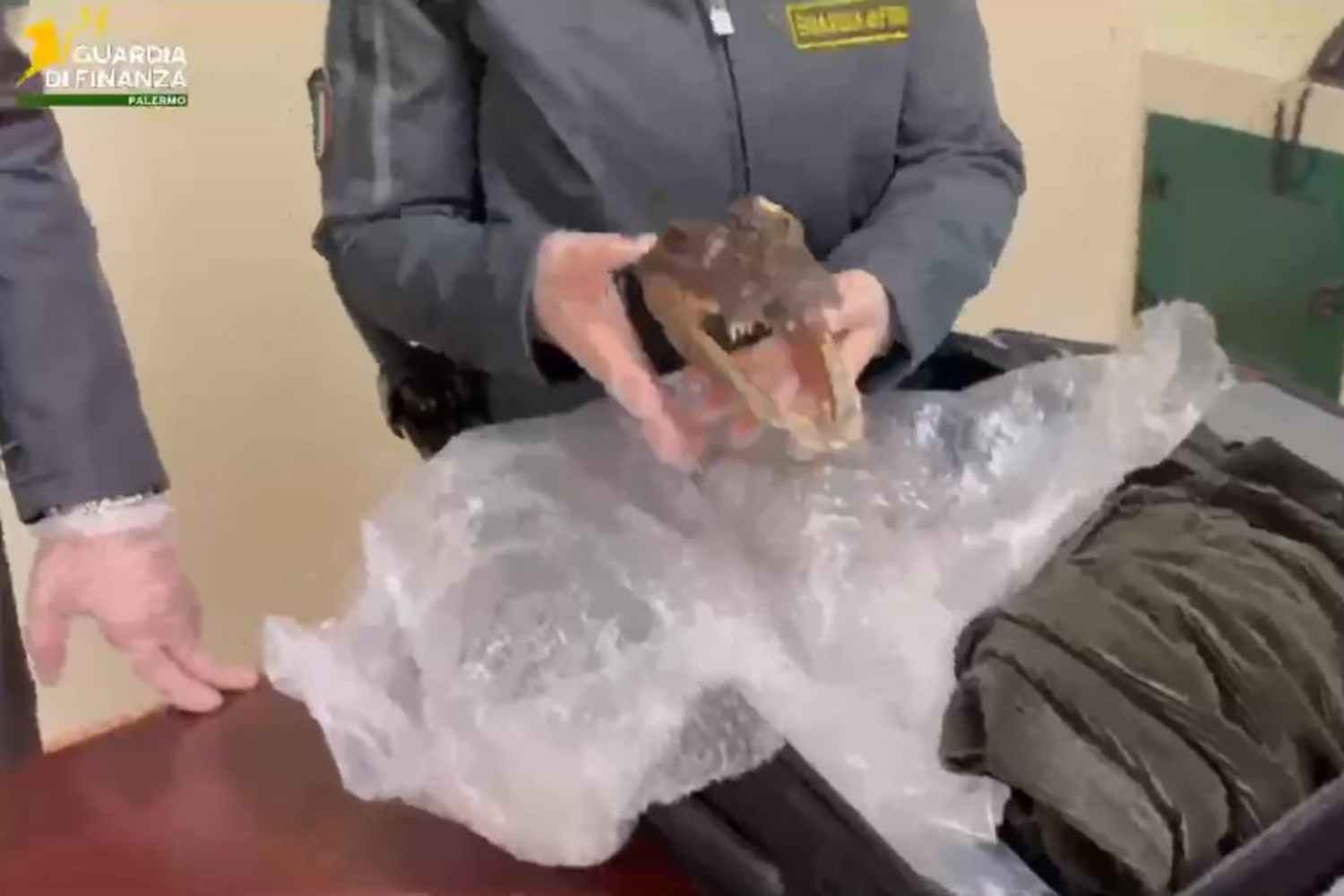
An episode that highlights how widespread the illegal trade of protected species still is: the dried head of a crocodile belonging to the species was seized at the Palermo-Punta Raisi airport Crocodylia sppin danger of extinction.
The check that led to the seizure
The financiers of the Guardia di Finanza of the Provincial Command of Palermo, together with the officials of the Customs and Monopolies Agency (ADM), intercepted a passenger from Palermo coming from Bangkok, with a stopover in Rome Fiumicino. During the baggage inspection, the macabre “souvenir” emerged: the head of the reptile, native to the tropical and subtropical regions of Asia, had been dried with its teeth exposed and wrapped in a plastic bag to evade controls.
The artefact was immediately seized and the passenger, who was reported to be on the loose, was charged with a violation punishable by law with severe sanctions: a fine of 20,000 to 200,000 euros or imprisonment from three months to a year.
The protection of protected species according to the CITES Convention
The operation is part of the controls provided for by the Washington Convention (CITES), the international treaty that regulates the trade of animal and plant species at risk. The species Crocodylia spp it is protected precisely because of its critical conservation status, threatened by poaching and the destruction of natural habitats.
This is not an isolated case: illegal wildlife trafficking represents one of the most profitable illicit trades in the world, with a turnover that seriously damages global biodiversity. The global CITES COP20 conference is currently taking place in Samarkand, Uzbekistan, bringing together delegates from over 180 countries to strengthen strategies for the protection of species at risk.
Collaboration between institutions to protect the environment
The seizure is the result of the operational synergy between the Guardia di Finanza and the Customs and Monopolies Agency, consolidated by the memorandum of understanding signed in 2023 and renewed in May 2025. This cooperation has strengthened controls in airport spaces, with the aim of effectively combating environmental crimes.
In short, bringing home such a “souvenir” is not only illegal, but contributes to putting already seriously endangered species at risk. An important reminder for all travellers: some travel memories are better left where they are, for the good of the planet and… your wallet.
