
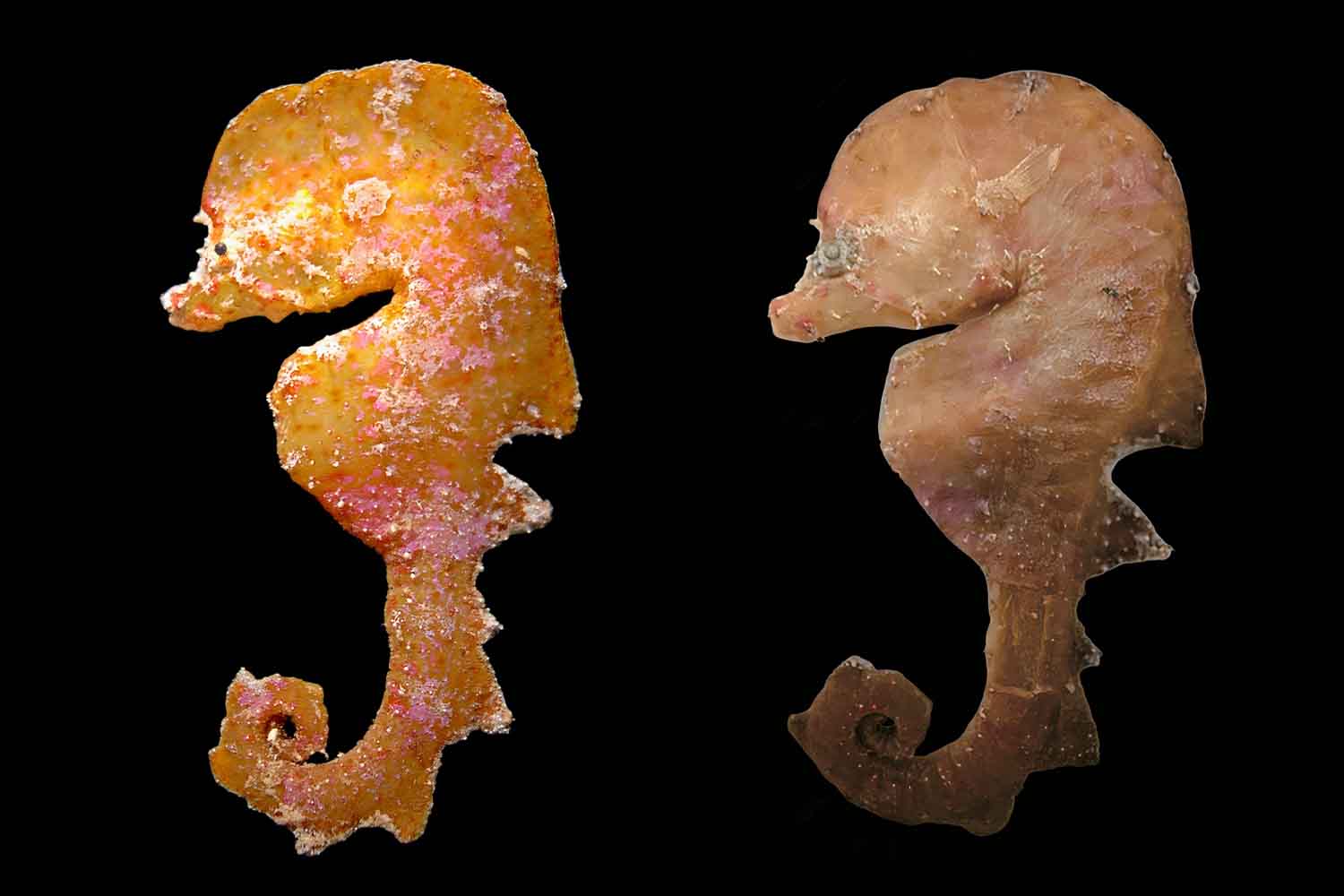
A dredger lowered to about 50 meters deep off the coast of southern Australia was looking for brachiopods, small animals protected by a shell. When it returned to the surface in 2006, it was also carrying an orange fish just over five centimeters long. It ended up in the invertebrate collection of the South Australian Museum and remained there for years. The expedition was looking for invertebrates; the fish had simply been in the wrong drawer.
Looking at it, it looked like a seahorse. It had a head tilted towards its belly, a tail capable of holding on and, being a male, a closed pocket to keep the eggs. However, analyzes of the skeleton and DNA revealed a different story. The fish was described as Australyichthys aegisa new species known through a single specimen. Together with two other fish already classified as seahorses it now forms the new genus Australyichthys.
The study published in Journal of Lost Species he also reclassified Australyichthys minotaur And Australyichthys paradoxus. All three belong to the large family that includes seahorses, pipefish and sea dragons, but they have followed their own evolutionary path.
The authors nicknamed them sea Muppetsmarine puppets, due to their soft body and rather bulky head. The new species is the helmethead sea Muppetthe helmet-headed marine Muppet. The name aegis it recalls the aegis of Greek mythology, the shield evoked by the dome that dominates the head.
A CT scan looked under the disguise
There are very few specimens preserved in museums and damaging them would have meant losing material that was impossible to replace. The researchers then used micro-CT, a kind of very precise CT scan capable of showing even tiny bones in three dimensions. The images made it possible to compare the skeleton of the three fish with that of a real seahorse. The external similarity, at that point, began to give way.
Seahorses have a rigid cage of fused bony plates around the belly and a distinctive structure on the head, similar to a small crown. In the Australyichthys the lower plates remain separate and some bones are arranged differently. The silhouette spoke of a close relationship. The skeleton showed that those fish had been built following another design.
DNA confirmed the result, although it was only possible to analyze it in the new specimen. A. aegis it had been preserved in ethanol, a substance that keeps genetic material in better condition than the formalin often used in museums. Examination of hundreds of pieces of DNA placed it close to seahorses, on a distinct evolutionary branch. For the other two species the reclassification is based on shared bones, because no usable DNA was available.
Evolution has repeated the same form
The discovery shows that the typical seahorse shape appeared at least twice within the same fish family.
In biology this phenomenon is called convergent evolution. Animals with different histories develop similar characteristics when living in comparable conditions or facing the same problems. It happened, for example, with the wings of birds and bats, which arose along separate evolutionary paths. In the case of Australyichthysevolution has brought back a tilted head, a prehensile tail and a male egg pouch.
Scientists will now have to understand what advantages this shape offered in the depths of South Australia. The information on the life of these fish, for now, is almost all inside the display cases. No one has ever observed them alive in their environment. The known specimens were collected by chance from trawl nets and dredgers lowered between approximately 50 and 124 meters deep.
Little light reaches those altitudes. Sponges, soft corals and other organisms form shelters in which such small fish could easily hide. Exploring these seabeds requires technical diving, cameras and surface-guided vehicles. Waiting for another specimen to end up in a net by chance has so far given rather meager results.
Seven fish collected in almost eighty years
The study analyzes seven specimens collected over almost eighty years along more than 2,500 kilometers of Australian coastline. Eight are indicated in the abstract, while tables, methods and descriptions report seven: a small internal inconsistency that does not change the new classification.
The most recent example is A. aegisrecovered in 2006. No other finds have been recorded since then. The authors therefore consider Australyichthys a “lost” genre, following the definition proposed in the magazine Oryx for animals for which recent evidence of survival in the wild is lacking. The word “lost” indicates that science has lost track of the species for at least ten years, but does not allow it to be declared extinct.
For these fish, there is a lack of sufficient data on distribution, number of individuals and possible threats. They may be very rare or live in rarely visited deep areas. With seven specimens and no direct observations, establishing this would be little more than an exercise in the imagination.
Future research will have to concentrate on the sites of old captures using remote-controlled vehicles, technical diving and perhaps environmental DNA, which allows one to search the water for genetic traces left by animals. For now this new evolutionary branch is known through seven small fish preserved in museums. No one has ever seen them swim. One of them even remained in the invertebrate collection for years: an entire family was waiting for someone to open the right drawer.
