
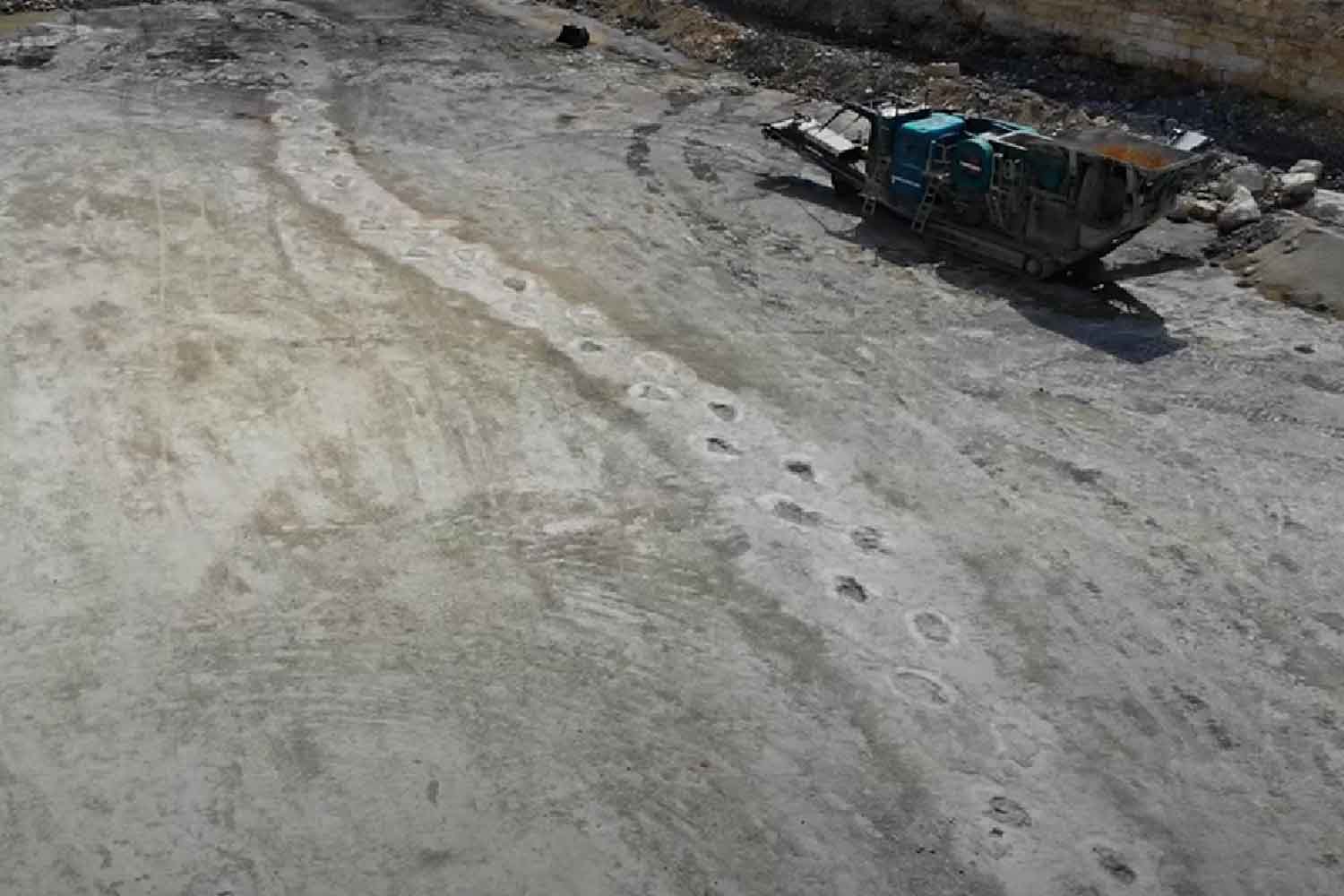
In Oxfordshire, in the heart of England, a group of researchers has brought to light something extraordinary: the longest trail of dinosaur tracks ever found in Europe. Measure 220 metres and dates back to approximately 166 million years agowhen that area was a muddy plain crossed by enormous sauropods with very long necks.
The discovery took place in the quarry of Dewars Farmone of the most important sites of the so-called “Dinosaur Highway” British. The excavations, conducted in summer 2025 by a team from the universities of Oxford, Birmingham And Liverpool John Mooresinvolved over one hundred people including scholars, students and volunteers.
A race against time to save the giants’ footprints
The work was not easy. After an unusually hot and dry summer, the ground had hardened “almost like concrete”, says the geologist Duncan Murdock of the Oxford University Museum of Natural History. For a week, the team had to dig extremely carefully so as not to damage the footprints, some of which were long up to one meter.
In the course of the investigation, researchers have identified approximately 80 sauropod tracks which cross the site from north to south. Alongside the main runway, three more have been discovered, one of which continues a series already identified in 2022.
But the real surprise was the quantity of traces: “Now we know that dozens of individuals they moved in this area at the same time, perhaps as a herd,” explains Murdock. A discovery that changes our perception of sauropods, from solitary giants to possible social animals.
The lost world emerges from the fossilized mud
The footprints were not the only evidence of the past. During the excavation, they emerged remains of marine invertebratesfragments of fossil plants and even one crocodile jaw. All elements that help reconstruct the environment in which these animals lived: one coastal mudflatcrossed by rivers and subject to the tides, where giant herbivores left traces destined to last millions of years.
In some areas they have also been identified three-toed footprints (three-fingered) probably belonging to Megalosaurusa carnivorous dinosaur that lived in the same places. Signs that tell of a rich and dynamic ecosystem, where herbivores and predators crossed paths along the same natural paths.
To better understand the formation of footprints, scholars have taken sediment samples under and inside the fossilized cavities: analyzes that may reveal details on the climate and composition of the Jurassic terrain.
A precious legacy for science and for the memory of the Earth
This track represents a unique document of its kind. Not just for the length — the largest ever recorded in Europe — but also because it offers a direct window into dinosaur behavior. The arrangement of the footprints allows us to study pace, direction and speed of sauropods, but also possible deviations or interactions between individuals.
Each footprint is a fragment of history, a literal imprint of time. And thanks to the joint work of universities and volunteers, this “dinosaur highway” continues to tell a fundamental chapter of life on Earth.
