
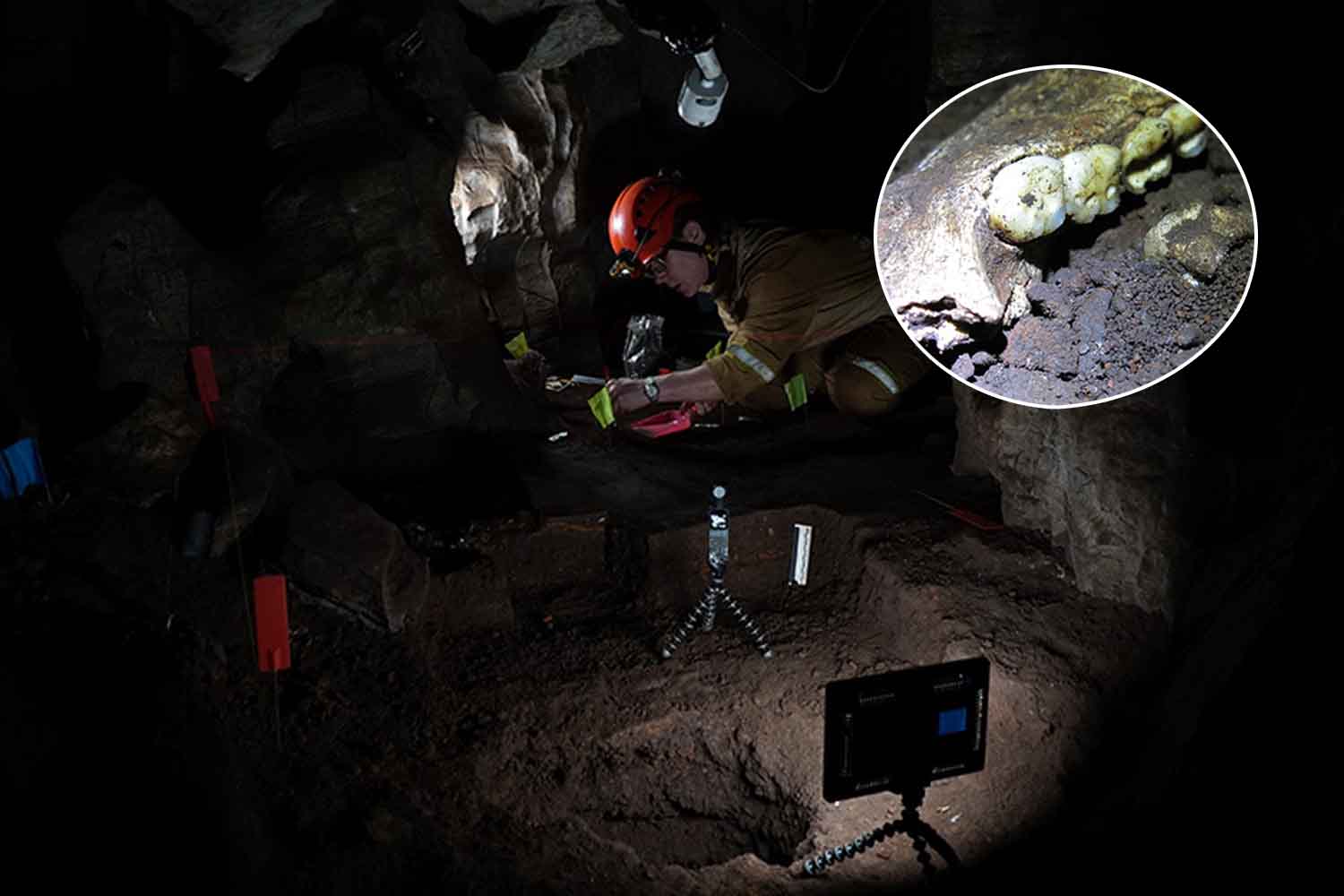
Sometimes all it takes is a tooth, not even a whole one, to knock out a row of certainties that have been patiently placed there for years. In the case of Homo naledithe small extinct relative of modern man found in the Rising Star cave system, South Africa, the teeth have become twenty-three. Twenty-three fragments of enamel, belonging to at least twenty individuals, analyzed with a technique capable of reading ancient proteins without massacring finds that are worth more than any museum display case. The result, published on Cell on June 24, 2026, has that annoying quality of serious discoveries: it opens a door and immediately behind it shows ten others closed. In the samples studied, the researchers found proteins linked to the X chromosome, while , the protein marker normally associated with the male Y chromosome. Translated without too much embroidery: all the individuals analyzed could be biologically female.
A narrow cave, too many identical bodies
Rising Star is located in the Cradle of Humankind, the “cradle of humanity”, a South African UNESCO heritage area not far from Johannesburg. Here, in 2013, the research group linked to the Rising Star project brought to light an enormous quantity of remains: over 1,500 fossils and about 150 teeth attributable to Homo naledi, a species that lived more or less between 335 thousand and 241 thousand years ago. Access to the main chamber, the Dinaledi Chamber, passes through very narrow tunnels and vertical sections that seem designed to discourage anyone who has even a moderately civilized relationship with enclosed spaces.
©University of the Witwatersrand, Johannesburg
Homo naledi, already, seemed built to embarrass the manuals. It had a small brain, slightly larger than that of a chimpanzee, yet a body full of contrasts: shoulders and primitive features, legs suitable for walking, hands and feet with characteristics closer to ours. A mosaic, in short. One of those creatures that remember how evolution often proceeds through attempts, adjustments, legacies held together with a logic that in retrospect seems orderly only because we look at it from too far away.
Even before this analysis, one detail disturbed paleoanthropologists: the adult skeletons of Homo naledi found in the Dinaledi chamber were very similar to each other. Too similar. In many species of hominins, part of the difference between adult individuals depends on sexual dimorphism, that is, on the physical variations between males and females. Here, however, dimensions, shapes and anatomical features showed an unusual compactness. For years some larger specimens had been interpreted as males. Now even those finds fall into doubt, including “Neo”, one of the largest skeletons, and other individuals who seemed to widen the gap between sexes.
The teeth found
Ancient DNA remains the most direct tool for determining an individual’s biological sex when he or she survives. The problem is precisely that “when”. DNA degrades, especially in hot, humid, complicated environments. Tooth enamel, on the other hand, is a more stubborn archive. It is the hardest tissue in the human body and can protect protein fragments for very long times, even when the DNA has already left the field. This is why paleoproteomics, i.e. the study of ancient proteins, is becoming a kind of new torch in places where previously we proceeded almost in the dark.
The technique used on Homo naledi has been described as minimally destructive: an acid etch on the enamel to extract peptides, small fragments of proteins, then analyzed with mass spectrometry. In practice, the tooth is interrogated without being sacrificed. The protein sought was amelogenin, present in dental enamel in different forms: AMELXlinked to the X chromosome, e AMELYlinked to the Y chromosome. When AMELY appears, the presence of a biologically male individual becomes very solid. In the twenty-three teeth analyzed, however, that male signal is missing.
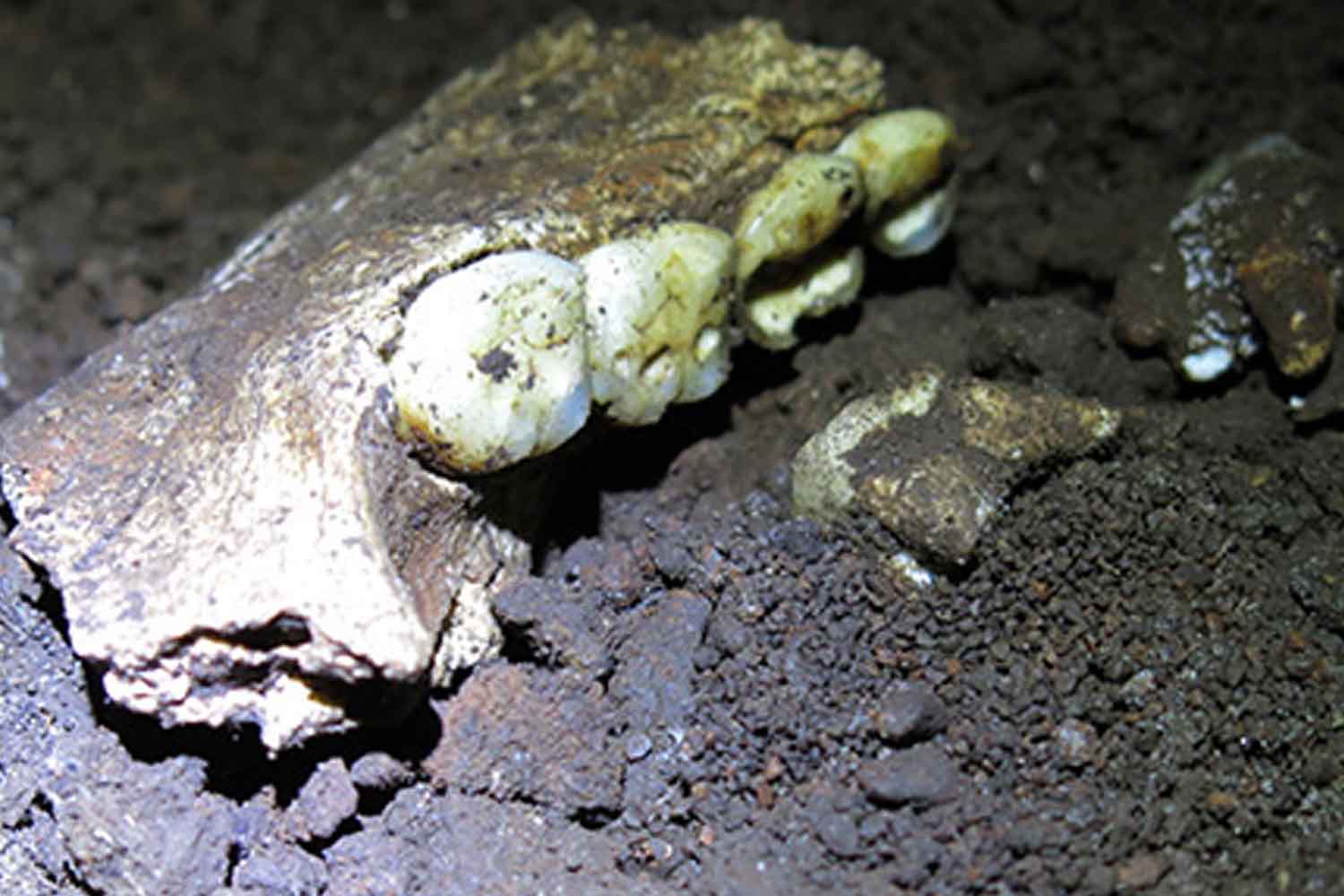
©University of the Witwatersrand, Johannesburg
The statistical oddity is notable. Sampling twenty individuals and finding them all of the same sex, in a random context, has a very low probability. The research team also indicated this element to strengthen the hypothesis that something selective happened at Rising Star: a choice, a practice, a rule, perhaps a form of storage of the dead linked to sex. Here, however, it is necessary to keep the pace short. Why say that the remains they could all be female it is correct. Saying that we already have an intentional female cemetery before us too quickly closes a story that for now requires further proof.
The most difficult leap: from biology to ritual
The most suggestive hypothesis is also the most slippery one: Homo naledi could have separated the dead on the basis of sex, perhaps gender, much earlier than we are used to imagining for behaviors of this type. That would be a huge step, because intentional funerary practices are often associated with species with larger brains, such as Homo sapiens and Neanderthals. Homo naledi, with his small brain and his body full of evolutionary contradictions, instead forces us to ask a more uncomfortable question: how much cultural complexity have we too quickly attributed to the size of the brain alone.
The site, moreover, was already at the center of heated discussions. In recent years the Rising Star team has claimed to have found clues of intentional burialspossible use of fire and engravings on the cave walls. These are important interpretations, much discussed, precisely because they would push back behaviors long considered typical of human beings with cognitive abilities closer to ours. The new dental proteins add a powerful piece, even if they do not erase the cautions: a concentration of individuals without male markers can bring the idea of selective behavior closer, but it is not enough on its own to describe the gesture, the rule, the reason.
Then there is the biological alternative, less cinematic and therefore fundamental. The absence of Amelogenin-Y could depend on a deletion or mutation of the gene AMELY in the Homo naledi population. Rare cases of loss of AMELY signaling have been observed in some current human populations; something similar was also found in a Neanderthal male. In that case, a male might appear “feminine” on enamel analysis, because the marker sought is simply not there. The researchers themselves consider this possibility unlikely in a whole group of twenty individuals, but they leave it on the table. And it is good that it remains there, visible, without being swept away by the charm of discovery.
Within this caution lies the best part of the story. If Rising Star really preserves only females, or almost only females, then we will need to understand where the males were, why those bodies ended up there and according to what dynamics. If, however, Homo naledi had had a genetic peculiarity capable of hiding the AMELY signal, the discovery would still be enormous: it would change the way we read biological sex in fossils and would force us to review methods that today seem quite robust. In both cases, the mystery remains. Only the room in which to look for the answer changes.
A discovery that weighs more than Homo naledi
The most concrete thing, at the moment, concerns the method. The possibility of extracting ancient proteins from dental enamel with minimal damage could become a turning point for the study of African hominins, often preserved in environments that are not very favorable for ancient DNA. Many fossil finds are teeth, jaw fragments, tiny pieces that for decades have left open discussions about sex, kinship, internal variability, even belonging to one species or another. Paleoproteomics promises to enter right there, in that gray area where the eye sees shapes and measurements, while chemistry can add a second voice.
This also applies to famous fossils, those that the public knows almost as characters: Lucy, Mr./Mrs. Ples, the ancient South African Paranthropus, the hominins of East Africa. Knowing whether an individual was male or female can change much more than a caption. It can change ideas about how large a species was, how bodies varied, how groups were organized, which individuals were preserved in certain places and which disappeared from the fossil record. The difference between biology and culture, in prehistory, is often a thin fissure. Here it becomes a crack wide enough to look into.
There also remains an almost narrative detail, difficult to ignore without turning it into a postcard. The first deep excavations at Rising Star were entrusted to a group of female scientists and speleologists, the so-called “underground astronauts”, chosen also because they were able to pass through the very narrow tunnels of the cave system. Now those fossils, recovered by women in a space that rejected many modern male bodies, may belong to a fossil community composed only of females. Science is usually wary of too beautiful symmetries. It’s good. But some coincidences remain there, with their sharp noise.
For now Homo naledi continues to do what it has always done: complicate categories. Small brain, perhaps complex behaviors. Ancient body, almost familiar feet. Fossils numerous, yet still insufficient. A cave full of remains and an elementary question that weighs more than many answers: where are the males. Until the rock returns an unequivocal individual, Rising Star will remain like this, narrow, dark, stubborn. A room full of teeth that have just started talking.
