
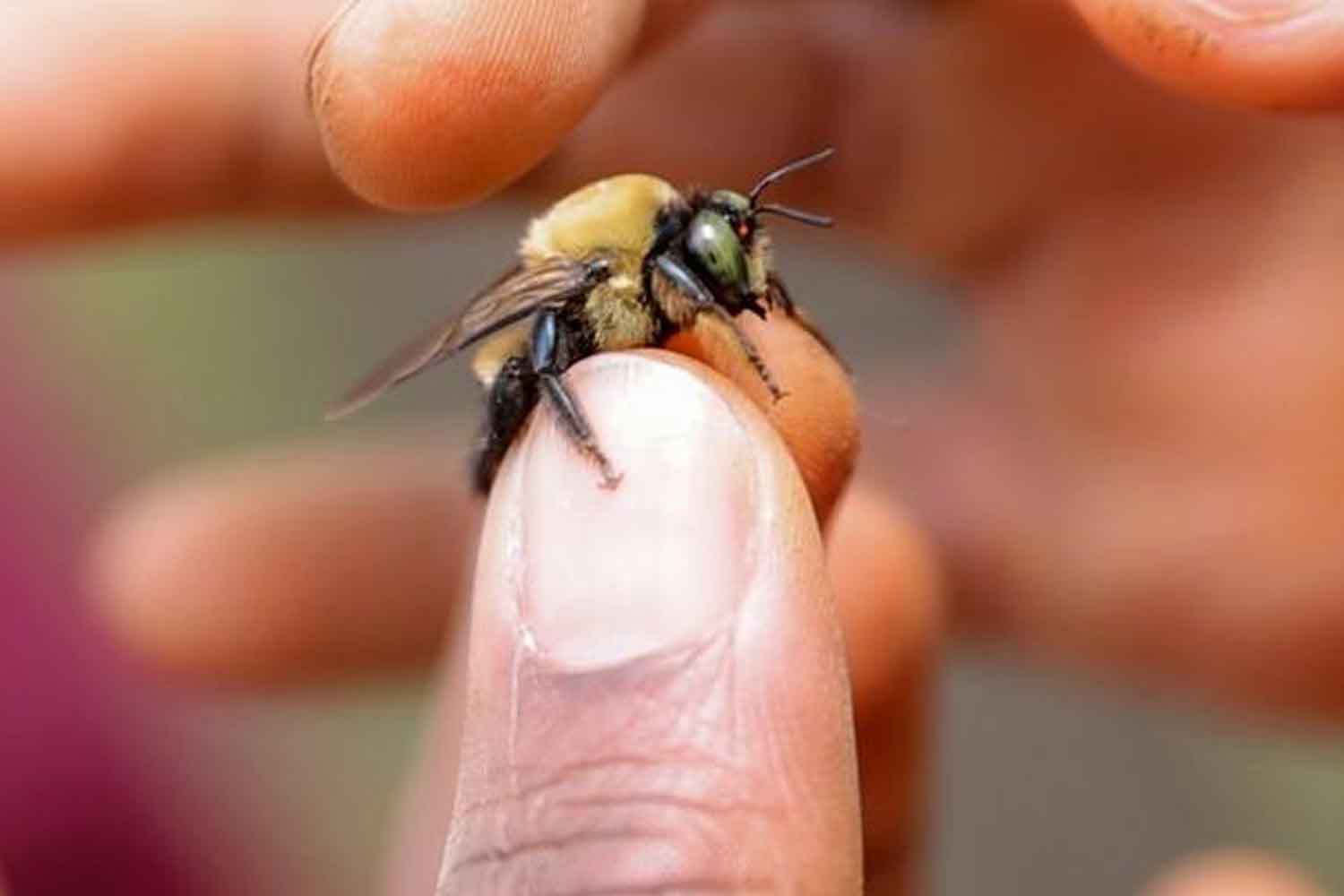
There is a bee that builds its nest using some sort of natural plastic. It produces it itself, uses it to protect the larvae underground and, after a few months, that material begins to degrade. A capacity that the plastics industry has been trying to reproduce for years, above all to find alternatives to polyethylene, one of the most used and persistent materials in the environment.
Researchers from Virginia Tech and the University of Tennessee studied it, who discovered how the polyester produced by Colletes inaequalisa solitary North American bee, has properties similar to those of polyethylene, although it degrades much more quickly in the soil. According to the study published on PNASin just four months the percentage of polyester in nursery linings dropped from 73% to 40%. All without industrial composting systems, high temperatures or particular treatments. The soil in which these bees usually live is enough.
Bees that build nests lined with natural plastic
There Colletes inaequalis it is also called the “cellophane bee”, a rather apt nickname. Unlike honey bees, it lives alone and digs small underground nests, where it lays its eggs and prepares the chambers to house the larvae. To protect them from humidity and microorganisms present in the soil, cover the walls with a thin, resistant and waterproof film. A kind of protective packaging, made directly by the bee.
The material is a natural polyester, chemically different from traditional polyethylene, but with some very similar characteristics. It resists water, has a crystalline structure comparable to that of common plastics and maintains considerable stability during the period in which it must protect the nest. The surprise comes when that coating begins to deteriorate.
Jonathan Coote, professor of the Department of Sustainable Biomaterials at Virginia Tech and first author of the study, explained that the material has characteristics normally associated with plastics that are particularly resistant to degradation. Yet, in the ground, it behaves differently.
In four months the polyester goes from 73% to 40%
To understand how this particular natural plastic works, researchers collected nest linings in two locations in Tennessee, analyzing newly produced materials and others that had remained underground for up to eleven months. In more recent nests, polyester accounted for approximately 73% of the liner weight. After four months, the percentage had dropped to 40%.
The data concerns the composition of the covering, which also contains silk, and documents a significant degradation of the polyester already in the first months. The material, therefore, begins to deteriorate without the need for the particular conditions required by many plastics marketed as biodegradable.
For researchers, this is a particularly interesting result because bee polyester has a crystallinity of around 60%. Generally, such a structure makes plastic materials more difficult to decompose. And yet this particular combination of resistance and biodegradability seems to work.
Scientists suspect that some enzymes capable of breaking the chemical bonds of the polyester may favor the process. The arrangement of the molecules could also contribute to making these bonds more accessible to the action of water and microorganisms. The precise mechanism is still under research, but the observed result already offers an interesting avenue to explore.
From bee nests to the packaging of the future
About 160 million tons of polyethylene are produced worldwide every year, according to estimates reported by researchers. We find it in bags, food packaging, containers and many other everyday objects. It is light, economical, durable and waterproof. All characteristics highly appreciated by the industry, which however contribute to making it extremely persistent once dispersed in the environment.
Even when it fragments, it can continue to be present in the form of microplastics. Scientists have long been looking for materials capable of offering similar performance, but with significantly shorter environmental durability. Many biodegradable alternatives, however, require specific composting conditions or degrade very slowly in the soil.
The polyester produced by Colletes inaequalis could help overcome some of these difficulties. As explained by Virginia Tech, the goal is to understand which characteristics of its structure allow the material to be resistant during use and biodegradable after having fulfilled its function. Once the mechanism has been identified, researchers would like to reproduce it artificially, designing new polymers that can also be used on an industrial scale.
The idea was born from a rather curious collaboration. Coote works on plastic chemistry, while Laura Russo, an ecologist at the University of Tennessee, studies bees. It was Russo himself who told his colleague about the existence of these insects capable of producing a material similar to polyethylene. From that conversation was born a research which also involved scholars from the University of Minnesota and which, after years of work, led to the characterization of the natural polyester of bees.
Of course, the goal is not to breed millions of insects to produce bags and containers. Coote himself ruled out this possibility, explaining that the industry should learn to reproduce the process, without entrusting production directly to bees. For now, scholars have identified a natural material with promising properties. The next step will be to understand how to obtain similar characteristics in an artificially produced plastic, while maintaining its biodegradability.
The bees, for their part, have already solved the problem for which they use this material: to build a resistant protection for the larvae, destined to degrade in the soil after having carried out its function. And they do it without laboratories, patents or industrial plants. Long before anyone decided to study them.
