
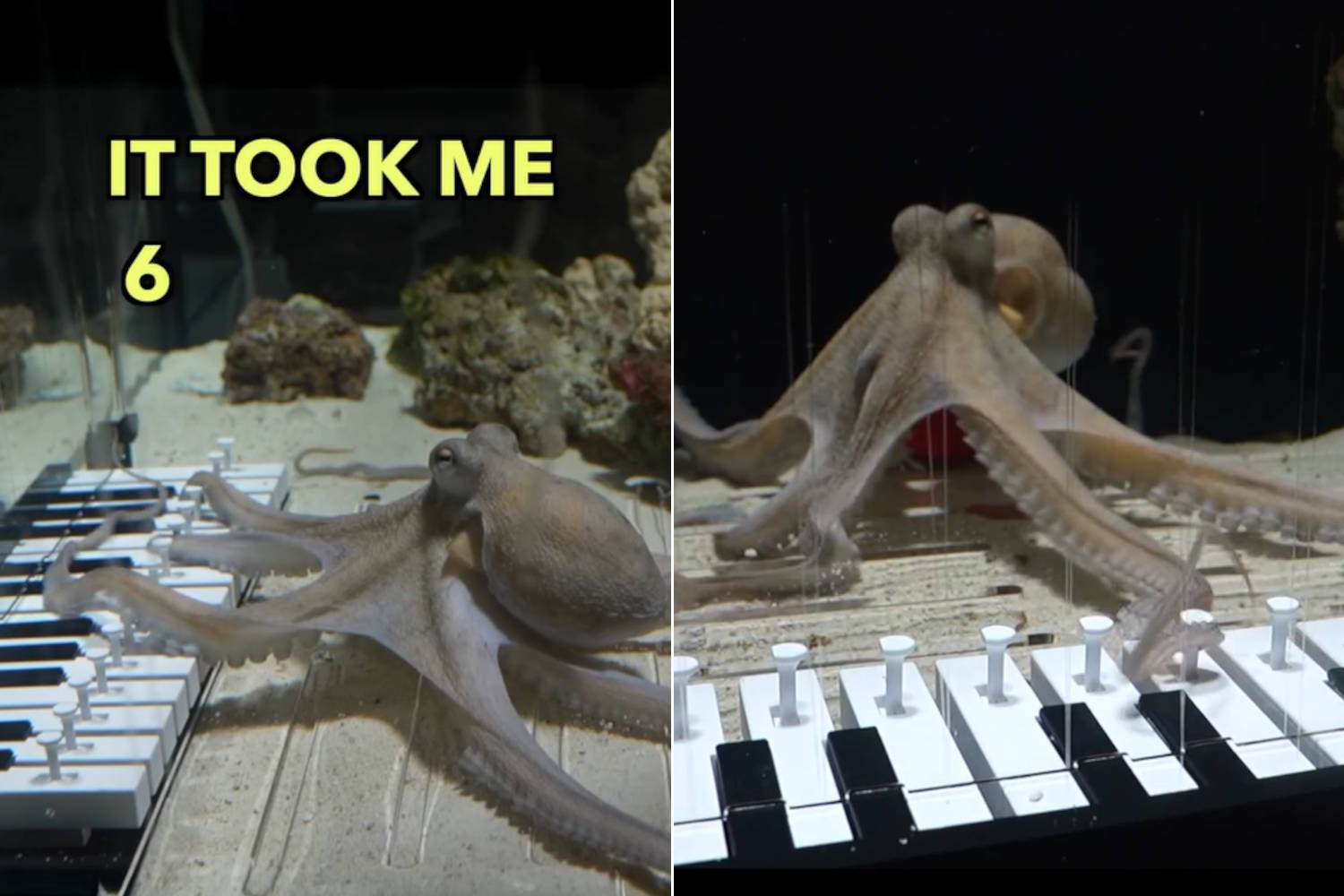
The story of the octopus Tako and the Swedish musician Mattias Krantz went around the world in just a few days. A video, millions of views and an out-of-the-ordinary idea: teaching an octopus to play the piano. It all started when Mattias met the octopus that he was destined to become food on a fish market stall and decided to save him from that fate, bringing him home and calling him Tako. This rescue gesture then became a project documented on social media, an experiment that struck the collective imagination for its uniqueness. Seeing a marine animal move its tentacles on a musical instrument is something that surprises, intrigues and moves.
View this post on Instagram
The intelligence of octopuses in the spotlight
There is no doubt that this case highlights the extraordinary cognitive abilities of octopuses. For years, science has recognized these cephalopods as having a complex form of intelligence, with memory, problem solving and a nervous system distributed in the tentacles. As several studies point out, the octopus brain is an example of evolutionary convergence, capable of developing advanced functions despite being very distant from humans on an evolutionary level. Krantz’s experiment, from this point of view, reinforces an awareness: we are faced with an animal that is anything but “simple”.
However, a context far from nature
This is precisely where the critical point arises. Demonstrating that an octopus can learn a musical sequence does not mean that playing the piano is natural or necessary for its well-being. The adaptation of the tool, the food reinforcement systems and the constant training tell more about human creativity than about the animal’s need. The risk is to transform the intelligence of the octopus into spectacle, bending it to a use that serves above all to amaze the viewer.
Between disclosure and entertainment
Experiments like this tread a fine line. On the one hand they contribute to spreading respect and interest towards a species often reduced to a simple food resource. On the other hand, they raise ethical questions about how we use intelligent animals for viral content. Recognizing the capabilities of octopuses should lead us to protect them more and respect their natural environments, not just to seek new forms of entertainment. The real lesson, perhaps, is not that an octopus can make music, but that its intelligence deserves limits, context and responsibility.
View this post on Instagram
You might also be interested in:
