
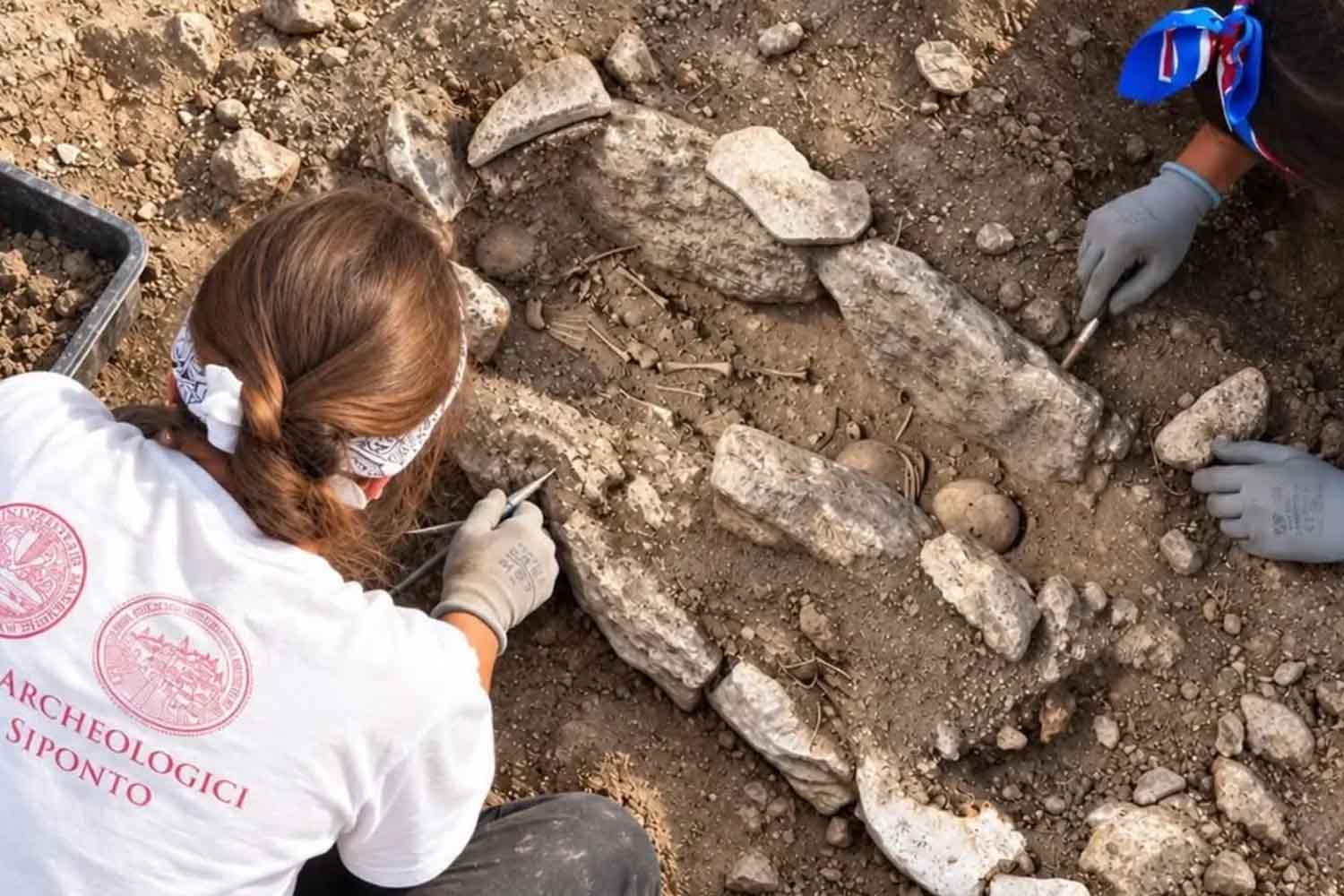
Seven or eight children, all of whom died before they were one year old and some when they were only a few months old. Their remains emerged during the archaeological excavations underway in Siponto, a hamlet of Manfredonia, in the Foggia area, inside a small burial site in the medieval cemetery built in the area of the ancient Roman amphitheatre.
The discovery dates back to the last days of September and was made known by ArcheoSipontum, the association that collaborates in research and dissemination activities on the site. The bones have already been cleaned and prepared for anthropological analyses; DNA investigations and carbon 14 dating will follow. It is from there that more precise indications can be obtained on the age at death, on the chronology of the burial and, if the genetic material allows it, also on any relationships between the children.
Below the medieval cemetery there is a Roman amphitheater
The burial is located in the cemetery developed next to a medieval church, which was itself built over walls and ruins of the Roman amphitheater. In the space of a few meters Siponto therefore puts several of its lives one on top of the other: the Roman city, the medieval one and its last phases before depopulation.
The systematic excavations have been conducted since 2021 by the Universities of Foggia and Bari and have now covered approximately 5,000 square metres. As the University of Foggia explains in the sheet dedicated to the project, various phases of reoccupation have already emerged in the amphitheater area: homes, grain pits, burials, a place of worship and the cemetery.
The Ministry of Culture summarizes the history investigated by the project in approximately 1,500 years, from the foundation of the Roman colony until the progressive depopulation of the city in the 14th century in favor of nearby Manfredonia.
According to the archaeologist Giuliano Volpe, professor at the University of Bari and one of those responsible for the research, the new tomb belongs to the later phases of this cemetery, between the 13th and 14th centuries. The chronology, for now, remains a first attribution: carbon 14 dating will clarify it.
Many graves of women and children
Numerous female and child burials have already emerged in the cemetery, including those of newborns. For Volpe this presence testifies to the high infant mortality that accompanied Siponto’s last phase of life.
The new discovery, however, adds a different detail: here the remains of seven or eight very young children were found together in the same burial. The anthropological analysis will now have to establish more precisely how old each of them was and will be able to provide information on the state of the bones and living conditions.
A few days earlier the Siponto excavations had already yielded another deposition inevitably destined to strike: an adult woman with a child welcomed by her right arm. But it’s about another sector of the citythat of the ancient port district, where a second medieval cemetery has been identified.
In the report of the excavation signed by Giuliano Volpe himself, the woman is estimated to be between 30 and 40 years old and the child around 4-5. The position of the bodies suggests a close bond, but does not yet authorize us to call them mother and son: even there, the analyzes will say something more.
It is a small distinction only in appearance. In Siponto, in a few weeks, two cemeteries and two different pieces of the last centuries of the city have resurfaced.
For the seven or eight children in the amphitheater, however, we currently know much less. They were all under one year of age, some were a few months old and were laid together when Siponto was nearing the end of its long urban history. Anthropology will now try to establish how many months they were; carbon 14 when they were buried; the DNA, if preserved well enough, could tell if there were family ties between them. After seven centuries, for now, the bones are enough: very small, and still full of questions.
