
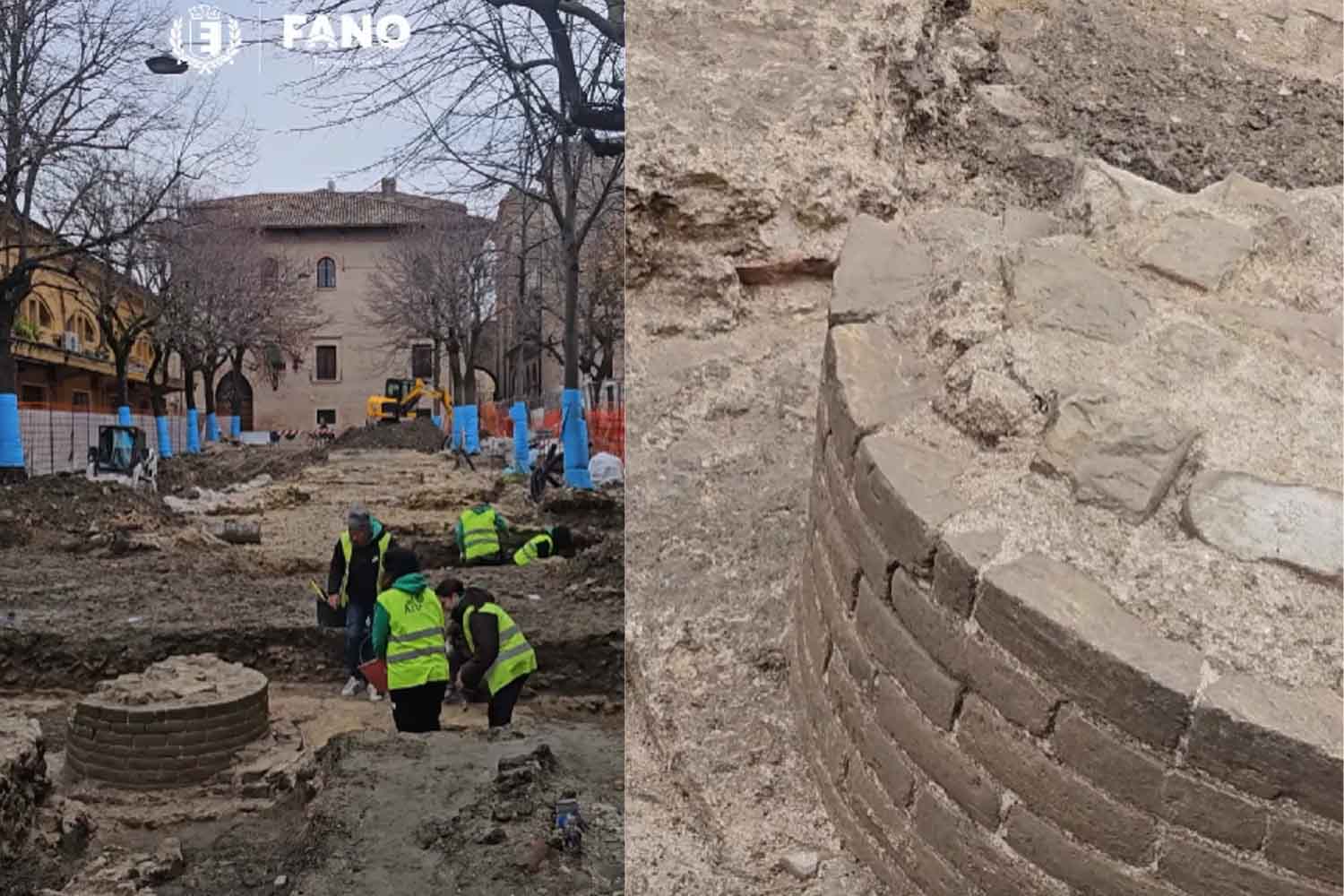
There are discoveries that come suddenly and others that seem to mature slowly, as if the ground needed the right moment to speak. TO Fanothat moment has arrived. During the excavations in Piazza Andrea Costa the remains of the Vitruvius Basilicaa building that for centuries existed in books, in drawings, in scholars’ hypotheses, but not in visible reality.
Now that distance between theory and matter has narrowed. And what emerges from the underground is not just a set of ancient stones, but a concrete piece of urban history that returns to dialogue with the contemporary city.
A discovery that renews the link between Fano and Vitruvius
Archaeological investigations have brought to light monumental columns, wall bases and perimeter structures attributable with great reliability to the Basilica described in De Architecture from Vitruvius. This is not a suggestive attribution, but a convergence of archaeological, topographical and textual data that strengthens a hypothesis cultivated by generations of scholars.
Vitruvius, born in ancient Fanum Fortunae, the current one Fanois a central figure for Western architectural culture. His treatise has spanned the centuries, influencing the Renaissance and the very way we think about built space. The Basilica of Fano is one of the few buildings that the Roman author explicitly attributes to himself, making this discovery even more significant.
What the excavations tell us
From the first information that emerged, in addition to the large columns, they were identified remains of walls with traces of plaster and preparatory levels of the floorselements that allow the monumentality of the building to be reconstructed even if the original surfaces have been lost over the centuries. The city, as often happens, was transformed by stratifying functions and structures, but without completely erasing what was underneath.
The Basilica of Vitruvius is not an isolated find, but a piece that helps to better understand the ancient form of Fano, its role in the Roman world and the way in which public spaces were thought of as places of meeting, administration and collective life. It is a discovery that speaks of urban planning, not just archaeology.
Because this news also concerns the present
The value of this discovery lies not only in its historical exceptionality, but in the way in which it forces us to rethink the relationship with the cities we inhabit. Fano didn’t suddenly become older: it already was. Simply, today we have a deeper awareness of it.
In a historical moment in which we talk more and more about urban regeneration, land protection and sustainabilitydiscoveries like this are a reminder that the soil we walk on is a fragile and precious resource. Every urban intervention can be transformed into an opportunity for knowledge, if approached with attention and respect. The Basilica of Vitruvius thus emerges as a symbol of a possible balance between past and future, between development and memory.
View this post on Instagram
