
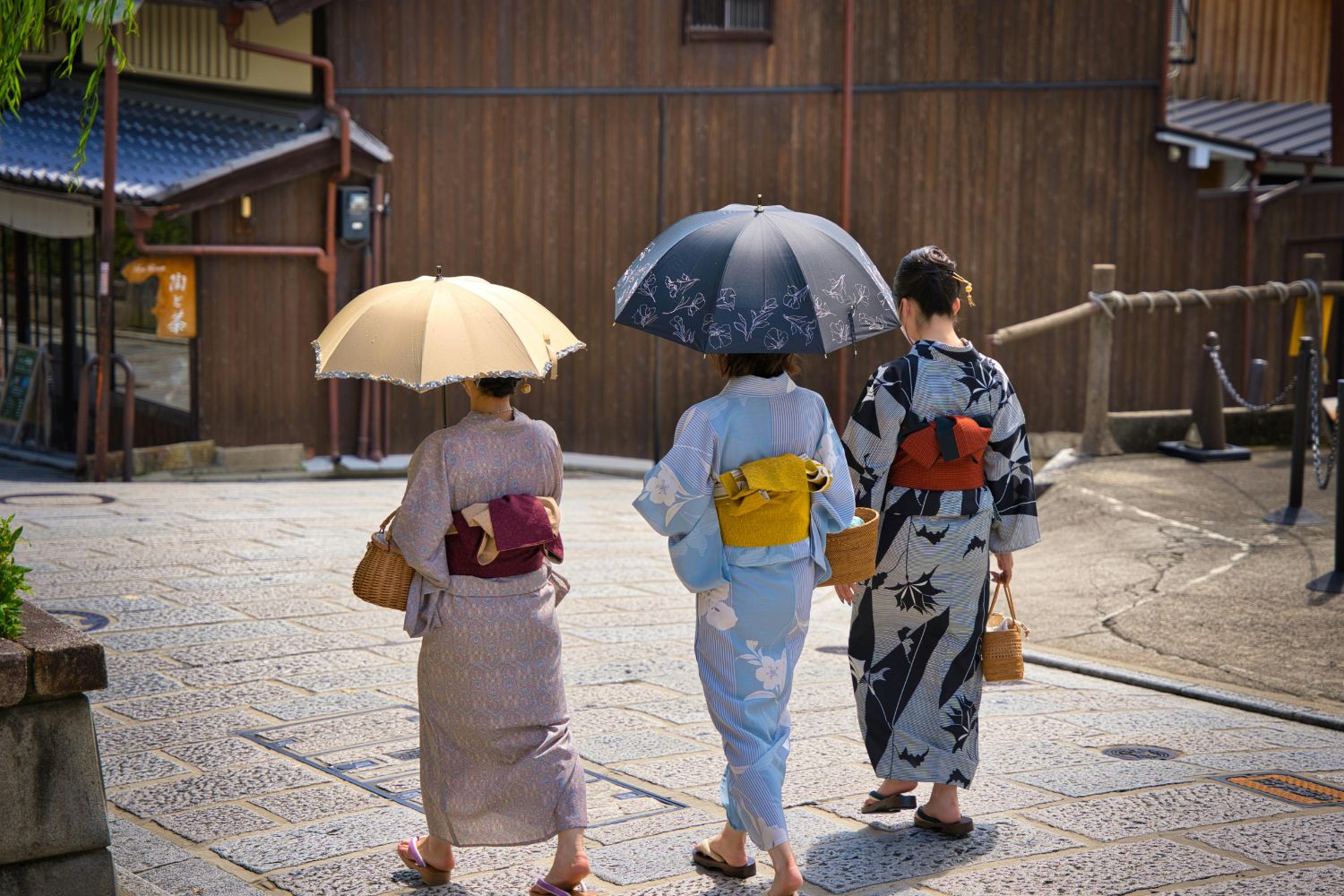
In Japan the umbrella is not just for the rain
For a European tourist newly arrived in Tokyo, Osaka or Kyoto, the scene may seem curious. In the height of summer, under a scorching sun and without a cloud in the sky, thousands of people walk with an open umbrella. They are not waiting for a storm and this is not a fad. What is called in Japan higasaliterally “sun umbrella”, has become one of the most effective and widespread tools for dealing with extreme heat.
While in many countries people seek relief with hats, refrigerated bottles of water or stops in the shade, in Japan there is a growing belief that a simple umbrella can represent one of the most immediate defenses against heat waves. An economical, portable and surprisingly effective solution, which in recent years has even been promoted by public institutions as a health prevention measure.
A country increasingly affected by extreme heat
The phenomenon must be understood in the climatic context of Japan. In recent years the country has seen increasingly scorching summers, with record temperatures and very high humidity levels. Large urban areas, from Tokyo to Nagoya, also suffer from the “heat island” effect, which amplifies the feeling of stuffiness and increases health risks.
Japanese authorities consider heatstroke a true health emergency. For this reason, the Ministry of the Environment and the Japan Meteorological Agency have introduced a national alert system that warns the population when thermal stress indices reach dangerous levels. In parallel, the government began encouraging the use of sun umbrellas as a preventative measure against heat-related illnesses.
It is therefore not a simple cultural habit, but a concrete response to a problem that is becoming increasingly serious.
The umbrella creates a personal shade that is always available
The strength of the sun umbrella lies in its simplicity. In an urban environment where trees are often insufficient and asphalt surfaces accumulate heat, the sunshade functions as a small, portable shaded area.
Unlike a hat, it simultaneously protects the head, face, neck and part of the trunk. It also reduces direct exposure to sunlight and limits overheating of the body.
Japanese experts often describe the higasa like a sort of “personal tree”: a mobile shadow that accompanies those who move around the city on foot. In a context where many people use public transport and travel long distances on foot, this ongoing protection can make a significant difference.
Scientific studies confirm the effectiveness
What makes the Japanese case particularly interesting is that the usefulness of sun umbrellas is not based only on subjective perception.
Several studies have concretely measured their effect on thermal stress. Research published in Journal of the Meteorological Society of Japan compared the effectiveness of a UV-blocking umbrella with other urban cooling strategies, such as street trees and misting systems.
The results show that the umbrella is able to reduce perceived temperature and heat stroke risk indicators significantly. According to the study, using a sunshade can lower the WBGT (Wet Bulb Globe Temperature) index, one of the most used parameters to assess heat risk, by approximately 1.3 degrees Celsius. It can also reduce your risk of heatstroke by an entire alert level.
Even more surprising is the comparison with trees. Researchers have calculated that the effect of a good anti-UV umbrella can reach approximately 75% of the effectiveness of an area shaded by urban trees.
In other words, when a tree-lined avenue is not available, the umbrella represents a valid individual alternative.
A reduction in perceived heat of up to 3 degrees
The Japanese Ministry of the Environment also carried out several measurements during public awareness campaigns.
According to data released by the authorities, using a sunshade can reduce the WBGT heat index by approximately 1-3 degrees Celsius. It may seem like a small difference, but in extremely hot situations, a few degrees can make you go from a high-risk condition to a relatively safer one.
This reduction is particularly important for the elderly, children and people with chronic conditions, the most vulnerable categories during heat waves.
From female accessory to tool for everyone
For a long time, sun umbrellas were associated primarily with women. Historically they were also used as a tool to protect the skin from tanning, considered less than desirable in some Asian cultural contexts.
In recent years, however, their meaning has changed radically.
The increasing intensity of Japanese summers has transformed the higasa from an aesthetic accessory to a personal protection device. Public campaigns have insisted on this aspect: using the umbrella not for beauty reasons, but to avoid health problems.
In 2019, then-Environment Minister Yoshiaki Harada also explicitly invited men to use sun umbrellas to prevent heatstroke. The message marked an important cultural shift.
Today, seeing men in suits with open parasols on the streets of Tokyo is no longer unusual.
More and more men are choosing the parasol
Statistics show that the phenomenon is growing rapidly.
A survey conducted in 2025 found that many Japanese have started using a sun umbrella because of the extreme temperatures. Among new users, about half were men. The main reason given by respondents was not to avoid tanning, but to prevent heat stroke.
Even in large cities the use of the male parasol has become increasingly common. According to various findings, the increase in temperatures is rapidly changing behaviors that until a few years ago would have seemed unusual.
Institutions distribute free umbrellas
The importance attributed to this solution is also evident in public policies.
Since 2020, Japan’s Ministry of the Environment has partnered with umbrella-sharing services to distribute free parasols on days when heat warnings are issued. The objective is to encourage preventive behavior and reduce the number of hospitalizations due to heat stroke.
In some regions, rental points have been installed where citizens and commuters can get an umbrella to travel during the hottest hours.
It’s a pragmatic approach: if heat is a public health problem, then shade can also become a public service.
A lesson for European cities
The Japanese experience also offers an interesting starting point for Europe, where heat waves are becoming increasingly frequent and intense.
There is a lot of discussion on the continent about urban reforestation, reflective paving, fountains and green infrastructure. All fundamental measures, but which require investments and long timescales. The sun umbrella, on the other hand, represents an immediate and accessible answer.
It costs little, requires no energy, produces no emissions and can be used anywhere. It is a simple, almost banal technology, but precisely for this reason extremely effective.
In an era where climate change forces cities to adapt rapidly, the success of higasa demonstrates that not all solutions need to be complex or technologically advanced. Sometimes you just need to recover an everyday object and use it differently.
The shade as a climate adaptation strategy
Behind the image of the Japanese walking with open umbrellas under the sun there is a broader lesson. The cities of the future will have to learn to live with increasingly higher temperatures and develop new adaptation strategies.
The shade does not replace trees, urban parks or climate policies. But it represents one of the most immediate forms of individual adaptation to extreme heat. Scientific studies show that it reduces thermal stress, institutions promote its use and millions of people have already integrated it into their daily lives.
For this reason, what at first glance may seem like a Japanese extravagance is actually a rational response to one of the main challenges of the 21st century: continuing to live and move in cities as the planet warms.
