
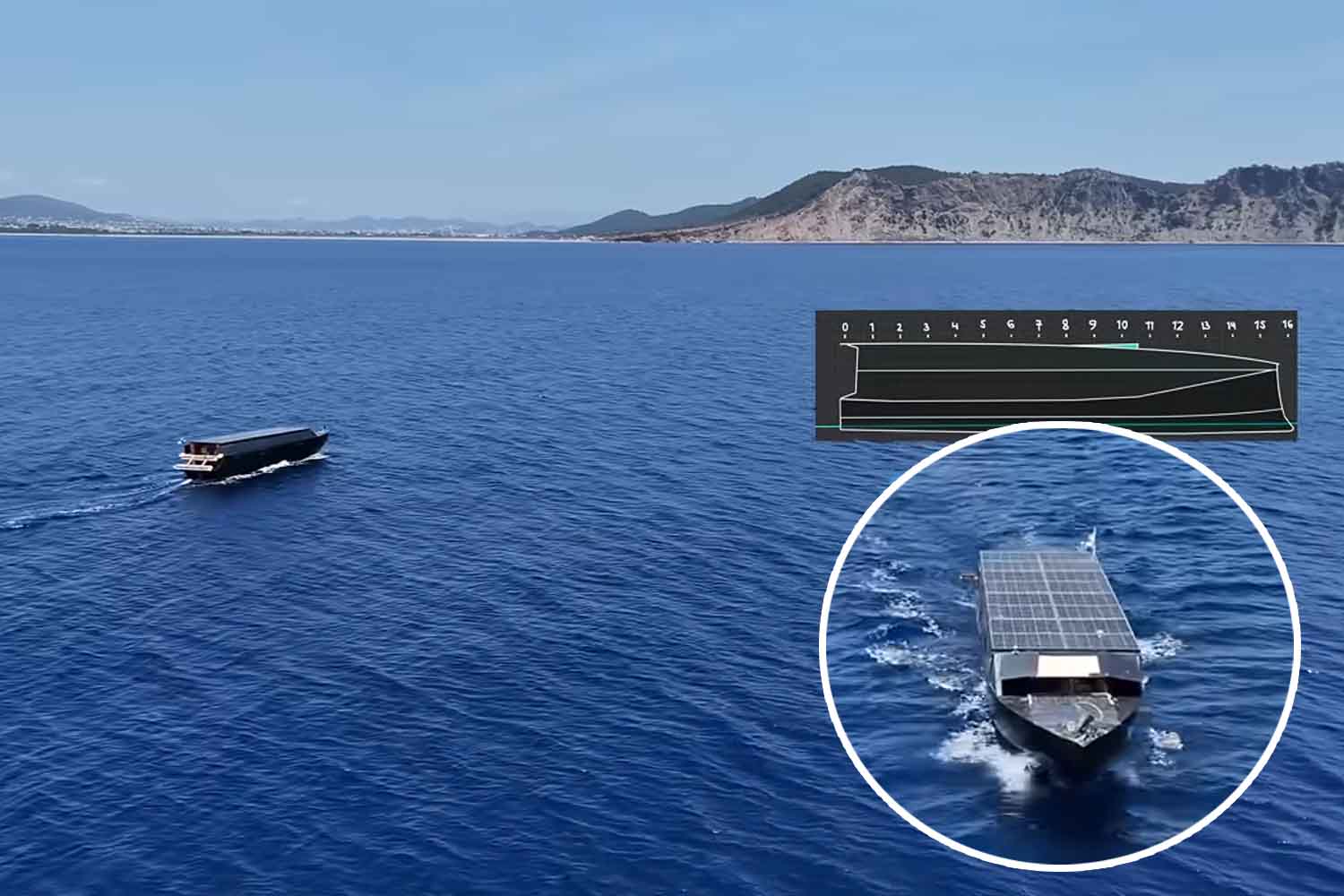
An 11 meter long solar boat, built in a shed and then brought from Finland to Ibiza, seems like the perfect content for the usual social fairytale: the solitary genius, the impossible feat, the automatic applause. Once the veneer has been removed, a much more concrete question remains: how far can an electric vehicle really travel when it has to produce the energy itself, meter after meter, with the panels mounted on the roof?
The Finnish Lukas Sjöman tried, who built Helios 11 almost entirely by hand, a handcrafted yacht powered by photovoltaic panels, batteries and electric propulsion. According to available reconstructions, the construction would have required approximately 200 days of work, with a structure made of marine plywood and fiberglass, a solar system on the roof and minimal spaces for living on board.
The result is a habitable, light boat, full of compromises. It has an electric stove, a small refrigerator, a toilet and everything you need to stay on the water without turning everything into a luxury yacht with a green sticker stuck on it. Helios 11 works because it reduces weight, consumption and demands. First comes the limit, then the technology.
Weight decides everything
A solar boat starts from a simple and rather unpleasant law: everything weighs. The hull weighs, the batteries weigh, the furnishings weigh, the water weighs, even comfort weighs when it becomes too generous. And all that weight then needs to be shifted.
This is why Helios 11 is described as a very light boat, with a mass of around 1.5 tonnes. An important fact, because the solar energy available on a limited surface has precise margins. You can mount panels, you can accumulate in batteries, you can optimize the system, but the physics remains there. If the medium consumes too much, the sun immediately becomes insufficient.
The photovoltaic system installed on the roof would reach around 6 kW, with a system based on 48 volt batteries. The energy powers the electric propulsion and part of the on-board consumption. On good days, with full sun and favorable conditions, the boat can cover significant distances. With overcast skies, more difficult seas or short days, navigation changes pace. Helios 11 forces you to think about energy before moving.
The boat goes, of course. But he goes when conditions allow. We slow down, we wait for better windows, we cut consumption, we watch the weather more carefully. Technology works together with design discipline. The solar panel, alone, creates little poetry and a lot of energy balance.
Up to Ibiza
After construction, Sjöman took Helios 11 on a serious journey: from Finland to Ibiza, crossing Sweden, Denmark, Germany and France, between canals, rivers and more open routes. The reconstructions speak of approximately 5,700 kilometers traveled without refueling.
The data is striking, also because it concerns a boat built in an artisanal way. But the journey also tells something else. On Northern European routes the light can be poor, the weather can change quickly, the water can make everything more tiring. Then there are the normal unexpected events, those that ruin the perfect narrative and make the story more credible: logistical problems, adaptations, even the theft of the auxiliary tender in Spain. Sjöman solved the problem by building a small support vehicle with improvised materials.
This detail tells the true side of a prototype: it works if those who use it also know how to repair, adapt and invent a solution when a piece is missing. The energy transition, when seen up close, often looks less like a rendering and more like a person with tools in hand.
Helios 11 also has an auxiliary sail, useful when the wind can help or when the batteries need to be saved. Here too, no magic: sun, electric and sailing divide the work. A practical system, built to use what’s there, when it’s there.
It’s not a shortcut
Helios 11 must be kept in its scale. A DIY solar boat alone doesn’t change boating, let alone shipping. Large ships, ferries, global logistics and trade routes are on another planet in terms of size, consumption and complexity. The maritime sector will have to cut emissions with a combination of efficiency, electrification where possible, new fuels, port infrastructure and much tougher rules.
In 2023, the International Maritime Organization updated its climate strategy, setting the goal of achieving net-zero emissions for international maritime transport around 2050 and pushing for technologies and energy sources with zero or almost zero emissions already by 2030. Within this framework, Helios 11 remains a tiny experiment. But it highlights something concrete: before looking for clean energy to power energy-intensive vehicles, we need to build vehicles that consume less.
You might also be interested in:
