
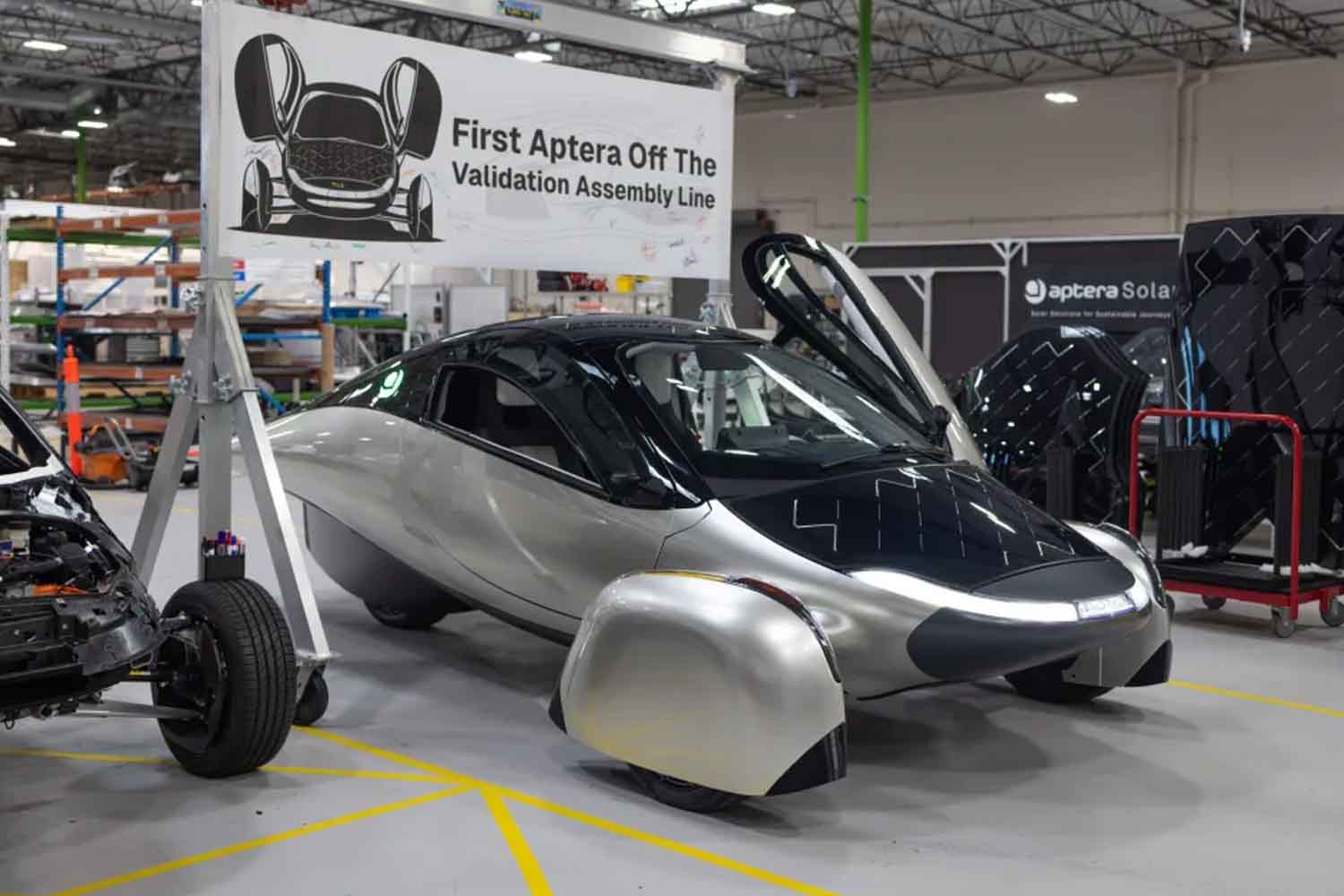
For years the car that charges itself thanks to sunlight has remained suspended between technological dream and futuristic promise. A fascinating idea, often told in prototypes at car shows or in startup laboratories. Today that vision takes a small but significant step towards reality: in March the first example of the solar car developed by Aptera Motors rolled off the assembly line.
It doesn’t mean we’re about to see these cars on European roads tomorrow morning. However, it means that a project that began almost twenty years ago has passed one of the most delicate phases: transforming an engineering idea into a complete vehicle, functioning and ready for final checks. And this is where the story gets interesting.
From the technological promise to the first exit from the production line
When we talk about sustainable mobility we often tend to imagine sudden changes and immediate technological revolutions. The reality is much slower, made up of attempts, restarts and obstinacy. The Aptera solar car project demonstrates this well. It all began in 2007, when the company presented a first prototype capable of attracting curiosity and skepticism at the same time. The idea is radical: to build an ultra-light, extremely aerodynamic vehicle that uses solar energy as a real support for electric traction.
The path, however, is not linear. In the following years, complicated moments and major slowdowns arrived, with difficulties emerging in 2009 and again in 2013. The project seems destined to remain one of the many experiments in alternative mobility. Then something changes.
In 2022, a new demonstration model is shown, much closer to the final version. In 2024 the startup decided to directly involve the public by launching a large crowdfunding campaign, collecting over two thousand pre-orders. A clear signal: there are those who really believe in this idea.
In the meantime, the first road tests are also arriving. One of the most significant takes place along historic Route 66, where the vehicle travels approximately 500 kilometers in real-world conditions. A symbolic journey that engineers need to observe the performance, consumption and behavior of the vehicle. The news that arrived in the last few days tells of the next step: the first fully functional vehicle has left the validation assembly line.
It is not yet the start of commercial production. The first models will serve as a test platform. Fundamental elements such as braking, structural resistance and thermal management will be analysed, essential steps to obtain EPA approval and be able to start deliveries. To achieve this result, the company designed a production line made up of 14 stations, designed to make the assembly process repeatable and industrially sustainable.
How it works
What is immediately striking about the Aptera solar car is its shape. It doesn’t look like the cars we are used to seeing in everyday traffic. The vehicle has three wheels and seats two passengers, with a bodywork shaped like a drop of water, a solution designed to minimize air resistance.
The doors open upwards with a butterfly wing movement, while the structure uses advanced composite materials. The bodywork features carbon fibre, Kevlar and linen fibre, a combination designed to achieve lightness and resistance at the same time.
The most interesting part, of course, concerns energy. The vehicle integrates a network of photovoltaic solar panels distributed over different surfaces of the bodywork. The cells are located on the bonnet, roof, dashboard and tailgate, allowing sunlight to be captured throughout the day.
This energy does not completely replace traditional electric charging, but complements it in a concrete way. Under favorable conditions the car can recover enough energy to travel about 40 kilometers a day without connecting to the grid. However, when the full battery is used, the declared range reaches approximately 640 kilometres, a value that exceeds that of many electric cars on the market today.
The project continues to attract attention from a commercial point of view as well. According to data released by the company, bookings recorded so far are close to 50,000 units, for an estimated value close to 1.5 billion euros.
Beyond the numbers, however, the real interesting point remains another: demonstrating that a car capable of exploiting the energy of the Sun every day can really exist. The first vehicle rolling off the assembly line isn’t a revolution yet, but it tells something important.
You might also be interested in:
